Sierra Leone after Charles Taylor
As Charles Taylor lost his appeal last month against his sentence for war crimes, BBC Media Action's Alpha Karama blogs about how a radio programme gave survivors of Sierra Leone’s civil war the chance to respond, reflect and demand more of their government.

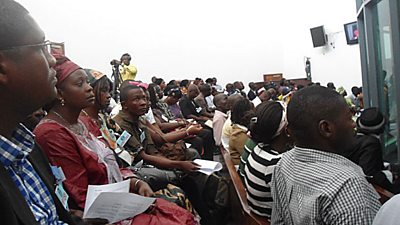
Since the beginning of Charles Taylor’s trial for aiding war crimes during Sierra Leone's civil war, BBC Media Action has supported Sierra Leonean journalists in their reporting of the International Criminal Court proceedings in The Hague. And as the former Liberian president lost his appeal against a 50-year sentence last month, our team in Freetown continued the hard work with two special episodes of our Hague Link radio programme.
Throughout the trial, Hague Link brought experts together in the studio to discuss the events in court and respond to people's questions so that as many Sierra Leoneans as possible were able to follow and understand the trial.
We followed the same format for these two special shows, sending our reporters to pre-record questions from people all over the country and asking people to send in their queries by text message or post them on our Facebook page. The shows were broadcast on Sierra Leone's national broadcaster SLBC who linked up with local radio stations across the country.
Bringing the story home
The first episode was broadcast live before the verdict and focused on the five-year-long trial which began in 2007 and Charles Taylor’s appeal against his conviction last year. On the studio panel were representatives from the Special Court for Sierra Leone, Freetown’s Centre for Accountability and Rule of Law, and the Amputees and War-Wounded Association.
And as well as experts explaining the complexity of the case, the show featured the voices of those who are still affected by the decade-long conflict in which some 50,000 people died.
Our reporter Mariama Khai Fornah travelled to the village of Bomaru where the first shots were fired in March 1991 to find out the villagers’ reaction to the trial. She reported from the rebels' slaughter house, where the RUF rebels executed civilians, and the war museum in the village where she spoke to people who are still suffering.
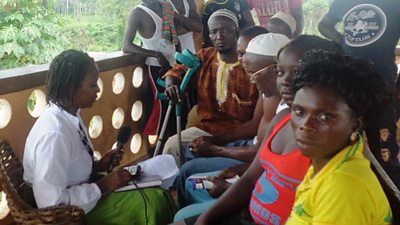
"We want to pray for the souls of all our relatives who lost their lives during the war," one villager from Bomaru told her. "We hope the court’s judgement will appease them and our country can be at peace."
Looking to the future
The second programme was broadcast after Taylor’s appeal was rejected. Our reporters were among the few journalists from Sierra Leone who posed questions to both the prosecution and the defence lawyers during a press conference linked with The Hague after the verdict was pronounced.
Most Sierra Leoneans were delighted about the verdict but wanted to express their concerns about how the government is implementing the reparation project which is supported by the UN Peace Building Fund. One of the project’s key priorities was reparations for victims of the war by providing new housing facilities, small grants and surgery for those in most help. But limited funds have meant such help was in short supply and many victims are complaining that they have not yet benefitted from this project.
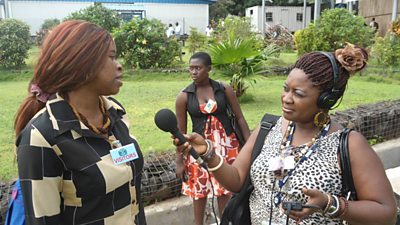
"We are happy because Taylor has been sentenced," he said. "But despite that, most of us are still suffering. We know Taylor is a rich man so we want his wealth to be transferred to us who have been battered, lost limbs and left homeless. I think that would help. But the government should also be committed to helping our plight."
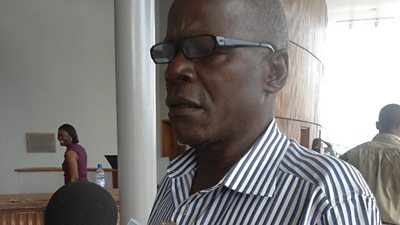
Edward Conteh, the national Chairman of the Amputees and War Wounded Association, was one of the studio panellists and agreed with Mr Sherrif. "As amputees we can only be happy if we can be supported as stated in the reparation project. I used to be a qualified mechanic repairing vehicles, but now I have had a limb amputated, I have been rendered useless."
But Mr Conteh was also optimistic. "If the government can support us, we will overcome our disabilities."
Meanwhile our team in Freetown will do our best to make sure the survivors keep getting their voices heard.
Related links
Communicating justice: reporting the trial of Charles Taylor
BBC Media Action's work in Sierra Leone
Follow BBC Media Action on Twitter and Facebook
Latest Sierra Leone stories
More stories from Sierra LeoneSearch by Tag:
- Tagged with Sierra LeoneSierra Leone
- Tagged with AfricaAfrica
- Tagged with StoriesStories
- Tagged with Governance and rightsGovernance and rights
