A man's world?
Research Officer Jo Casserly examines the evidence of women’s participation in politics in the countries in which BBC Media Actionwork.

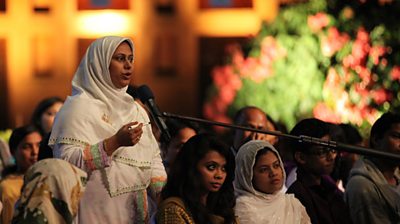
One of the most surprising figures to come out of last week's World Economic Forum's annual meeting in Davos wasn't to do with economics. It was, in fact, the number of female delegates taking part in the event itself: a paltry 15%.
Headlines have since asked ‘Where were the women in Davos?’. But is this microcosm of the political and economic elite representative of women's participation in politics more widely? Let's examine the evidence.
Mind the gap
The WEF's Gender Gap Report on 135 countries shows that women are consistently under-represented in parliaments around the world – although Cuba and Sweden come closest to parliamentary parity.
Perhaps surprisingly, the report also shows that developing countries can teach Western countries a thing or two about fairer representation. For example in Tanzania, 36% of parliamentary representatives are women. In Nepal, it’s 33%. In the UK? Only 23%.
Grassroots
But the Gender Gap Report only looks at women's participation in national politics. BBC Media Action's survey data from the countries in which we work gives a unique insight into how ordinary women participate in politics at a local level.
In Tanzania, for example, female representation in parliament appears to be underpinned by women’s active engagement in grassroots politics.
Women participated consistently more than men: they are more likely to take part in an effort to solve a problem in their communities, more likely to attend a local council meeting and more likely to contact officials and traditional leaders.
But in other countries where we have similar data, the outlook is a little less positive.
In Sierra Leone, Nigeria, Kenya, Bangladesh, Nepal, Burma and the Palestinian Territories, women tend to participate less than men. But even with this disparity, in certain countries the figures are encouraging.
In Sierra Leone, where promoting women's participation in politics has been at the top of the agenda as part of the post-conflict reconciliation process, our research found 60% of women had taken part in an effort to solve a problem in their communities, compared to 68% of men.
However, in Bangladesh and Nepal, despite relatively high levels of female representation in parliament (20% and 33% respectively), women's grassroots participation is quite low.
In Nepal, 24% of women have contacted an official or traditional leader, as opposed to 61% of men. And in Bangladesh only 6% of women have taken part in efforts to solve a problem in their communities, versus 33% of men.
Giving a voice
Countless barriers, from economic deprivation to violence against women and domestic duties, mean that it is often more difficult for women to participate in politics than men. But in spite of these challenges, our data shows that women are playing an active role in their communities.
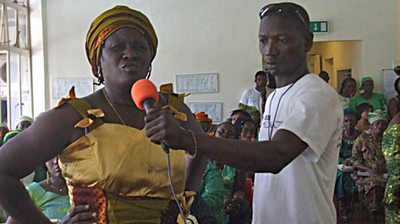
BBC Media Action's governance TV and radio programmes seek to ensure these women’s voices are more audible, give them a platform to question their leaders and equip them with the confidence to participate in politics and in their communities. We do this by covering issues which address the needs of women and girls and by always ensuring women are fairly represented on the shows’ panels and audiences.
So while the Davos delegate list shows there’s still some way to go for parity on the global political stage, look deeper and the picture is both more complex and more encouraging.
Related links
BBC Media Action's work with women and girls (PDF)
BBC Media Action's work on governance and rights
BBC Media Action's Research and Learning team
Search by Tag:
- Tagged with StoriesStories
- Tagged with ResearchResearch
- Tagged with Governance and rightsGovernance and rights
- Tagged with BangladeshBangladesh
- Tagged with TanzaniaTanzania
- Tagged with Sierra LeoneSierra Leone
