Bonded labour: insights from the field
How villagers in the Indian state of Chhattisgarh are informing a new radio series helping bonded labourers stand up for their rights.

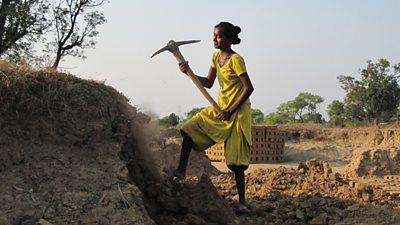
But something else has also endured alongside modern industry: a form of slavery that persists in the 21st century.
Bonded labour – in which a person is trapped into working as a means of repaying a loan – was abolished by the Indian government in 1976. The Bonded Labour Abolition Act made the practice illegal and set out monetary benefits to the victims. However, the system of bondage continues to exist and evolve.
Traditionally, it has roots in India’s elaborate caste system, where lower caste farm labourers would work to pay off debts from their higher caste landlords. In the rapidly changing modern economy, however, this system has mutated along the lines of exploiting those that are most economically vulnerable.
During my recent visit to Chhattisgarh, I witnessed many examples of bonded labour. At one site near Korba, our team was instantly surrounded by about 300 workers, many of whom are paid less than Rs 130 (£1.40) per day.
Korba's natural resources draw workers from Orissa, Madhya Pradesh, Jharkhand and West Bengal. First promised a sum above the minimum wage, labourers are extremely vulnerable to exploitation by thekedaars (contractors or middlemen).

Sunil, a 19-year-old migrant labourer from a border district in Jharkhand, hadn't been paid for three months. His thekedaarhad withheld his wages to make sure that he doesn't leave his current job with the money.
The appalling conditions in which tribal people in this region live also mean they are particularly vulnerable to bonded labour.
Gudumati is a small settlement, a 3 km trek deep inside the forests of Korba. Two families live there and all seven children suffer from acute malnutrition and stunted growth. Their parents are unaware of the most basic medical provisions, relying on jadibootis (herbs) to cure serious ailments.
These tribes are so isolated that one family head called Langhvaram whom we met did not know about the existence of any government official, not the chief minister of the state nor the district magistrate. He wasn’t even aware who the sarpanch (village head) was.
Tribal settlements such as these receive few visitors – they seemed uncomfortable with our presence – and whatever interactions they have with the outside world are fraught. This makes reaching them or informing them of their rights difficult so they remain particularly vulnerable to exploitation.
In BBC Media Action's previous work on bonded labour in Uttar Pradesh and Bihar, we identified geographical, socio-economic and occupational areas where vulnerability to bondage was high.
Armed with that information and the insights we had gained from our research in the field, we made a 36-episode radio programme Majboor Kisko Bola! (Who Are You Calling Helpless!) which combined information about labour welfare and rights with entertainment. Broadcast to rural populations, the programmes were complemented by 20 listener groups in each state. Research carried out in May 2011 found that the radio show led to an increased understanding of the nature and consequences of bonded labour amongst listeners.
This recent visit to Chhattisgarh has provided us with insights which will inform a new series of the programme that addresses the geographical and economic realities of our new target states.
One noticeable finding from our trips is how migration and contract-related bondage has risen while debt-related agricultural bondage has declined.
The issues are different, the people are different and the types of labour and bondage are different.
What is unchanged is our desire to reach and inform people and help them stand up for their rights.
Related Links
Majboor Kisko Bola! slideshow and video
Preventing bonded labour in India
Latest India stories
More stories from IndiaSearch by Tag:
- Tagged with IndiaIndia
- Tagged with AsiaAsia
- Tagged with StoriesStories
- Tagged with Governance and rightsGovernance and rights
- Tagged with Bonded labourBonded labour
