In the Ebola crisis, information is aid
Caroline Nursey on our work on the Ebola crisis, and the challenges of sharing information within the countries affected and beyond.

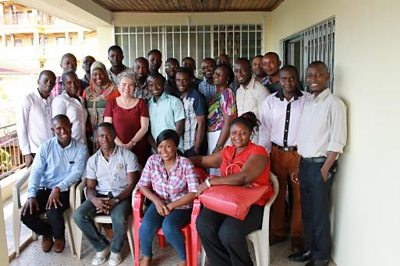
When I told them that I was planning a brief visit to Sierra Leone, reactions from family and friends ranged from “You can’t!” to hailing me a hero. In reality my visit entailed nothing at all dangerous – time in the office with our team of international and Sierra Leonean staff, visits to government offices and local radio stations, and a stay in a comfortable Freetown hotel. Yet our fear of this terrible disease makes it difficult for even an informed audience to judge what the risk actually is.
Ebola virus disease (“Ebola”) is only transmitted through direct contact with the bodily fluids of someone who has Ebola. A person is not infectious until they show symptoms - initially fever, headache, muscle pains and sore throat (like many other illnesses). And it is in the later stages of the disease that it becomes far more infectious when the viral count is high and the symptoms of vomiting, diarrhoea and bleeding mean that it is spread easily.
It is a challenge for those in the “information rich” global North to understand what Ebola is and how taking sensible measures can prevent its spread. From the quarantining of perfectly healthy aid workers in the USA to hysterical demands that children from West Africa be excluded from British schools, we see how hard it is to get the facts right, and then understood, and then shared. There is a large and growing body of reliable advice available on the websites for the Centers for Disease Control (CDC) and the World Health Organization (WHO), but that does not mean that it is followed.
Rumour and myth
And as I saw during my visit to Freetown, it is even harder to ensure that Ebola is understood in Sierra Leone, where BBC Media Action is working with 40 radio stations across the country to provide people with accurate information and to encourage safe behaviour.
Some Sierra Leoneans are still in denial that Ebola exists. It is understandable to blame strange deaths, which seem incomprehensible, on witchcraft. And dangerous rumours spread quickly, such as that drinking salt water, rum or even chlorine can prevent or cure the disease. So we are making programmes in the national language, Krio, and training local radio stations to make their own programmes about Ebola in local languages: what it is, how it is spread and how to keep people safe. And thanks to a new and generous partnership with the Paul G. Allen Family Foundation, we are about to extend our broadcasts and outreach to Liberia as well as training media producers, humanitarian workers and officials in ten neighbouring countries so that they are prepared if the epidemic spreads.
Accurate information is helping. Many people are now hand washing and avoiding physical contact, and most people know the number to ring – 117 - to seek help (even though in some parts of the country that help will not arrive quickly).
Respecting the dead
But some behaviour is much more difficult to change. Traditionally, family members and friends wash the bodies of those who have died to show their love, while all those attending a funeral touch the body to show respect. At the moment, experts say that 70% of new infections come from contact after death with the bodies of those who have died of Ebola. So these centuries old traditions that lie at the heart of West African culture have to be suspended or adapted if Ebola is to be stopped.
This week’s episode of our Krio programme Kick Ebola nar Salone (Kick Ebola out of Sierra Leone), tackled this topic head on with discussion between an imam, a pastor and members of an Ebola burial team about alternative ways to show respect to those who have died. Both the imam and pastor used scriptural references to show that touching bodies is not demanded within either Christianity or Islam. As burial teams clad in full Ebola protection gear take bodies away, wrapped in plastic body-bags, they pause so that families can – from a distance - pray and say goodbye to their loved ones.
Over the coming weeks, our team in Sierra Leone will continue to seek multiple ways to reach people using drama as well as straightforward advice and discussion to encourage the changed behaviour. Colleagues across the organisation are supporting them and some have been willing, at short notice, to take new assignments in West Africa to meet the urgent need and to deliver the broader span of work.
And now I am back in London, furnished with my certificate from NHS England that “there is no public health reason to prevent a return to normal duties or to restrict activities” in case anyone in the UK shuns me. As I settle back into my “normal duties”, my thoughts remain with my colleagues in Sierra Leone who are working so hard on this day-to-day, while worrying about their families and friends and what turn the epidemic might take next. They are the true heroes in the crisis.
BBC Media Action’s work in Sierra Leone
Follow BBC Media Action on Twitter and Facebook
Latest Sierra Leone stories
More stories from Sierra LeoneSearch by Tag:
- Tagged with Sierra LeoneSierra Leone
- Tagged with AfricaAfrica
- Tagged with StoriesStories
- Tagged with HealthHealth
- Tagged with Resilience and humanitarian responseResilience and humanitarian response
- Tagged with EbolaEbola
