"Fan-tas-tic": Using music to teach English in Cambodia
Senior Producer Finn Aberdein on English Is Fun, a new model of English language teaching is working in Cambodian schools.

A new word has caught on in the classroom.
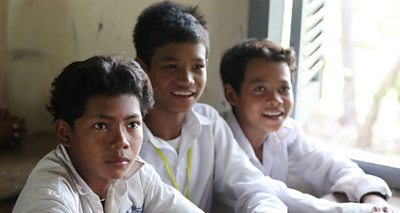
Around 40 teenage Cambodian students sit at their fixed wooden desks, listening and singing along to a new series of the radio programme English Is Fun.
"How's it going today? Fantastic!" they sing-come-yell in unison with the singer, clearly enjoying this way of learning.
And it's a relief. Using music to teach English is still something very new in Cambodian state schools and it's taken seven months to put the series together, scripting, pre-testing and evaluating along the way.
I work for BBC Learning English and since 2010 we have partnered with BBC Media Action to produce three series of English Is Fun, 120 programmes in all and funded by The Nippon Foundation of Japan. They are designed to help Cambodian students with their English speaking and listening skills in an engaging and interactive way, using songs, quizzes, pronunciation sections and the voices of native speakers of English.
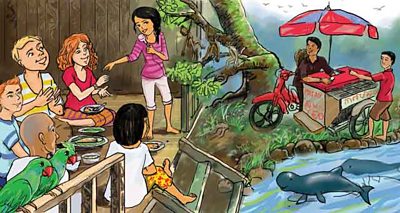
There is also a storyline which follows Cambodian schoolgirl Devi and her friends as they journey through rice fields and jungles on a quest to open a mysteriously carved box. They are helped by their talkative buddy Mr Parrot, who finds love on the journey.
These programmes help meet a dire need for teaching materials in Cambodian schools, which are seriously underfunded. Of course things have come a long way from the Khmer Rouge period (1975-1979) during which all schools were closed and many teachers persecuted or killed. These days, teachers suffer from poor pay and most schools have no electricity or running water.
With English Is Fun, teachers tune in to the radio programme at an assigned time and listen and interact together with the students. They then do a series of follow-up games and activities so students practise what they have learned.
It’s a model that seems to be working. One of our stakeholders, the Cambodian Ministry of Education, Youth and Sport conducted an assessment of speaking and listening skills, comparing students who were using the programme with students who are not. Their figures show English Is Fun students performed an average of three times better in speaking tests and four times better in listening tests.
We've been working with the ministry to ensure our programmes mirror the state curriculum for English, and are also culturally appropriate. We’ve also been working with ESC "Kizuna", the non-governmental-organization, who are responsible for implementing the school side of the project, and producing textbooks to accompany the radio programmes.
For me, the best part about this project has been this spirit of working together. By bringing together two BBC departments, three talented young Cambodian producers and scores of teachers, ministry officials and our Japanese donors and partners, I think we have crafted something that can help inspire students now and for years to come.
The next practical step is to get these programmes made part of the state syllabus nationwide, so every Cambodian student going through school grades 7, 8 and 9 would use them.
If we can achieve that, it really would be "fantastic."
The new series of English is Fun started on Monday 8 October and is broadcast nationwide in Cambodia on AM on three local FM stations.
Related links
Elsewhere on BBC Media Action:
