A vote for debate
Chair of BBC Media Action and Director of BBC Global News describes the critical role of the BBC Media Action debate programme Sema Kenya (‘Kenya Speaks’) in the run-up to the Kenyan elections.

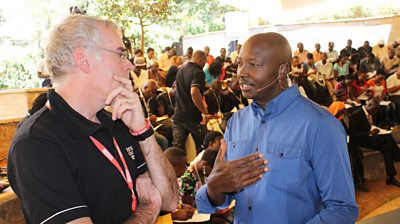
Live TV debate is often unpredictable but that’s part of the appeal – for audience, for panellists and for production crew alike. On Friday in the UK, BBC TV viewers watched Lord Heseltine, the Prime Minister’s adviser on economic growth, suddenly falter during a live appearance on BBC Question Time (QT). He was stopped not by a heckler, or a blip in his rhetorical powers, but by something in his pocket, a ringing sound: it was his wife on the phone.
After hastily retrieving the mobile, he recovered his composure fast, and to laughter from the audience said: “My wife is supporting what I have been saying, she is just letting me know.”
On the same day that the London QT aired I had been on set in Nairobi watching another audience-led debate show. Sema Kenya (‘Kenya Speaks’) is broadcast on radio on BBC Swahili, through partner radio stations, and through TV broadcaster KTN.
The programme is playing a critical role in the run up to Kenya’s general elections to be held on 4 March. It has been travelling around the country offering a huge opportunity for audiences to take part in and engage with election issues in a safe, open and informed environment. It was great to be in the country at such an important moment to get a sense of what people are feeling and doing.
Nervous time
It’s a serious time in Kenya and people are nervous. Will a collective act of goodwill pull the country through? Or will the violence of the elections five years ago - that resulted in 1,000 people dead and 600,000 displaced - flare again? Just this weekend Kofi Annan, the former UN Secretary-General, reminded Kenyans that the post-election violence of 2007/2008 left the country “on the precipice of self-destruction”. This time round the outcome seems genuinely in the balance and Sema Kenya shows that uncertainty and judgment being played out.
Despite the sombre backdrop to the show, as I watched the floor manager act as warm-up man and chat with the audience ahead of broadcast, and as the audience and panel began to interact, I saw that humour can play an important part. The more the panel addressed the audience concerns with seriousness - but with humour - the better the response. There was a cohesive, good-natured spirit.
The theme of the programme was to explore the mechanics and institutional support systems around the election, with a panel made up of Ambassador Yusuf Nzibo, Commissioner of the Independent Electoral and Boundaries Commission, Mzalendo Kibunjia, Chair of the National Commission on Integration and Cohesion as well as police spokesman Charles Owino, and government spokesperson Muthui Kariuki.
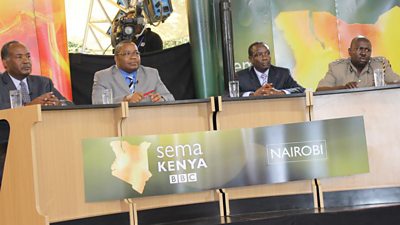
The police spokesperson Charles Owino was one of several officials answering questions from the audience about voter intimidation and concerns about safety. Some were worried about the large number of police on the streets, would they help or hinder a smooth election? Charles Owino was a powerful speaker, large and jolly, he opened his hands expansively, inclusively, and said with a smile: “Do I look threatening?”
Programmes like Sema Kenya offer people a place where they can connect to talk to their leaders directly, share worries, and air debate. TV programmes like these really can make a difference by holding leaders to account and getting to the heart of citizens’ concerns.
Sema Kena shows real commitment to and emphasis on getting voices from the audience heard – in person, via mobile phone (not the Mrs Heseltine approach, but by calling the show’s production staff), and through emails and Facebook comments. Presenter Joseph Warungu stood on the side of the audience, quite literally, roving among them, helping them with questions, ensuring they – rather than panel – led discussion, and putting people at ease when facing Big Names.
Behind the scenes Caroline Karobia, Editor of Sema Kenya at BBC Swahili was juggling to ensure people could speak up. And there was strong direction from Bonnie Katei, TV director whose focus ensured excellent cut away shots, with a variety of faces and plenty of women contributors. Real production skills were on show, and after the edition had wrapped and an engaged audience of 200 voters headed for home I was pleased to be able to tell the – entirely home-grown Kenyan production team - just this.
I have worked on many election programmes around the world but this really did strike me as one of the best. The incoming BBC Director General Tony Hall has noted the growing importance of the BBC in the wider world and Sema Kenya embodies this. It is not just about BBC heritage, and the quality and commitment we bring to the output, it is also about public service, building partnerships with other broadcasters, and fostering journalism skills too.
Sema Kenya is broadcast at 1pm on Sundays by Pamoja FM and Mondays on KBC ( Pwani FM - 6.15 am, Coro FM - 8am and Kitwek FM - 11am), Star FM (10am), KU FM (6pm) and on Tuesday on Radio Sahara at 7pm. It is shown by Kenyan TV station KTN at 6pm on Sundays.
Related links
BBC Media Action's work in Kenya
Latest Kenya stories
More stories from KenyaSearch by Tag:
- Tagged with KenyaKenya
- Tagged with AfricaAfrica
- Tagged with StoriesStories
- Tagged with Governance and rightsGovernance and rights
