The challenges of reporting in Ukraine
Tony Howson, BBC Media Action's senior trainer, on watching how the Ukrainian journalists he worked with have been covering the current crisis.

Tracking the latest news on Ukraine from my kitchen in Scarborough has been a nerve-racking experience.
My son was in Kyiv working as a volunteer for the International Red Cross. Under sniper fire he was ferrying out casualties from the city’s Independence Square last month as the clashes between protestors and police intensified.
He had told me his Red Cross arm-band would protect him. Then we heard that he and a colleague were targeted as they were lifting out a casualty. His friend was shot in the back.
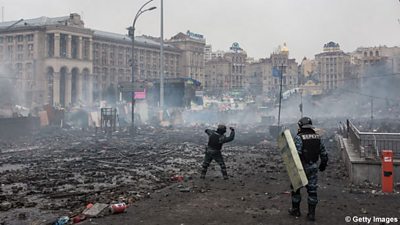
Through the internet we were able to access Ukrainian TV channels and news services. It gave me a chance to see how some of the journalists I had worked with over the years were coping.
BBC Media Action is currently working on a journalism mentoring project in Ukraine, the latest in a number of large-scale activities carried out since 1996.
One of our trainers, Valentina Samar caught my attention as she delivered a live report from Crimea. I watched as she described the tense events on the Peninsula, now controlled by pro-Russian troops.
I was impressed by her careful language and use of local knowledge to create a picture of what was happening. I first met Valentina in the late 90s when we worked on a BBC World Service Training Overseas project designed to counter hate speech against Crimean Tatars.
Our paths crossed again when she became one of our local trainers as we worked on transforming the university journalism curriculum, in particular with the main university in Kyiv, but also in Uzhhorod and Crimea’s Simferopol.
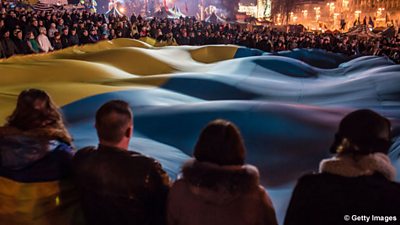
There have long been challenges and surprises working in the region, with the underlying political tensions sporadically bubbling to the surface. In 2003 BBC Media Action set up Top Media in Odessa, a media support project offering legal advice and training. When the EU-funded project closed two and half years later, a journalism student burst into tears in my office, apologising for spying on us for the SBU – the former KGB.
It was a sensitive time; we were being monitored as a result of the scandal following the kidnap and murder of journalist Georgiy Gongadze. There were concerns that, as a BBC entity, we might encourage coverage of the story in ways the then authorities would not like.
Back in the current crisis, Andriy Kulykov, another trainer we worked with, a former BBC journalist and now one of Ukraine’s leading talk-show presenters, has also been at the heart of events.
He took a brave step of broadcasting his programme Svoboda Slova (Freedom of Speech) not in Ukrainian, but in Russian – an attempt to reach out to all sides.
He has also used his BBC journalism training and experience as a trainer with Media Action, to maintain balance during his on air interviewing..
And for me, as a listener eager to know the latest, I am grateful to those who worked on projects with me over the years, who maintain the editorial standards we have promoted and kept me in touch with how my family’s life is being affected – now and in the uncertain future Ukraine is facing.
Related links
Latest Ukraine stories
More stories from UkraineSearch by Tag:
- Tagged with StoriesStories
- Tagged with UkraineUkraine
- Tagged with Media freedomMedia freedom
- Tagged with Europe and CaucasusEurope and Caucasus
- Tagged with Capacity strengtheningCapacity strengthening
