Drama queen
How the bad advice of a flamboyant fortune teller called Ebla, in a radio soap in Somalia, helps save the lives of babies and mothers. By BBC Media Action's trainer John Tucky.

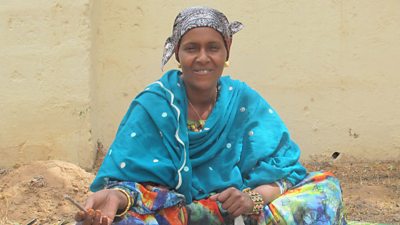
Ebla is the forceful, flamboyant and funny fortune teller we invented for the Somali radio soap Dareemo.
She believes that breastfeeding isn’t possible for a couple of days after birth and thinks a mother’s thick, yellowish first milk is bad for the baby and should be thrown away. Both of these beliefs are wrong but they're widespread in Somalia and many babies die as a result.
So why have we got a character in the drama who believes them?
Aiming to save lives
Our radio soap - or ‘behaviour change radio serial drama’ when I'm writing reports - aims to save the lives of babies and mothers in Somalia, where the current mortality rates are horrendous.
It does so by persuading people to change their behaviour in various different ways. But for this behaviour change drama to work, we needed to know what people in Somalia are doing now which causes so many deaths and why they're doing it.
So, the local team conducted research on the behaviour of our target audience before we started to create characters and storylines.
From research to drama
The difficult part, though, is building that research into a compelling drama. The approach I take provides a very neat structure for doing this. (I didn't invent the approach, I hasten to add: that was done by the American Centers for Disease Control.)
For the Somali drama, we were asked to address six behaviours, so, the local writing team and I developed six characters, one for each of the behaviours. Ebla was invented to address breastfeeding in the first hour of birth. The other five are different aspects of feeding and basic hygiene.
During the 18 months of the drama, Ebla and the other five characters will go through a process of behaviour change. They'll go from unhealthy to healthy behaviour, acting as role models for listeners.
We then looked at the research findings to find 'barriers' and 'enablers' for each of these characters.
‘Barriers’are the things that will get in the way of the character changing their behaviour. Ebla's mistaken beliefs about breastfeeding are two of her barriers.
‘Enablers’, are the things which prompt and help the character to change. For Ebla, the death of her first grandchild at two weeks old is a big ‘enabler’.
In the drama, then, the characters slowly change, fighting their barriers all the way, and helped by their enablers.
Matters of life and death
Almost all of the barriers and enablers come from the research, so this approach is a very good way of building the research into the heart of the drama. And it produces moving, powerful drama, because these barriers and enablers are matters of life or death.
Mind you, I had a terrible time getting some of the team to accept that babies should die in our drama.
It was only when I said, in frustration, "We're killing fictional babies, so that real ones stay alive," that I won the argument.
The drama may involve subtle and sophisticated persuasion. Making it sometimes doesn't.
Related links:
From the BBC Media Action blog:
From BBC Media Action:
