Tackling fear of Ebola on the airwaves
How BBC Media Action in Sierra Leone is using media during the Ebola crisis, and working to counteract the stigmatisation of survivors.

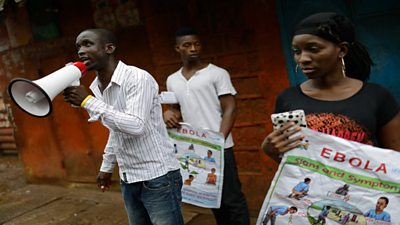
Here in Sierra Leone, the Ebola virus continues to spread, and misinformation spreads with it.
In my work as a radio producer I have heard stories of people recovering from the Ebola virus disease (usually known simply as Ebola), only to face terrible stigma, making it difficult for them to get on with their lives. One survivor James Ngebah, told me, ‘’I lost 19 of my family members as a result of the Ebola but I survived the virus but when I returned home, my neighbours stopped my wife from fetching water from the water well even though she doesn’t have the virus.”
“This stopped me from trying to fetch water too,” he added. Our neighbours totally ignore us. This is a bitter experience for me and worse than the virus I’ve survived.”
Greatest fear
After a radio programme in which we had given advice about Ebola, I took a call from a man called Mustapha Kamara, a 37 year old cocoa farmer who lives in Mandu village in Kailahun, Eastern Sierra Leone. Mustapha’s greatest fear, he told me, is that his entire household could become infected.
Although there have been no known incidents of Ebola in Mandu, the nearest reported case is only three kilometres away. The area has been under quarantine for over two months and life is really difficult. The travel restrictions have led to food shortages and as result, food prices are inflated. People are confused and frightened, and suspicious of anyone who has been infected with the virus.
“We were strongly warned by our community leaders not to engage with anyone who claimed to have survived the virus,” Mustapha told me. “I vowed that I would never allow a survivor to come close to me”.
Survivors pose no risk
But listening to our radio programme - Kick Ebola Nar Salone (Kick Ebola Out Of Sierra Leone)had helped change his mind. He told me that he now understands that survivors of the strain of Ebola currently in West Africa are unlikely to contract that strain again and once they have fully recovered, do not pose a risk to others. Just as importantly he understands how to help protect himself and his community.
“I want to thank BBC Media Action,” he said, “because it has helped me get knowledge on what to do to prevent the spread of Ebola virus and how it can be contracted, which initially I had no idea about.”
Mustapha says people in the community now know that they should restrict the movement of people to and from the village, report any suspected cases, and act more sensitively towards people who have Ebola. They will also refrain from burying any relatives who die from Ebola – but will instead contact the burial team in either Kenema or Kailahun.
After speaking with Mustapha, I felt that he sounded hopeful and confident rather than frightened. He believed he had enough information to protect himself and his family from this dreaded disease.
Power of media
This is a difficult time in Sierra Leone and West Africa and it’s impossible to know what will happen next. But speaking to Mustapha reminded me of the power of the media in a crisis – especially when programmes are produced in local dialects. As radio producers, my colleagues and I have a crucial role to play in the fight against the disease – we can reach isolated communities with practical and accurate information, in languages and terminology that people understand.
Our conversation inspired me to continue to give 100% to my job, and gave me hope that we can save the lives of listeners all around the country.
Related links
BBC Media Action’s work in Sierra Leone
Mariama Khai Fornah’s blogs from Sierra Leone
Follow BBC Media Action on Twitter and Facebook
Latest Sierra Leone stories
More stories from Sierra LeoneSearch by Tag:
- Tagged with Sierra LeoneSierra Leone
- Tagged with AfricaAfrica
- Tagged with StoriesStories
- Tagged with HealthHealth
- Tagged with Resilience and humanitarian responseResilience and humanitarian response
