

"And If You'd Like To Contact The Programme..." Pt 2
This post is part of the tenth birthday celebrations of bbc.co.uk. Part 1 is here.
In my last post, I was looking at how email and message boards have revolutionised the relationship between the BBC and what used to be a much more passive audience - even if the technology powering those boards was a little temperamental at times.
By 2003, it was clear that the BBC needed to move to a new system, and the decision was taken to migrate the message boards to the DNA software that the BBC had acquired when it purchased the Douglas Adams-inspired h2g2 site in 2001.
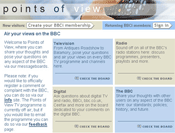 Ashley Highfield wrote on this blog the other week about his so-called public "spat" with James Murdoch, but Sky haven't always had a rough deal from the BBC's New Media department. In 2004, one of the first boards to move to the new system was Points Of View, which fell under my remit. In the process, I inadvertently signed off as approved a design that included a very prominent Sky remote control in it, rather than the more neutral "sticky-backed plastic"-type of branding that BBC regulations require.
The biggest editorial issue for the BBC with "user-generated content" has always been moderation. Good moderating is an arcane art. If you are doing it for the BBC, you are likely to be moderating across several subject areas - so you might not necessarily be an expert on what is being discussed. The sheer volume of posts also means that while regular board users get to know each other and the history and context behind postings, the moderator may be looking at a particular board for the first time. On a reactively moderated board, the moderator may only see the one post that has been complained about - not the ten provocative posts leading up to it.
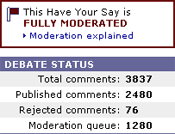 Opinion among the audience is divided about how effective the BBC's moderation is. Nobody likes it when their message fails to appear, and the BBC News Have Your Say even has an indicator of the status of the moderation queue in a bid to be transparent.
Steve Hermann recently asked for feedback on how users saw the BBC's blogs - and the issue of comments came up over and over again, with opposing views:
"I continue to think that the blogs and HYS need a community moderation scheme akin to Slashdot in order to reduce the number of 'me too' posts and so that thoughtful, worthwhile comments can be given greater prominence." - Kendrick Curtis
"Comments which add to the debate should be published but those which are rambling or simple repetitions should not...Editors should exercise their experience in vetting comments. Wake up BBC!!" - Pancha Chandra
"Disagree with those who opine that the number of comments should be slashed by removing 'repetitions' or rambling comments." - JustSomeCalifornian
"I don't know about the blogs, but drastic improvement is needed on Have Your Say. On the recent France/US Special Relationship topic, only 18% of posts were published!" - Steven Martin
I think opinion is still divided within the BBC as well. Sites like Digg and Slashdot are often cited as examples of good community moderation tools in action; however, they also have a relatively homogenous audience group using them. That is far from the case with the BBC's audience.
In my mind, particularly on the BBC News site, the current model is an improvement. For all the flaws of "Have Your Say", it is vastly better than its closest interactive forerunner, "The Great Debate" message-board - which was, frankly, a bear-pit.
The fact that the current "Have Your Say" feels more like a letters page on a specific topic, rather than a message board for chit-chat, seems to have quietened down the repetitive flame wars between individual regular posters. Despite the number of messages that don't get through the moderation queue, the BBC is now publishing many, many more contributions than when it used to select them by hand in the old "email and publish" model.
There is no doubt that contributions from the audience add value to the BBC News site, make it more entertaining, and allow the BBC to showcase a diverse range of views. However, BBC News receives something astonishing like up to 30,000 contributions to Have Your Say a day. Even using a lower conservative estimate, that adds up to several million messages a year, which is of course, quite resource-intensive to manage and moderate.
Over the last ten years, the BBC has steadily moved from an "email and publish" model, to pre-moderation, through to post-moderation and eventually, in many areas, reactive moderation.
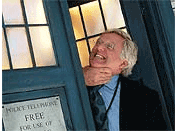 Reactive moderation, however, has its pitfalls. I remember a flurry of panic within the BBC when it was suddenly noticed that the Doctor Who message board was riddled with insulting comments about incoming Chairman Michael Grade, due to his role in the show's demise during the 1980s. Of course, nobody had complained about what was being posted, since most Doctor Who fans agreed with the unkind things being said about him.
There are also plenty of other places on the Internet, like Digital Spy or most newspaper websites, where audiences can gather and discuss the BBC. Interactive tools like blogging have given a voice to campaign groups both for and against the Corporation. Email has proved to be an effective lobbying tool over issues like the BBC screening of "Jerry Springer - The Opera", whilst there is seldom a time when a search for BBC on the Number 10 e-Petitions site won't turn up something to sign.
This represents perhaps the biggest shift over the last ten years. The correspondence between the BBC and the Licence Fee payers who fund it now happens much more out in the open. You used to be able to write to the BBC, and hope that Barry Took might read your letter out, and... erm, well, that was about it. Alternatively you could write to a newspaper about the BBC, and hope they published it. Nowadays, it only takes a couple of comments on the BBC's Points Of View message board, and Emily Maitlis or Fiona Bruce find their legs being debated in the national press.
Martin Belam is a former Senior Development Producer, New Media


Comments