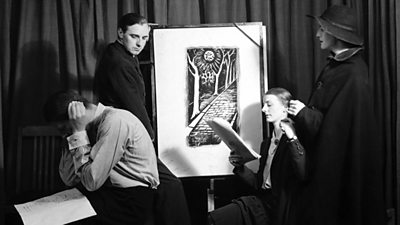

In my last blog I was in Wales in the 1970s, the decade of my childhood, thinking about children’s programmes and the Welsh version of Camberwick Green. This time, I want to travel back further in time, to 14 July 1930 in fact. 90 years ago, the Baird Television Company and the BBC broadcast the first television drama on British television, a remarkable feat, given that ‘true’ television had been demonstrated publicly for the first time only four years earlier.
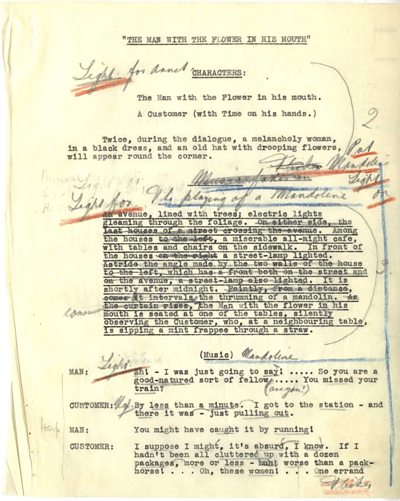
There is very little documentation in the BBC written archives in the file on the play itself – R5/7/1 if you’re interested – and only a prompt copy remains. That said, it was a collaboration between the Corporation and the Baird Television Company and many of the Baird written records were destroyed in a fire that ravaged the company’s studios in the Crystal Palace in 1936. Nevertheless, there are references to the play in other BBC files (eg the BBC Control Board).
Background
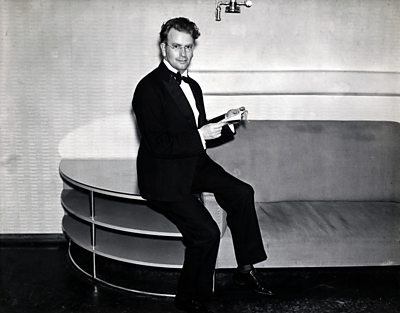
In January 1926, John Logie Baird, the Scottish inventor, demonstrated ‘true’ television for the first time to members of the Royal Institute in his Soho laboratories. From that point onwards his company, founded the previous year, sought to persuade the public to purchase television receiving sets, and the government to allow the company to broadcast.
It sought the cooperation of the BBC, the sole broadcaster of the time, to work with it in developing television, but the Corporation – for a whole host of reasons – were reluctant to invest time or money in the new invention. However, increased political pressure from the government led to the BBC reluctantly providing transmitter facilities to the Baird Company for regular experimental broadcasts for a very limited number of hours a day, initially from the 2LO transmitter in London and later from Brookmans Park in Hertfordshire. By the middle of 1930, the BBC and the Baird Company had decided to embark on the first television drama.
The Play
Val Gielgud, the BBC’s Productions Director, chose a one-act play by Luigi Pirandello, The Man with the Flower in his Mouth, as the first television drama production. Up until this point, television broadcasts had been relatively unambitious, mainly due to technical limitations – talks, singing, musical instrument performances, all quite static but, nevertheless, entertaining for those watching. The Evening Herald of July 4th looked forward in anticipation to this ‘thoroughly interesting experiment’ and suggested that it might even lead to an increase in demand for television sets.
The play was broadcast from the Baird Television Company studio in 133 Long Acre in London on the medium wavelength via the BBC’s transmitter at Brookmans Park (which had only been opened in March that year, this allowing synchronised sound and vision, as opposed to what had been transmitted between the start of the experimental transmissions in September 1929 – sound first, then vision). Earle Grey played the man with the ‘flower’ (referring to a type of skin cancer), his wife was played by Gladys Young, and the other character was played by Lionel Millard.
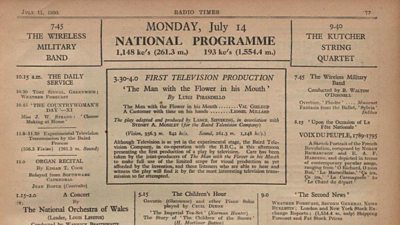
The play was billed in the Radio Times and given a separate ‘box’ in the top middle of the page for Monday 14 July. As noted in the RT, the play was adapted and produced by Lance Sieveking. Sieveking was a pioneering BBC radio producer, noted for his experimental and modernist productions in the late 1920s.
He worked with Gielgud, and Sydney Moseley of the Baird Television Company to broadcast this landmark production. Indeed, Sieveking, writing in August 1930 in the Royal Television Society journal, Television, compared the 14th July celebrations of the revolution in France with the 14th July 1930 revolution in television.
Reaction
Although the exact numbers watching are impossible to gauge, we can be quite confident that it was hundreds (rather than thousands) of enthusiasts who had either built or purchased 30-line television sets to watch a screen the size of a postcard. The Sheffield Daily Independent predicted on the day of transmission that this would be ‘by far the most interesting television transmission so far attempted’.
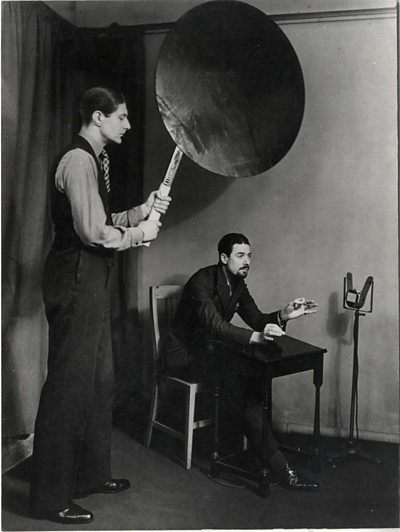
A lengthy review in The Times the following day, 15th July, outlined the difficulties involved in producing the play – the cramped conditions of the studio, the small space in which the actors had to act, the need to keep movement to a minimum for fear of blurred pictures on the receiving end (for technical reasons), the need for a black and white chequered board to signify a change of scene. In a comment reminiscent of a school report’s ‘could do better’, the review ended: ‘The time for interest and curiosity is come, but the time for the serious criticism of television plays, as plays, is not yet.’
The broadcast was viewed across the UK. The Belfast News-letter of 15July welcomed the experiment, calling it ‘a start in the right direction’ whilst the Sheffield Daily Telegraph heralded the production as ‘another milestone’. The August 1930 edition of Television, received letters of compliment from around the country, including Newcastle, ‘the North’, and Chesterfield (where apparently 130 people, including schoolchildren, saw the play).
A big success, a landmark production, a milestone … but the BBC Control Board was less impressed and it decided that the Corporation would not collaborate on a similar production in the future, providing only technical support to the Baird Company if required. Nevertheless, The Man with the Flower in his Mouth had laid the foundations and had begun to explore the grammar of television which would be developed further by the BBC Television Services in 1932-35 and 1936-39. But that’s for another blog…..
Biography
Dr Jamie Medhurst is a Reader in Film, Television and Media and Co-Director of the Centre for Media History at Aberystwyth University. He is author of A History of Independent Television in Wales (2010), and The Early Years of Television and the BBC (2021), Broadcasting in the UK and US in the 1950s: historical perspectives (2016) and editor of the journal Media History.
He is currently writing a book on television and society in Wales in the 1970s, the result of a Leverhulme Trust Research Project Grant. Dr Medhurst is also involved with research projects on key documents in European media history, and on the social history of broadcasting in Wales.
