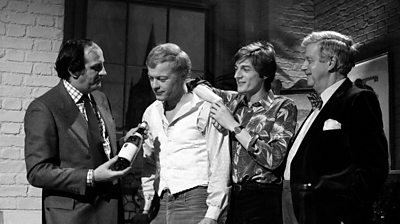

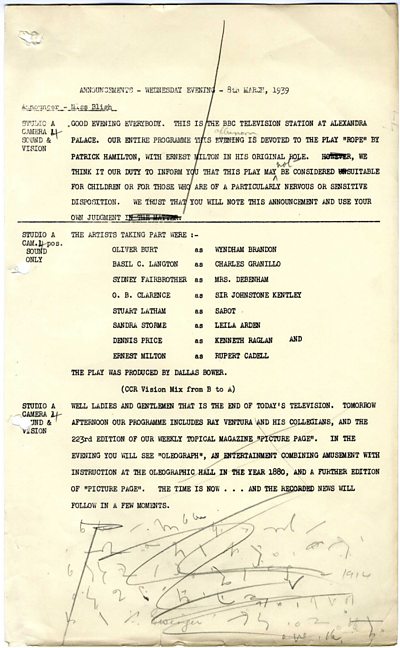
When Patrick Hamilton’s stage play Rope was first adapted for BBC television in 1939 the on-screen announcer Jasmine Bligh warned viewers: “We think it is our duty to inform you that this play may not be considered suitable for children or for those who are of a particularly nervous or sensitive disposition.”
It is likely that the BBC was warning its viewers about the main subject of the play – a gruesome murder – but it could also have been concerned that viewers might be offended by the two leading characters who were a homosexual couple. In 1939 same sex acts between men was a criminal offence, and censorship would have prohibited the BBC to feature any explicit gay characters in its drama output.
The word homosexual was not even mentioned on BBC television until 1953. In the 1930s, and until the 1967 Sexual Offences Act partially decriminalised homosexual acts, gay men existed outside the law, and were considered unnatural by the majority of the general public. However, after 1939, the BBC produced three more television adaptations of Rope, in 1947 (featuring Dirk Bogarde), 1950 and 1953.
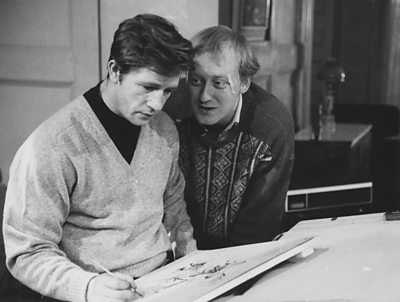
Horror of Darkness
In 1965 John Hopkins’s Horror of Darkness, shown in the BBC’s acclaimed but controversial series The Wednesday Play, was a breakthrough in gay male representation. It is a psychological drama in which Robin Fletcher (Nicol Williamson), a sad, tortured soul disrupts the relationship between his friend Peter (Alfred Lynch) and Cathy (Glenda Jackson).
Robin’s declaration of his love for Peter is beautifully realised, and it is probably the first open expression of the love of one man for another in British television. However, Robin’s love for Peter is unrequited and, after Peter rejects him, Robin commits suicide. Hopkins, one of BBC television’s most acclaimed and respected writers, put together a complex and compelling play that was appreciated by some viewers.
Public Reaction
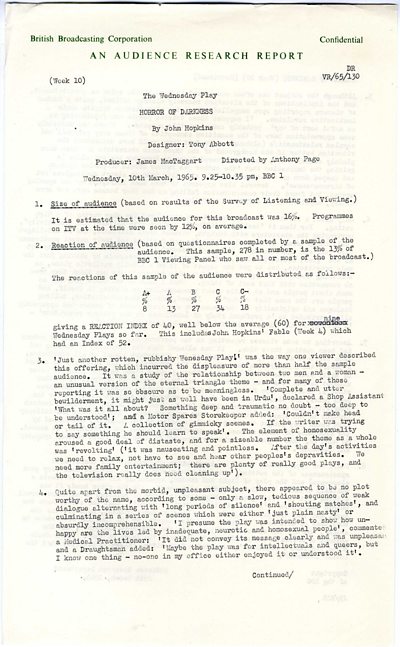
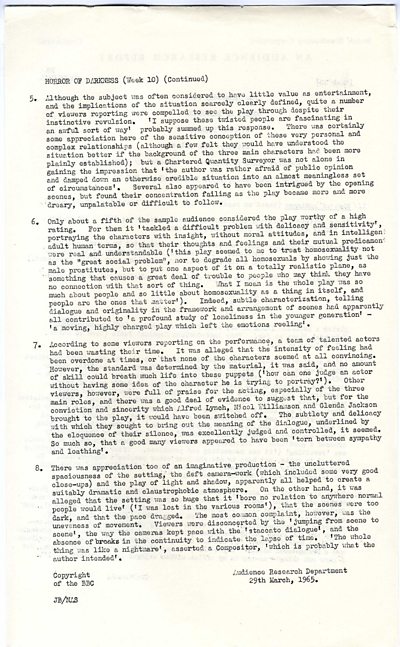
In BBC1’s Duty Office Log for 10 March 1965, viewer’s reactions to the play on the evening of the transmission ranged from the confused: “There are six of us watching this play. What is it all about? Perhaps you will ring back and tell me” to the outraged: “Disgusting stuff”, “What has come over the BBC. You are always showing us plays about perverts.”.
Other reactions were, on the whole, favourable and enthusiastic: “First class. Excellent”, “Brilliant. The tense relationship between the players was brought out marvellously…Terrific”, “One of the best plays I have seen on TV. Excellently acted, marvellously written and beautifully done in every way.”
However, the Audience Research Report states: “The element of homosexuality aroused a good deal of distaste, and for a sizeable number the theme as a whole was ‘revolting’…’I suppose these twisted people are fascinating in an awful sort of way’ probably summed up this response.”
The Wednesday Play – which ended in 1970 – was often controversial, especially when it dealt with themes that some television viewers found upsetting. One of its most vocal critics was Mrs Mary Whitehouse. In 1964 the ‘housewife’ who purported to speak for the nation’s viewers helped to launch the Clean Up Television campaign which soon afterwards evolved into the National Viewers’ and Listeners’ Association (NVALA).
In spite of Mrs Whitehouse’s protests, there were other notable productions in the Wednesday Play series that featured gay themes or characters and these included Hugo Charteris’s The Connoisseur (1965), Simon Gray’s Spoiled (1968) and Peter Terson’s The Last Train Through the Harecastle Tunnel (1969).
Coming Out
In 1970 Play for Today replaced The Wednesday Play. However, it took a while for the series to focus on gay characters. In Coming Out (1979) writer James Andrew Hall lead character was an ‘Agony Aunt’ (Anton Rodgers) who finds he may have to come out of the closet. The play received a mixed reaction.
Richard Last in the Daily Telegraph found it “a sympathetic view of homosexuality” while Keith Howes, reviewing it for Gay News, blasted it for being “incapable of tackling the ‘coming out’ theme it had set itself…this was the gay world seen through pebble-thick glasses with all the self-deprecation and mendacity that television viewers have been conditioned to expect.”
Howes felt that the play, though relatively frank and revealing about the lives of gay men, was negative in its attitude towards gay men in particular, and gay political action in general.
Only Connect
Also in 1979, one month after Coming Out and forty years after the BBC’s first television adaptation of Patrick Hamilton’s Rope, there came a major breakthrough. W Stephen Gilbert, an openly gay drama producer at the BBC, commissioned Noel Greig and Drew Griffiths to write an original drama for television. They had already been acclaimed for their stage work with the radical theatre company Gay Sweatshop. The result was Only Connect, shown on BBC2 in a series called The Other Side.
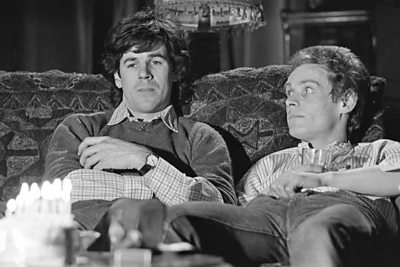
It concerned a research student’s rediscovery of the forgotten figure of Edward Carpenter, a socialist pioneer and campaigner for gay rights. Keith Howes enthused in Gay News: “Credit should be bestowed upon all the people involved with Only Connect. It was a sensational work in the truest sense: changing our perceptions, stimulating our minds, stretching us. Although it was…completely accessible to non-gay people, it was ultimately ours. All we were required to do was to adapt to its pace and structure and watch it.”
With Only Connect the BBC succeeded in producing a beautifully crafted and satisfying drama that portrayed the lives of gay men in a thoughtful and naturalistic way. It is a masterpiece and yet it is overlooked in histories of British television. Rare exceptions have been Keith Howes’s indispensable encyclopaedia Broadcasting It (Cassell, 1993) and Lez Cooke’s A Sense of Place: Regional British Television Drama (Manchester University Press, 2012).
What makes Only Connect special is that W Stephen Gilbert produced it with great love and care and he allowed two gay writers to have a voice, which they’d never have been given on television anywhere else. Says Keith Howes: “This was the turning point in gay television history that failed to turn. It is its beginning and its end. The publicity around Coming Out completely submerged Only Connect, and, because it isn’t seen, or acknowledged anywhere, nobody will ever know what we have really lost.”
Stephen Bourne’s Playing Gay in the Golden Age of British TV will be published by The History Press on 22 November 2019.
Biography
Stephen Bourne has been writing Black British history books for 30 years. He is the author of, amongst others, Black in the British Frame – The Black Experience in British Film and Television (Bloomsbury Academic, 2001) and Playing Gay in the Golden Age of British Television (The History Press, 2019). His latest is Deep Are the Roots – Trailblazers Who Changed Black British Theatre (The History Press, 2021).
In 2017 Stephen received a special award from Screen Nation (known as the ‘Black BAFTAs’) for his documentation of black British film and television and an Honorary Fellowship from London South Bank University for his contribution to diversity.
