All the World's a Screen - Adapting Shakespeare
In anticipation of our latest film, Arena: All the World’s A Screen - Shakespeare on Film, transmitting on BBC Four, this Sunday 24 April at 9pm, we consider what makes the Bard’s work so attractive to filmmakers across the globe (pun intended). Directed by David Thompson, All the World’s a Screen charts the cinematic evolution of Shakespearean adaptations since the conception of cinema, right through to the present day. Adaptations are fundamental to cinema: from classics like Hitchcock’s The Birds, to small comedy-dramas like The Lady in the Van, all the way to huge budget sci-fi films like The Martian, and some estimates suggest that 65% of the films we see are adaptations. It is no wonder then, that the plays of the world’s most influential writer are also the most filmed ever, with over 400 feature-length productions made. The general consensus is that Shakespeare wrote 37 plays; they span every genre and introduce us to a dizzying array of characters. Shakespeare’s writing is therefore an adaptive storyteller’s dream, ideal for presentation on the big screen.
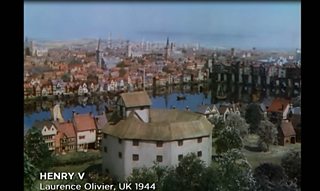
Nevertheless, the process of adaptation is not easy. Filmmakers are faced with hundreds of choices in their move from the stage to the big screen. In 1985 the shift from literature to the cinematic was described by author Charles Newman, in a scathing critique of contemporary culture, as a move to ‘a wilfully inferior form of cognition’. He presents his view according to some imagined hierarchy of medium, characterising cinema as a greedy, capitalist exercise. But none other than Laurence Olivier had already undermined this notion when he produced a film adaptation of Shakespeare’s Henry V in 1944. Praised for its ‘faithfulness’ to the text, for being a ‘Shakespearean’ adaptation of Shakespeare, the film is nothing short of spectacular. Olivier’s first directorial effort, Henry V opens self-reflexively, recreating an Elizabethan stage performance in Shakespeare’s famous Globe Theatre. An actor tells us to open our mind’s eye in order to overcome the limitations of the theatre. Olivier’s film then transports us into a world of cinematic realism, replacing our mind’s eye with the camera’s eye, grounding the spectator in the world of Shakespeare’s Henry V. Olivier’s nod to these different perspectives reveals his view that ‘there wasn’t anything that could not be done’ in the medium of cinema. His film set the benchmark for how Shakespeare could be adapted. It was both commercially and critically successful; winning him an Academy Honorary Award in 1946 for ‘his outstanding achievement as actor, producer and director in bringing Henry V to the screen’. He later went on to win the first Best Picture Oscar given to a British film, with his adaptation of Hamlet. Olivier’s success cemented the legitimacy of cinema as a powerful tool for anyone who wanted to bring Shakespeare’s work to life; that same success urged filmmakers around the world to follow suit.
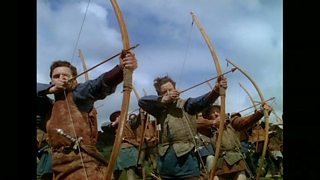
A battle scene from Olivier's Henry V
Filmmakers from America, Russia, Finland, Poland, Japan and India have adapted Shakespeare, some more faithfully (in the vein of Henry V) than others. However, Akira Kurosawa’s 1957 epic, Throne of Blood (based on Macbeth), shows how an adaptation can retain the soul of the source text, whilst also radically changing several of its central elements. What emerges is a highly captivating re-working of Macbeth, presenting images of great force and beauty in a way only cinema can. Kurosawa reflects the themes and characters of the play but in a completely new cultural context and with a non-literal translation of the text. Shakespeare’s superlative storytelling becomes interwoven with Japanese history, as Kurosawa himself explained in the following clip from Arena’s documentary on the director from 1986.
At times, spectators may become preoccupied with the fidelity of an adaptation to its source text, subscribing to Newman’s supposed hierarchy of medium. Yet works like Kurosawa’s, and other daring adaptations like the 1990s teen rom-com 10 Things I Hate About You (based on The Taming of the Shrew), prove that adaptations do not need to be completely ‘faithful’ in order to produce art of value. Shakespeare thrives in any genre, as demonstrated by the numerous Bollywood adaptations that are extremely popular today, children’s animations like The Lion King in which the lion Simba stands in for Hamlet, and even B-movie sci-fi like Forbidden Planet. These films succeed in retaining the spirit of Shakespeare (however removed from the original text), whilst captivating new and wider audiences in the process.
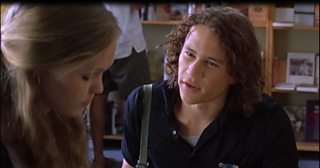
Julia Stiles and Heath Ledger in Gil Yunger's '10 Things I Hate About You'
The decision to retain Shakespeare’s verse and language or not nonetheless remains central to any and every cinematic version of Shakespeare’s work. Some question how it is possible to retain the language of the 16th century and interest a modern audience. For instance, would Kurosawa’s Throne of Blood have worked if the verse and language had been more literally translated? Perhaps not for a Japanese audience, who are more accustomed to the style of Noh theatre. Similarly, would teens have gone mad for 10 Things I Hate About You if the language had remained faithful? Despite Heath Ledger’s sexual magnetism, probably not. At the same time, some filmmakers consider the language to be secondary to the plot or the emotional core of the plays. Italian director Franco Zeffirelli, whose 1968 adaptation of Romeo and Juliet was praised for its youthful energy rather than its attention to the rhythm of Shakespeare’s verse, describes the reasons why he chose to focus instead on the intangible soul of the play instead.
This is not to say, however, that Shakespeare’s verse cannot be integrated into a modern adaptation. Enter: Baz Luhrmann, stage right. Lurhmann’s wildly successful 1999 Romeo + Juliet proves that transporting the star-crossed lovers into the MTV culture of the nineties, whilst retaining an assiduous attention to the verse, can result in an intoxicating blend of old and new.
Despite the differing opinions on what makes Shakespeare work on screen, his plays continue to inspire filmmakers, who can realise their own artistic vision with Shakespeare’s words as a guide. These interpretations tell us about different cultures and histories, and just occasionally we see a film that casts new light on old stories. From ‘faithful’ adaptations, to transposing works in entirely new contexts and cultures, art is undeniably derived from art. 400 years after his death, Shakespeare’s plays have inspired filmmakers of every generation and Arena: All the World’sa Screen provides you with a wonderful selection of examples. It’s just a shame we won’t be here to see where cinema will take Shakespeare in 400 years’ time!
This post was written by Ben Londesbrough, who is a second year English Literature student at the University of Exeter. After graduation he hopes for a career in film or television, where he can put his square eyes to good use.
