

Your classic grand prix - race 14
The latest edition of our classic grand prix series focuses on the Italian Grand Prix, the oldest race still on the Formula 1 calendar.
It was first held at the atmospheric Autodromo di Monza as long ago as 1922, making it the oldest track as well, and in that time it has hosted some of the sport's greatest races.
We have selected four from the event's relatively recent history and are asking you to select which one you would most like to watch here on the BBC Sport website and on the red button on interactive television.
We would like you to leave your views as responses on this blog and we will use them to inform our choice of which race to highlight next week to whet your appetite in the run-up to this year's Italian Grand Prix.
For the chosen race, we will broadcast the full 'Grand Prix' highlights programme that was shown on BBC television at the time, as well as the shorter highlights packages we cut for all the races.
We will also make available short and long versions of the highlights of last year's Italian Grand Prix, won by Brawn's Rubens Barrichello.
This week's selections are the 1987, 1991, 1996 and 1998 Italian Grands Prix. And to fend off the inevitable calls for some other races, I'll remind you that last year we featured 1988, 1990, 1995, 1999 and 2004, so we cannot pick them again this year.
The first of our selections, 1987, featured one of the late, great Ayrton Senna's best - and most overlooked - drives.
In his last year at Lotus, Senna had taken two opportunistic wins at Monaco and Detroit, but his car, despite its unique active suspension, was no match for the flying Williams-Hondas of Nigel Mansell and Nelson Piquet. So in Italy, the Brazilian chose to gamble on trying to make it through the race on one set of tyres.
He took the lead as the drivers in front of him - Piquet, Mansell, Ferrari's Gerhard Berger, Benetton's Thierry Boutsen and McLaren's Alain Prost - made their mid-race tyre stops.
Senna had driven brilliantly to stay in touch with the leading group while also preserving his tyres as best he could in the first half of the race, and he appeared on course for a superb victory.
Then, seven laps from the finish he made a mistake while trying to lap the Ligier of Piercarlo Ghinzani and slid off into the gravel trap at Parabolica. By the time he rejoined, Piquet had slipped through into the lead.
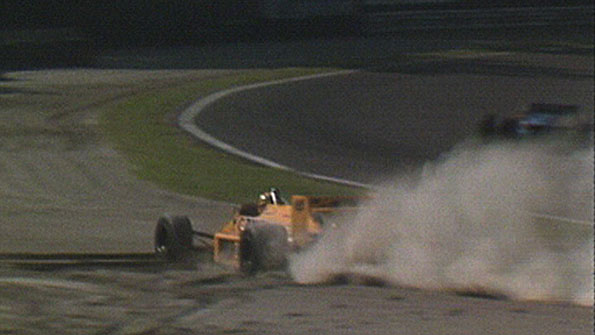
Senna gave chase, but his tyres - and for that matter his car - were not up to the job. He hung on bravely, though, and crossed the line less than two seconds behind his fellow Brazilian.
Our next choice is 1991, a race held against the backdrop of one of F1's great controversies - Benetton's poaching of Michael Schumacher one race after he had made his grand prix debut for Jordan, to whom he was under contract.
Mansell's Williams FW14 was a faster car than Senna's McLaren by this stage of the season and the Englishman was trying to close a points gap his rival had built up by winning the first four races of the season as Williams struggled with reliability problems.
Senna led from pole for the first half of the race, fending off the challenge of Mansell and Williams team-mate Riccardo Patrese. Mansell and Patrese, held up by Senna, were having their own battle too, and the Italian passed his team-mate for second place at the Ascari chicane on lap 26, only to spin off at the same place a lap later.
That left Mansell to challenge Senna alone, and he finally made it past with 19 laps to go. Senna pitted for new tyres, rejoining in fifth before working his way back up to finish second.
Schumacher finished fifth on debut for his new team, ahead of team-mate Piquet, whose F1 career he effectively ended by outpacing him for the rest of the season.
The next choice is 1996, when Damon Hill tossed away a chance to clinch his world title two races early.
That year, race officials had been forced to put piles of tyres on the kerbs at the apex of the chicanes after a worrying incident in practice when a block of concrete ripped up by one car that had strayed too far over the kerbs broke the front wing of the Williams driven by Jacques Villeneuve, Hill's team-mate and title rival.
The stacks of tyres were an inelegant solution to the problem - they were asking to be hit. And Hill did exactly that while leading the race on lap six, spinning and stalling his engine.
Fortunately for him, Villeneuve had already made the same mistake, bending his suspension and creating tyre problems that would mean he would fail to score points, so Hill still left Monza with a 13-point championship lead. But it took him until a nail-biting final race of the season in Suzuka to finally clinch the crown.
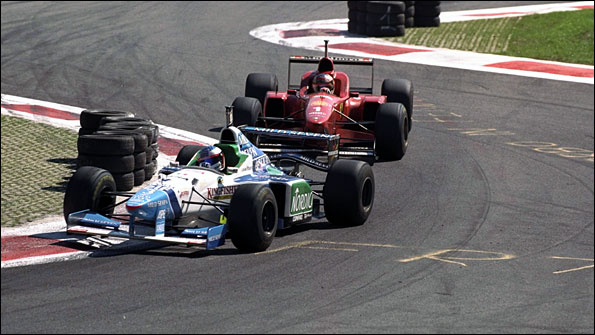
Hill's exit left Benetton's Jean Alesi in the lead from Schumacher, who was in his first season at Ferrari, then a far less competitive proposition than it became.
Schumacher was clearly faster, but could not pass the Benetton until eventually managing to do so during the pit-stop period. The German stopped two laps later than Alesi, set stunning times on his in and out laps, and emerged in the lead, after which he cruised to the flag.
It was the first Ferrari win at Monza since Berger's in 1988 and the place went predictably wild.
Finally, we have 1998, a race that brought the intense title battle between Schumacher and McLaren's Mika Hakkinen to a head.
Schumacher was on pole, with Hakkinen third on the grid, but a bad start left the Ferrari driver only fifth, although he quickly moved up to third behind Hakkinen and the Finn's McLaren team-mate David Coulthard by the end of the second lap.
The McLaren was generally the faster car in 1998, but at Monza things did not go smoothly for the team. Hakkinen began to run into brake problems, and Coulthard passed him for the lead on lap eight, whereupon Hakkinen began to fall into Schumacher's clutches.
Coulthard's engine failed on lap 17 - and the cloud of smoke it emitted unsighted both Hakkinen and Schumacher. In the confusion, Schumacher slipped ahead into a lead he was never to lose. Hakkinen soldiered on to finish fourth and he and Schumacher left Monza, with two races remaining, tied on points.
I know some of you would like to watch some of the great races from earlier in Monza's history - the closest ever F1 finish in 1971, for example. There are, sadly, some gaps in the archive that mean we do not have enough serviceable footage from many of these pre-1980 grands prix.
No matter, there's four super races to choose from. I look forward to reading your views.
 NOTE: This blog is no longer being updated, for Andrew's latest articles please visit

Page 1 of 2
Comment number 1.
At 15:21 2nd Sep 2010, Simon wrote:Got to be 96. One of my first F1 memories where, watching the bloke I wanted to win (Damon), I had cause to turn the air blue with frustration. Not that I've ever done it since of course...
Complain about this comment (Comment number 1)
Comment number 2.
At 15:28 2nd Sep 2010, physical_graffiti wrote:Great races to choose from the archive, I honestly can't decide which of the extended highlights would be better! Both Senna & Schumi out drove the cars they were given. Nothing else pleases me more in racing than seeing such a feat.
Complain about this comment (Comment number 2)
Comment number 3.
At 15:30 2nd Sep 2010, Chemmayhem wrote:https://www.youtube.com/watch?v=0VB8Ry5kKjQ - 1972 gp for ya
Complain about this comment (Comment number 3)
Comment number 4.
At 15:32 2nd Sep 2010, Danh155 wrote:1998 for me. Schumacher's pass on Hakkinen is up there with some of the greatest overtaking manouveres for sheer opportunism and brilliance. All of this in a car that was far less competitive than the less reliable Mclarens.
Complain about this comment (Comment number 4)
Comment number 5.
At 15:39 2nd Sep 2010, Road_of_Bones wrote:I still cringe when I see Damon spin out in 96, so 1987 & 1991 for me please!
Complain about this comment (Comment number 5)
Comment number 6.
At 15:41 2nd Sep 2010, Kif wrote:Oooo. Nice and early for once! I shall try not to be the idiot who right at the start unfailing requests one of the races that's not on the list.
1971 sounds good.
Damn!
1987, then. And pleeease can some of the shows that run ad nauseam on Freeview (Football League and Wogan, I'm looking in your direction) spare us a couple of hours?
Ta.
Complain about this comment (Comment number 6)
Comment number 7.
At 15:44 2nd Sep 2010, JamesB wrote:1996 please....
Next year can we have some earlier races to choose from ?
1979 and Jody winning the title ?
1982 with Mario on pole on his return ?
thanking you !
Complain about this comment (Comment number 7)
Comment number 8.
At 15:45 2nd Sep 2010, Dispenser89 wrote:1991 please.
Complain about this comment (Comment number 8)
Comment number 9.
At 15:49 2nd Sep 2010, mickmickmurphy wrote:Decent choices but although I am a HUGE Lewis fan, I would have liked to have seen Seb's pole-to-victory in 2008. Not only was this Toro Rosso's first win, but remember, at that point Red Bull hadn't had a win. Eventually Red Bull were beaten in the Constructor's Championship, (by their "sister" team) Vettel was signed to Red Bull, and the teams were (sort of) divorced.
On that subject...
How well have Red Bull did since? Anything to do with Adrian Newey (only) designing one F1 car per season?
Complain about this comment (Comment number 9)
Comment number 10.
At 15:50 2nd Sep 2010, swrcsky wrote:Hmm, a random selection if ever there was one. Granted a lot of the best ones were covered last year and the absolute Monza classics (67, 71 and 73 to name but a few) are unavailable for understandable reasons.
So i'll go 1996. No particular reason why, just thought i'd be random and go for that one.
Complain about this comment (Comment number 10)
Comment number 11.
At 15:57 2nd Sep 2010, Bottomless_pit wrote:I started following F1 in 1992, and I've since seen highlights of all of Mansell's victories. On that basis I'd like to see 1987 as I've never seen this race.
Complain about this comment (Comment number 11)
Comment number 12.
At 15:57 2nd Sep 2010, Scott Thomson wrote:Got to be '96 for my choice.
Complain about this comment (Comment number 12)
Comment number 13.
At 16:02 2nd Sep 2010, craig-woollard wrote:Hmm... Interesting selection, but... For me I would have to say 1996... I would love to see the full highlights of '98 though. Hakkinen and Schumacher, the first major rivalry I could remember in F1
Complain about this comment (Comment number 13)
Comment number 14.
At 16:20 2nd Sep 2010, Muzz606 wrote:I'd have to say 1991 please
Complain about this comment (Comment number 14)
Comment number 15.
At 16:20 2nd Sep 2010, auslegal wrote:87 please.
Again, I know I say this often, thanks and keep up the good work.
Complain about this comment (Comment number 15)
Comment number 16.
At 16:39 2nd Sep 2010, Cronnie11 wrote:87 Please, and can i make a suggestion for the remaining tracks where there is limited or no archive footage, in that may we see some races from tracks that don't appear on the calander anymore? E.G Estoril 96, and Imola.
I was still a young pup in the mid 90's but seem to recollect some great races coming from those 3 tracks and many more cicuits before them.
Complain about this comment (Comment number 16)
Comment number 17.
At 16:40 2nd Sep 2010, GFasulo wrote:1996 please Andrew.
Complain about this comment (Comment number 17)
Comment number 18.
At 16:57 2nd Sep 2010, Niko wrote:I'll go for 1987. 1998 was certainly dramatic but there certainly wouldn't be enough for the full highlights. So we might as well have an oldie!
Complain about this comment (Comment number 18)
Comment number 19.
At 17:04 2nd Sep 2010, AJG07 wrote:Not 1996 - it's tragic for what should have been Damon clinching the championship - a week after being told he was ditched by Williams for 1997! It would have been the perfect fairy tale ending...
He was flying at the front as I remember and clipped the tyres - a mistake I believe Schumacher also made but he got away with it somehow!
I'll go for 1991 please...
Complain about this comment (Comment number 19)
Comment number 20.
At 17:04 2nd Sep 2010, Mikehuey wrote:I can't even remember whatI did yesterday, let alone previous GP's. Still, looking forward to this one. Not going to be a Red Bull me thinks.
Complain about this comment (Comment number 20)
Comment number 21.
At 17:16 2nd Sep 2010, Zoot wrote:I must say Andrew...I would love to see 1991 again, if only for the battle between Senna, Mansell and Patrese. However, your summary of it is a little different in my memory.
I seem to remember that Mansell was pushing and trying hard to get past Senna's McLaren, but no matter how hard he tried, the Englishman couldn't get through. Meanwhile, Patrese was catching both of them at an alarming rate.
1991 was the year of Mansell's Williams return and everything was geared towards him winning the title, with Patrese helping him as a team-mate (yes, I know, team orders were ok back then!)
Mansell and Patrese got on well as friends ourside the cockpit and I seem to remember Mansell moving over and letting Patrese through, so that he could have a go and try and get past Senna, or force him into a mistake.
Patrese managed to do this (I always felt on raw speed Patrese was quicker than Mansell) but just one lap later, Patrese threw it all away by spinning off.
Mansell, after seeing how Patrese managed to get the job done, duplicated the move and went on to win the race.
I hope that's how it happended otherwise I'm going to look a fool!
Complain about this comment (Comment number 21)
Comment number 22.
At 17:18 2nd Sep 2010, Red_Five_1992 wrote:Hello fellow classic F1 fans, at first look 87 caught my eye, then 91 and finally 96 - oooh, if you had to twist my arm my 'vote' goes to 87, but Ill be happy for any of those 3 to be given the extended highlights treatment, even happier if 2 are picked ;-) I think 87 has the edge as its Senna doing what he did best giving it 100% (and beyond) in an inferior car - which is why something like 93 was a special season the MP4/8 was a not very good, but thats probably because of its Ford V8, and yet Senna won races in it, but Im going off-topic here, sorry. Theres also something about those exotic 1000+BHP Turbo-charged cars which just screams of 80s excess, the only problem was the huge gap between the have and have-nots which were a safety issue when lapping, and they certainly were in this case (OK, the Ligier did have a Turbo engine, but it was a frankly rubbish Megatron unit). I remember there being a huge furore at the time over who legally had Schumis contract, with EJ threatening court action - I read subsequently he did indeed have a contract with Mercedes who paid Jordan to run Schumacher. I must admit I wasnt a huge fan back then - like Vettel he was VERY fast, but also dangerous, Im sure Seb too will be a World champ one day, just not this year. I remember having a good laugh at Hill hitting the tyres (OK, Ill admit I was never a fan, I now await a torrent of abuse...), but it was great to have a Ferrari win in Monza, especially as Irvine described the car as 'a dog' and one of the worst hed ever driven. Finally, I feel sorry for the Freeviewers missing out on the last round of classic F1, as I was one until recently (now have Freesat, the classic F1 coverage being part of the reason for upgrading as my broadband is a bit restrictive). So can I add my voice to the growing number of people unhappy over the Red Button schedulers decisions (but I stress not to the F1 web team).
Cheers
Complain about this comment (Comment number 22)
Comment number 23.
At 17:21 2nd Sep 2010, bigc wrote:Go for 1991
Complain about this comment (Comment number 23)
Comment number 24.
At 17:24 2nd Sep 2010, 20mlt09 wrote:great selection andrew its 1996 for me please
Complain about this comment (Comment number 24)
Comment number 25.
At 17:37 2nd Sep 2010, Bradley Sargeant wrote:1996 please
Complain about this comment (Comment number 25)
Comment number 26.
At 17:43 2nd Sep 2010, Ajayrious wrote:I'm gonna say 1996, because I've watched the previous years recently. 1998 would have gotten my vote as that was an awesome race, but alas we'd only get 10 minutes anyways so no point.
Complain about this comment (Comment number 26)
Comment number 27.
At 17:49 2nd Sep 2010, DickFreskie wrote:Can we have Doctor Who at the Proms 2010 over and over again on Freeview?
Complain about this comment (Comment number 27)
Comment number 28.
At 18:14 2nd Sep 2010, Marc Llewellyn wrote:'91 please!!
Complain about this comment (Comment number 28)
Comment number 29.
At 18:15 2nd Sep 2010, VEE67 wrote:Hmm,
1987 end of the turbo era and an awesome sight watching the drivers handle turbocharged monsters through Parabolica.
But mostly I remember Monza because it usually coincided with me racing at Spa. Which means that of the selection 1998 sticks in my mind. I never rated DC highly, although he was/is very skilled, but that day, I'd finished my race and was actually sitting in a bar in Francorchamps eating moules et frits and watching the race on a small tv in the corner supping a cool Jupiler.
So just for the memory it envokes I'd love to see 1998 again. Actually you can read that two ways and I guess both would be good. ;-)
Complain about this comment (Comment number 29)
Comment number 30.
At 18:20 2nd Sep 2010, Lena wrote:1991 Please!!!
Complain about this comment (Comment number 30)
Comment number 31.
At 18:42 2nd Sep 2010, Will Butler wrote:96 please, but I have always thought that 1994 was epic
Complain about this comment (Comment number 31)
Comment number 32.
At 18:48 2nd Sep 2010, Incast wrote:We haven't had a single 1991 race, in what was a brilliant season. The race has some fantastic battles and gets my vote.
In contrast 1996 is notable only for Hill's error. There's nothing much else of note in the race.
Complain about this comment (Comment number 32)
Comment number 33.
At 19:24 2nd Sep 2010, McFerrari wrote:Would love to see 1998 again. Hakkinen v Schumacher at it's very best. What a thrill!
Complain about this comment (Comment number 33)
Comment number 34.
At 19:29 2nd Sep 2010, Williams_F1_racer wrote:Got to be 1991, just to see the Mansell & Patrese dicing together, IMHO this is probably the Williams teams best and often overlooked partnerships, Riccardo kept Nigel honest, as he was no slouch himself.
Add the great Senna in to the mix in his final championship winning season, and we have a great race.
Complain about this comment (Comment number 34)
Comment number 35.
At 20:04 2nd Sep 2010, wrexhamunited1983 wrote:I vote for 1996.
A suggestion for the incomplete races from the late 60's and early 70's could be to use what footage is available and interlace it with still images etc and have analysis from Johnathan Legard or Martin Brundle like the 2002 Malaysian GP highlights.
Complain about this comment (Comment number 35)
Comment number 36.
At 20:37 2nd Sep 2010, TheBraveDoNotFearTheGrav3 wrote:1996 please ferrari win at monza we will not be seeing that this year!
Complain about this comment (Comment number 36)
Comment number 37.
At 20:37 2nd Sep 2010, Carwyn wrote:1987 please, I'd love to see the drive from Senna.
Complain about this comment (Comment number 37)
Comment number 38.
At 20:38 2nd Sep 2010, CNW0429 wrote:How in 2 years have you not chosen 1993? Easily more eventful than some of these events, with Senna and Hills first corner crash, Senna and Brundle crashing out, and of course Fittapaldi's flip after the line, plus much much more! First race I remember properly as a 4 year old, the highlights of it was always the first VHS to go in on a day off school!
But out of these I'll go for 1987.
Complain about this comment (Comment number 38)
Comment number 39.
At 20:48 2nd Sep 2010, flooch wrote:!971 was unbelievable. First 4 crossed the line within less than a second of each other & fastest GP of all time in terms of average speed if my memory serves. This was before Monza was ruined by the chicanes.
Complain about this comment (Comment number 39)
Comment number 40.
At 21:23 2nd Sep 2010, FoxesofNuneaton wrote:1996.
Maybe agony for Hill but kept the title going until the end of the season.
I bet Murray was jumping up and down in the Commentary Box.
I think 1996 nicks it, just for Pure Murray Walker Commentary.
Complain about this comment (Comment number 40)
Comment number 41.
At 21:34 2nd Sep 2010, Panis96 wrote:1996 please, I don't remember watching it at the time.
If not, 91 sounds good as well.
Complain about this comment (Comment number 41)
Comment number 42.
At 21:43 2nd Sep 2010, James Chapman wrote:Think I'll go for 1996 here, to see one of the last-ever BBC highlights before the move to ITV! (I'll be happy to see either of the other two from the BBC years too though).
Complain about this comment (Comment number 42)
Comment number 43.
At 22:05 2nd Sep 2010, stevvy1986 wrote:Never thought I'd say this, but I'm going to vote for none of them, purely because I want to choose all 4, and can't decide which I'd want to see full highlights of most.
Complain about this comment (Comment number 43)
Comment number 44.
At 22:22 2nd Sep 2010, Leswillox wrote:1987 please!
Complain about this comment (Comment number 44)
Comment number 45.
At 22:50 2nd Sep 2010, Karl wrote:91
Complain about this comment (Comment number 45)
Comment number 46.
At 23:07 2nd Sep 2010, 808 wrote:Would have loved 93 to be there just for the last lap crash of christian fittipaldi in the minardi lambo team, shades of vettels recent overtaking skills... but maybe next year.
Gonna have to go 91 this time, classic mansell and senna and looking forward to clips from last years brilliant win by the rubinho
Complain about this comment (Comment number 46)
Comment number 47.
At 23:38 2nd Sep 2010, wehateowls wrote:i going to chose 1996 it seems a great race and i dont i've seen a full race highlight package from 1996 so it would be good to see it. but if 98 was on BBC then i vote for that
my vote is 1996 please
Complain about this comment (Comment number 47)
Comment number 48.
At 23:48 2nd Sep 2010, Swerve1 wrote:The best one there is 1998 in my opinion. The Championship had been on a knife edge all season and Schuey had to claw something back, which he managed to do against all odds. Fantastic race between 2 great Drivers who were on the limit for a lot of the race and the 1998 Season.
As we'll get to see Hightlights of 1998 anyway, my vote goes for 1996, a race i don't seem to recall too well.
Fingers crossed the Freeview Scheduler can resist the temptation to loop Weekend Wogan 24/7.
Great Feature. Many Thanks Andrew
Complain about this comment (Comment number 48)
Comment number 49.
At 00:00 3rd Sep 2010, Ian wrote:Hello Andrew. I would like to see 1991 please. We havent seen any races barring Spa for Schumacher's debut year. I think It would be great to see the report on how Bennetton poached him from Jordan and set out defeating Piquet straight away. If not 1991 then 1996 please. I love the old Schumacher drives when he was in his prime.
Complain about this comment (Comment number 49)
Comment number 50.
At 00:26 3rd Sep 2010, Iolanda Aguiar e Oliveira wrote:1987, plz!!!
Complain about this comment (Comment number 50)
Comment number 51.
At 02:20 3rd Sep 2010, paulsf1fix wrote:Can I vote for 1996, I would vote for 1998 but we all know we won't get the full highlighs. Damon was a lot of pressure to win that title, it could have slipped into the hands of Villeneuve and I'm thankful it didn't. I was a Damon Hill back in the day, there were two things I wasn't about Damon's career one he joined Arrows in 1997 when he could have joined eiher Jordan or Prost (Ligier) and the other for parking a race-worthy Jordan in the pits when he could no longer be bothered to race. Overall I liked the guy and I was extremly upset that he didn't win the Hugarian GP in 1997, he was a good driver and was a shame he got into mototracing at a late age. He didn't get an F1 drive until he was 32. Any way I'm voting for 1996, end of.
Complain about this comment (Comment number 51)
Comment number 52.
At 02:22 3rd Sep 2010, paulsf1fix wrote:Sorry for missing out words... when I type fast I make mistakes.
can it still stand that I'm voting for 1996? Thank You.
Complain about this comment (Comment number 52)
Comment number 53.
At 08:15 3rd Sep 2010, Lloyd wrote:2008 please where seb vettel and str took there first victory
Complain about this comment (Comment number 53)
Comment number 54.
At 08:35 3rd Sep 2010, JamesH wrote:1987 - an amazing drive from Senna in what was a pretty ropey Lotus.
Reminds me of Alonso wringing everything from his Renault of the previous couple of seasons.
Complain about this comment (Comment number 54)
Comment number 55.
At 08:36 3rd Sep 2010, Webbie wrote:Has to be 1999 whit the second victory of Heinz-Harald Frentzen !!!!
Complain about this comment (Comment number 55)
Comment number 56.
At 08:55 3rd Sep 2010, WolfiePeters wrote:Sorry to be pre-historic, but
1971
Peter Gethin
BRM
Gethin won by about a foot or so at an av speed of 150 mph. He started the race half way down the grid.
Complain about this comment (Comment number 56)
Comment number 57.
At 08:59 3rd Sep 2010, WolfiePeters wrote:.......I forgot to say, from your selection 1991, got so excited thinking about 1971
Complain about this comment (Comment number 57)
Comment number 58.
At 09:23 3rd Sep 2010, sadisticend wrote:Would love to see the highlights for 1991, sounds like the best race.
Complain about this comment (Comment number 58)
Comment number 59.
At 09:40 3rd Sep 2010, Peter-8493 wrote:1987
Complain about this comment (Comment number 59)
Comment number 60.
At 10:11 3rd Sep 2010, ExpatRover wrote:For me it has to be the 1971 race!! I was there as a fifteen year old with my parents and the even nearly forty years later I can still recall the thrill of the constantly changing places. The excitement was electrifying and of course the crowd also added to the atmosphere. No race has ever come close to me since.
A British victory for driver and car was rounded off by the good natured bantering of the Tifosi as we left the circuit in our British car.
Complain about this comment (Comment number 60)
Comment number 61.
At 10:18 3rd Sep 2010, MrM2010 wrote:It has to be 1991 - an awesome race - classic Senna vs Nige!
Complain about this comment (Comment number 61)
Comment number 62.
At 10:35 3rd Sep 2010, Rich wrote:1987 Please!
Complain about this comment (Comment number 62)
Comment number 63.
At 11:11 3rd Sep 2010, twarzer wrote:I'm quite disappointed that in 2 years there was no pick older than 1987, but of course I'm glad we're getting highlights.
I'd like to watch 1987, it was a good race, not only Senna did great job, but we've had some great battles at the front.
Complain about this comment (Comment number 63)
Comment number 64.
At 11:36 3rd Sep 2010, Fragzie wrote:1991 would be nice.
Complain about this comment (Comment number 64)
Comment number 65.
At 12:16 3rd Sep 2010, Charlie wrote:1987 please. Just because that year was about the time I first started watching but was that young I can't remember exactly what happened. Would be great to see the extended highlights!
Thanks.
Complain about this comment (Comment number 65)
Comment number 66.
At 12:25 3rd Sep 2010, Simon Puiy wrote:My first choice will be 1991 as it was a great drive from Nigel Mansell in a season he came so close to winning (yet again). I would also like to see 1998 as McLaren should have won that race with the pace they had in the car that year however the fragile Mclaren once again cost Coulthard as result with an engine failure, mean while brake failure meant Hakkinen couldn't hold off Schumacher and eventually spun his car, although managed to continue and finish the race.
Complain about this comment (Comment number 66)
Comment number 67.
At 12:50 3rd Sep 2010, scoobiesnoop wrote:Got to be '91 for. Any jousting between Mansell and Senna is a must see (",)
Complain about this comment (Comment number 67)
Comment number 68.
At 12:59 3rd Sep 2010, The Monza Gorilla wrote:I'd love to see Brambilla in mid 70's, but without that option Senna in 87 was a great drive - hope to see a great Lotus drive this season to
Complain about this comment (Comment number 68)
Comment number 69.
At 13:00 3rd Sep 2010, SamTheFirst wrote:98 for me, wouldn't be displeased if 87 was chosen.
Complain about this comment (Comment number 69)
Comment number 70.
At 13:13 3rd Sep 2010, livpoksoc wrote:1996 for me, but please Andrew I beg of you...Get the Classic F1 coverage back on freeview! My laptop has died and I am left rueing my comments from the Spa GP about watching them online!
Thanks again team!
Complain about this comment (Comment number 70)
Comment number 71.
At 13:44 3rd Sep 2010, scotta27 wrote:got to be 1987 - its a no brainer?
Complain about this comment (Comment number 71)
Comment number 72.
At 13:47 3rd Sep 2010, Zena wrote:96 or 98 for me please. It would be great to see Schumacher at his best again. Will he ever get back to those winning days. We will see.
Complain about this comment (Comment number 72)
Comment number 73.
At 14:06 3rd Sep 2010, Wheelie EDSer wrote:1996 please!
Complain about this comment (Comment number 73)
Comment number 74.
At 14:18 3rd Sep 2010, Rev_Boddledale wrote:1991 please.
Complain about this comment (Comment number 74)
Comment number 75.
At 15:20 3rd Sep 2010, Liam wrote:To many Schumacher wins in most of the selections so will go for 1987 as I have never seen that race.
Complain about this comment (Comment number 75)
Comment number 76.
At 15:26 3rd Sep 2010, Ian wrote:Also Andrew I have just thought about a previuos classic grand prix you did asking for suggestions about what to do for next year. I think from the suggestions It would be good to vote for a season to be shown right across the year when the race weekend comes on. It doesnt have to be in order of the way the season went. What you could do is show the full qualifying session and full race for each event of the chosen year. You could upload the qualifying on perhaps the Thursday and through to the end of the weekend. Then on Saturday and Sunday show the whole race.
Complain about this comment (Comment number 76)
Comment number 77.
At 15:33 3rd Sep 2010, Antifia wrote:Andrew, the comment on Schumacher ending Nelson Piquet's career in 1991 is a rather revisionist one. If my memory serves me well, Piquet had already announced his retirement before Schumacher joined the team. On top of it, and contrary to what you said, Piquet actually outscored the German in the 5 race period in which they were team mates. So just to make things up for Nelson, please show the race of 1987!
Complain about this comment (Comment number 77)
Comment number 78.
At 15:58 3rd Sep 2010, miketurn wrote:1996 andrew sounds like agreat race i havnt seen it before
Complain about this comment (Comment number 78)
Comment number 79.
At 16:54 3rd Sep 2010, canary-neil wrote:Did I miss something in '96? Apart from the tyre chicane issues at the beginning and Schumacher's brief dalliance with them later on in the in the race (both entertaining, I grant you), the race wasn't all that exciting. This could be covered in the brief highlights package as Verstappen's pit fire was for Germany. I know we all have our opinions, so I'll leave it at that.
I am going to have to plump for either 1987 or 1991 for full highlights. Any race with Senna, Mansell, Prost, Piquet etc is worthy of full highlights.
Complain about this comment (Comment number 79)
Comment number 80.
At 16:56 3rd Sep 2010, sparkymarky wrote:1998 for me.
2000 should be on there too. Good race despite that horrific turn 2 crash which killed a marshall
Complain about this comment (Comment number 80)
Comment number 81.
At 16:58 3rd Sep 2010, mynameissport wrote:1991 please for full highlights. Not keen on 1996 or 1998 races
Complain about this comment (Comment number 81)
Comment number 82.
At 17:08 3rd Sep 2010, Cinder123 wrote:Some very good races here! I'd actually like to see 1996 featured as the extended highlights. Great drives by Schumacher, Hakkinen and Brundle and lots of incidents due to those tyre stacks (even though it pains me to see Damon Hill retiring as he did on lap six!)
Complain about this comment (Comment number 82)
Comment number 83.
At 17:21 3rd Sep 2010, f1_UN1T3D wrote:2008 by far!!!
Complain about this comment (Comment number 83)
Comment number 84.
At 17:44 3rd Sep 2010, Kif wrote:27. DickFreskie wrote: "Can we have Doctor Who at the Proms 2010 over and over again on Freeview?"
Oooo - sarky! (I like it!). No, I'm afraid the Freeview schedulers are more likely to go for back-to-back episodes of the entire "Terry and June" catalogue, in alternate reverse order, transmitted backwards, than actually put on something vaguely watchable on week days that you haven't already got sick of...
70. Stu Nicholson wrote: "Get the Classic F1 coverage back on freeview! My laptop has died and I am left rueing my comments from the Spa GP about watching them online!"
Ahh... Pride before a fall...
While on the subject (supposedly) of Classic F1, has anyone caught the story on the website of AB's alma mater, Autosport, on the possible return of the 1980's 'Ground Effects and Turbos' formula for 2013? I seem to recall there were some damned fine reasons for breaking up that little combination in the first place, so the reasoning to bring it back (apparently to improve overtaking and fuel economy) is interesting to say the least. I like the 80s for its racing, as I do the 60s, both for the nostalgic insanity of the times, but I'm not sure if F1 ought to be revisiting the obvious dangers that came with them. And does F1, which prides itself on innovation and cutting edge technology, want to be seen providing a thirty year old version of itself three years hence? Just a thought.
Complain about this comment (Comment number 84)
Comment number 85.
At 19:57 3rd Sep 2010, Tim_1985 wrote:I think it is either 87 or 91 for me. As it was Mansell's only victory at Monza I'll go for 91 :)
Complain about this comment (Comment number 85)
Comment number 86.
At 20:51 3rd Sep 2010, SennaSchuHamilton wrote:mmm... '87 and '96 in my mind are both exceptional, two young and future stars, both great in their own right, but I think '87 will do please Andrew, too young to have seen these races!
Complain about this comment (Comment number 86)
Comment number 87.
At 21:13 3rd Sep 2010, dom taylor f1 wrote:91 please
Complain about this comment (Comment number 87)
Comment number 88.
At 22:45 3rd Sep 2010, Chris Moule wrote:Regrettably 1967 is not available: I have yet to learn whether any other driver than Jim Clark ever made up [or could have made up] a complete lap at Monza after having to pit, to take the lead again...
But if you push me, 1987.
Complain about this comment (Comment number 88)
Comment number 89.
At 22:49 3rd Sep 2010, rob wrote:I'll go for 87 Please cos it's one i havn't seen before :)
Thank you
Complain about this comment (Comment number 89)
Comment number 90.
At 10:19 4th Sep 2010, F1Rocks wrote:1991 was an awesome race and gets my vote - Senna, Mansell, Berger, Patrese all going for the win - with Schumacher attacking behind. Perfect!
Complain about this comment (Comment number 90)
Comment number 91.
At 12:04 4th Sep 2010, Domanic wrote:bad luck to Jenson in Spa. I would like it to be 96 anything with my hero Damon in it, i can remember Murray shocked when he saw Damon who damaged his steering colum by pushing to hard and hitting the tyres.
Complain about this comment (Comment number 91)
Comment number 92.
At 12:40 4th Sep 2010, RaysF1 wrote:1987 please
Complain about this comment (Comment number 92)
Comment number 93.
At 12:54 4th Sep 2010, Richard Newton wrote:Got to be 1987
Complain about this comment (Comment number 93)
Comment number 94.
At 13:01 4th Sep 2010, MGUK82 wrote:'91 sounds like the best bet.
Complain about this comment (Comment number 94)
Comment number 95.
At 14:27 4th Sep 2010, neilmurg wrote:87 please, some superb Senna getting more out of his car than it should be capable of
Complain about this comment (Comment number 95)
Comment number 96.
At 15:32 4th Sep 2010, Dennis wrote:id like to vote 1991
Complain about this comment (Comment number 96)
Comment number 97.
At 15:36 4th Sep 2010, Senna-fan wrote:Hi Everyone,
There seems to be a lot of you asking for the old BBC races. Well guess what ? I have them, ALL of them. 1978 to 2010 Every single race and qualifying session ever transmitted on BBC.
Plus loads of F1 races from the 1930s to 1970s. They are mostly on VHS cassette and DVD. I put a transcoded high quality DVD version of them on a pair of 2000 gb usb hard drives.
So if anyone would like a FREE complete collection of every single F1 race email me at senna-fan@hotmail.co.uk
Senna-fan
Complain about this comment (Comment number 97)
Comment number 98.
At 17:29 4th Sep 2010, TheScuderiaAndy wrote:1996 please! cant seem to remeber the race that well, if not 1991
1st 1996
2nd 1991
Complain about this comment (Comment number 98)
Comment number 99.
At 18:32 4th Sep 2010, hotcamm wrote:1996 please.
Complain about this comment (Comment number 99)
Comment number 100.
At 18:33 4th Sep 2010, hotcamm wrote:1996 please
Complain about this comment (Comment number 100)
Page 1 of 2