
BBC BLOGS - Adam Curtis Blog

Archives for July 2010

LET THEM EAT PLASTIC

Post categories:

Adam Curtis|15:22 UK time, Friday, 30 July 2010

Comments

There are endless books and TV programmes that tell us that the period we have just lived through was the Age of Debt.

It was a time when debt was seen as good - an essential element of global stability. And those who said that rising debt levels were dangerous were dismissed as doom-mongers. Now they are "whistle-blowers"

These books and programmes also tell us how recently that idea - the belief that debt was good - came to dominate western societies. Only 30 years ago going into debt was portrayed as not only dangerous but morally wrong.

But what no-one has explained is why there was this sudden change?

Why did that attitude change so quickly? What drove it?

There is a really interesting new book by an economist Raghuram Rajan called Fault Lines. He argues that what led to the change was not just greedy banks, but growing social inequality in the West.

And - to put it crudely - when western governments were threatened by growing protests and dissatisfaction with this inequality, they simply bought the people off by giving them a mass of cheap money.

Raghuram Rajan has an extraordinary statistic. That if you look at the the growth in real incomes between 1976 and 2007, 58% of it went to the top 1%.

Faced with this, governments made a political choice. Rather than reform society, they removed all restrictions, gave up on their moral disapproval, and allowed a system to be created by the bankers that let everyone borrow.

It was better to give in and allow the "little people" to borrow rather than let them keep on striking and threaten social order. And what's more you could make lots of money out of it.

I am intrigued by this argument because it is the first time I have seen someone take the financial crisis and put it in a political and historical perspective.

It explains how the machinery of credit was used politically to try and manage and retain control the structure of power in the world. It was not a conspiracy, it was simply those in power taking the line of least resistance.

And it raises the question - if that system no longer works what will happen? The cheap money obscured massive growth in inequality and social stagnation. Will the resentment and envy re-emerge, and how will politicians deal with that?

I am researching this area, and I thought I would put up some of the films from the BBC archive from the time when there was moral disapproval by those in power of the "lower orders" wanting to "live beyond their means".

The programmes are quite extraordinary and riveting in their tone of patrician sniffiness about people borrowing on the "Never Never" and Hire Purchase. And not just from the bankers who are interviewed - it is also in the commentary.

But if you peer through that, you can see something else emerging in the ordinary people interviewed. It is a powerful desire to borrow money - so they can have what those above them in society have. The good life.

And beyond that there is a growing envy and resentment.

The first is a programme called Eye To Eye from 1958. It shows how back then everyone who wanted to borrow was investigated by this extraordinary organisation called the LAPT. The reporter calls it the private FBI - and it even had its own secret agents that would check up on people in every town and village.

There is also the wonderful Mrs Harrison - the wife of a managing director - in her kitchen showing off everything she has bought on HP. She looks just like Mrs Thatcher and she has a great food mixer.

In order to see this content you need to have both Javascript enabled and Flash installed. Visit BBC Webwise for full instructions. If you're reading via RSS, you'll need to visit the blog to access this content.
This is a brief bit from a programme called Men and Money made in 1964. It's a stockbroker talking about the "little people" who want to buy shares. In just two minutes it shows how patronising and snobbish financial institutions used to be.

It begins with a great new device to protect money being transported around the City.

In order to see this content you need to have both Javascript enabled and Flash installed. Visit BBC Webwise for full instructions. If you're reading via RSS, you'll need to visit the blog to access this content.

And here are three sections from a Man Alive made in 1968 called Beyond Their Means.

The interviews show just how much the televison-makers of that time, while claiming to be questioning and revolutionary, were in reality deeply involved in reinforcing the establishment attitudes of the time towards debt.

The first is a working class couple from South London and shows their weekly visit from the Tallyman. The commentary and the reporter's questions drip with a patronising snootiness - "Can't you make do with buying second hand furniture?"

In order to see this content you need to have both Javascript enabled and Flash installed. Visit BBC Webwise for full instructions. If you're reading via RSS, you'll need to visit the blog to access this content.

The next is an aspirational couple who are continually in debt. The reporter again is brimming with disapproval because the couple are being reckless. They are living beyond their means but they aren't poor.

Bad people.

But the couple - the husband especially - are amazing. He is a fantastic character. He borrows money he says as a protest against those around him who are richer. "To fling away the pittance that I have is a protest."

They show in extreme form the growing force of middle class aspiration and envy that Mrs Thatcher was going to harness ten years later.

He reveals that he has written to famous millionaires asking for more money. One is Charles Clore who was a property developer who also owned Selfridges. Another is Nubar Gulbenkian who was an oil magnate and a famous socialite in London in the 1950s and 60s.

In order to see this content you need to have both Javascript enabled and Flash installed. Visit BBC Webwise for full instructions. If you're reading via RSS, you'll need to visit the blog to access this content.

And the third is an upper-class couple who own a stately home that is falling down around them. Here the reporter treats them reverentially. The couple are presented as morally and socially good. They borrow because it is a duty to their country to keep their lifestyle and their house going.

Of course within 15 years TV-makers would switch sides and toe the new line on debt. A wave of programmes would help create the new system of Universal Leverage - showing everyone how they could use their property and other assets to create a personal mountain of debt.

But that's another story.

In order to see this content you need to have both Javascript enabled and Flash installed. Visit BBC Webwise for full instructions. If you're reading via RSS, you'll need to visit the blog to access this content.

PREDATOR vs ALIENS II

Post categories:

Adam Curtis|17:03 UK time, Tuesday, 20 July 2010

Comments

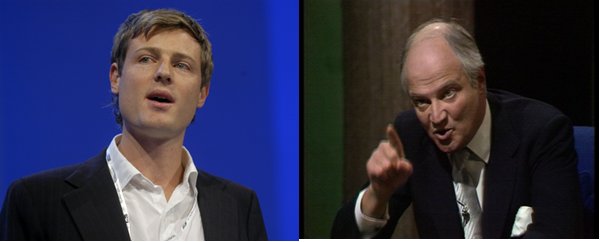
Last Friday Zac Goldsmith made a dramatic appearance on Channel 4 News.

The programme had accused him of not declaring some of his election expenses and he came into the studio live to answer the charges.

But Goldsmith seized the agenda and turned the interview around. He accused Jon Snow and his team of lying when they had said that he had previously refused to come on the programme. It is a fantastic scene which you can find HERE.

Goldsmith transformed the interview into an all out attack on truth and lies in journalism - at one point calling for "a new journalism".

What is fascinating is that his father, Sir James Goldsmith, did exactly the same thing 33 years ago on a BBC television programme at prime time.

goldsmithboth.jpgIt was an edition of The Money Programme in November 1977. James Goldsmith was a controversial businessman who had made a fortune taking over many old established British companies. One of them was Cavenham Foods which made Bovril.

The week before, the Money Programme had put out a film that accused Goldsmith of being an "asset stripper". He came on to defend himself - and what then happens is just wonderful.

Goldsmith takes over the programme. He accuses the two presenters of lying and starts interviewing them. He says their attack on him is part of "a malignant disease that is infecting this country"

One of the journalists bleats weakly: 'It's more conventional on these programmes for me to be asking you the questions"

I thought I would put up parts of the interview.

James Goldsmith is important because he used the power of the markets to break up the cosy patrician elite that ran Britain and its industries in the 1950s and 60s.

In the process Goldsmith helped transfer power in this country away from politics and towards the markets and the financial sector.

But 20 years later he decided that the giant market forces that he had helped re-awaken had become a threat to democracy. And in 1997 Goldsmith stood for parliament with his own party.

But he failed - and died two months later.

This year his son, Zac, stood for parliament and was elected. Zac has become an MP at a time when much of what his father feared seems to have happened. Our politicians are struggling to deal with a financial sector that seems no longer able to deliver the economic stability it once promised.

Maybe it would be better to interview Zac Goldsmith about what he - and his party - are going to do about the financial sector and their threat to economic stability and democracy rather than quibbling about the cost of circular stickers that say 'Zac'?

But it wouldn't be half as much fun.

In order to see this content you need to have both Javascript enabled and Flash installed. Visit BBC Webwise for full instructions. If you're reading via RSS, you'll need to visit the blog to access this content.

Kabul: City Number One - Part 10

Post categories:

Adam Curtis|17:33 UK time, Thursday, 8 July 2010

Comments

TERABYTES AFGHANISTAN

I have just got my hands on something wonderful and precious. It is five computer drives containing the unedited rushes of everything shot by the BBC in Afghanistan over the last thirty years.

It fills 18 terabytes of space.

It has been put together by Phil Goodwin who has worked for 14 years as a cameraman for the BBC in Afghanistan.

What Phil Goodwin has done is incredibly important. I cannot praise him or thank him enough. He has rescued moments of experience - both grand and intimate, sometimes intense or odd, or sometimes where nothing happens at all.

But they are all extraordinary because they are part of something that has happened in Afghanistan since the early 1970s that has had a profound effect on the world.

Yet it is increasingly clear that we in the west have no real idea of what that thing was. Or is.

Since 2001 we have been repeatedly told, by both politicians and journalists, that our troops are there to prevent further terrorist attacks on the west, and to bring modern democracy to a backward country.

But that is now changing. William Dalrymple wrote a really good piece in the Guardian last week arguing that by installing members of the Northern Alliance as the rulers of Afghanistan in December 2001, the Americans and NATO were unwittingly taking sides in a civil war that had been going on since the early 1970s.

They installed a Tajik-Uzbek-Hazara regime that has little interest in democracy. And what are called the Taliban insurgents are in reality a rebellion by the Pashtun majority in the country against that elite. And thus might represent the will of the majority.

He also argues that the fighting has become part of the proxy wars fought between India and Pakistan for the last 45 years. This is the argument too of the Economist. It had a fascinating piece last week about how Pakistan's support for the insurgents, like the Haqqani network, is driven by its fear of the growing Indian presence in Afghanistan.

If this is true it means that we in the west have become like foolish bit-players blundering around in a complex regional war that we do not understand.

It means that soon we will start to look back at everything that has happened in Afghanistan since the 1970s and reconfigure what it all meant. And when that happens all the footage that Phil Goodwin has saved will become extraordinarily valuable.

I find watching the uncut rushes fascinating. Long, held shots that you never see in the cut news stories. I want to start by putting up some of the unedited recordings - without any cuts, or added noise or music. All I have done is shortened them in a few places, but nothing is out of sequence.

Each one will have a simple explanation of what you are watching, and when, and where. That is all.

It is just stuff recorded. It doesn't make any sense. But it doesn't make any less sense than the way Afghanistan is reported by newspapers and television.

The first is a moment in the Beauty Spa at Bagram airbase in September 2004

In order to see this content you need to have both Javascript enabled and Flash installed. Visit BBC Webwise for full instructions. If you're reading via RSS, you'll need to visit the blog to access this content.

Here is the attempted assassination of Hamid Karzai. It happened in September 2002 as he was leaving the Governor's mansion in Kandahar. The assassin was from Helmand and had apparently been promised two Corolla cars if he managed to kill Karzai.

The footage contains some scenes that are possibly disturbing. And because the footage is not edited the camera holds longer on dead bodies than is normal in cut news reports.

In order to see this content you need to have both Javascript enabled and Flash installed. Visit BBC Webwise for full instructions. If you're reading via RSS, you'll need to visit the blog to access this content.

Lots of westerners came out to Afghanistan to help the Afghans become a modern democracy. Here is an art expert who has come to teach them about Conceptual Art. It starts with a group of young Afghan artists watching film of an installation in a western gallery, then she shows them Marcel Duchamp's 1917 urinal.

She is very keen to get them to say that if anyone did what Duchamp did in today's Afghanistan then they would be put in prison. It is interesting that the Afghans in the room, though they are polite, seem to disagree.

In order to see this content you need to have both Javascript enabled and Flash installed. Visit BBC Webwise for full instructions. If you're reading via RSS, you'll need to visit the blog to access this content.

This is a moment in the early evening somewhere in east Afghanistan on the 28th August 2002.

In order to see this content you need to have both Javascript enabled and Flash installed. Visit BBC Webwise for full instructions. If you're reading via RSS, you'll need to visit the blog to access this content.

In October 1995 the national government in Kabul was under assault from the Taliban. Here are some of the government troops trying to work out how to fire a big gun. I like the bit when they go and get what seems to be the manual.

Be careful if you are listening on headphones - there are sudden very loud noises that you may not expect.

In order to see this content you need to have both Javascript enabled and Flash installed. Visit BBC Webwise for full instructions. If you're reading via RSS, you'll need to visit the blog to access this content.

In July 2004 Afghan security forces raided a house in Kabul and found a private prison allegedly run by an American called Jack Idema. It had eight Afghan prisoners, some hanging by their legs from the ceiling. They claimed they had been tortured.

Idema turned out to be a strange fantasist - who had conned a lot of people in Kabul for 3 years. He claimed he was working directly to Donald Rumsfeld, running a super-secret force called Task Force Sabre 7. Their job was to hunt down the most wanted terrorists.

He claimed he had worked in "black ops" all over the world - including hunting down terrorists with nuclear weapons in their rucksacks in Lithuania. He also said he carried the genetic material of a dog called Sarge who had parachuted out of planes with him and sniffed out bombs. He said he was going to clone Sarge.

Idema was put on trial in Kabul. Here are the opening moments - including him talking to the press in the court room. With him on trial is an independent film-maker called Edward Caraballo from the Bronx who was making a documentary about Idema's black-ops. He is on the left of frame next to Idema.

The Afghans standing on the other side of the court room are the men who claimed to have been imprisoned and tortured by Idema

Idema's story is fascinating. Lots of very senior people believed his extraordinary stories. But we are now beginning to realise that many of the same people have believed a lot of other strange fantasies about Afghanistan over the past 9 years.

In order to see this content you need to have both Javascript enabled and Flash installed. Visit BBC Webwise for full instructions. If you're reading via RSS, you'll need to visit the blog to access this content.