Letter from Rio - via Salford

Jack Burgess
is a BBC content producer
When I saw a BBC appeal for volunteers to work on the Rio Olympics, I leapt at the chance, enough to give Greg Rutherford a run for his money in the long jump.
London 2012 had made an impression - not just Danny Boyle’s opening ceremony but the treasure trove of sporting triumphs which followed, including Usain Bolt’s second 100 metre victory, the now legendary ‘Super Saturday’ and Michael Phelps becoming the most decorated Olympian ever.
Who wouldn’t want to play a part, no matter how small, in the next incarnation of such a remarkable global event?
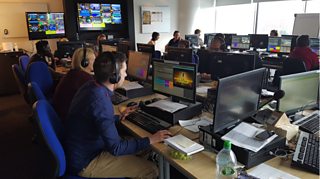
Jack Burgess (foreground) in the BBC Olympics engine-room
Now you might imagine that working for the BBC on the Rio Olympics would include a luxurious backdrop of sun-drenched beaches and carnival. Sadly not. Spare a thought for those of us left behind in Media City, Salford Quays, Manchester (lovely though it is).
I’m one of a team of 30 or so BBC volunteers logging the 42 sports, 306 events and 19 days of competitions that make up Rio 2016.
So what do I actually have to do?
I’m mainly covering the rowing and sailing and have to spot developing stories, controversies, funny moments, or standout moments for our social media and online pages. That’s the creative part.
It’s particularly rewarding to see someone in the pub after work showing their friend the exact piece of footage that you helped to get on the BBC News homepage earlier.
The not-so-exciting bit is trawling through hours of live feeds – including dozens of largely uneventful heats in the preliminary stages, to make sure the starts, ends, distances, graphics and results are properly timecoded for the editors in Rio (presumably so they have more time on the sun-drenched beaches).
The rowing proved particularly eventful on my first day with a boat capsizing in strong Brazilian winds and a rower from Togo getting so stuck in the bad weather that she started rowing back towards the start line.
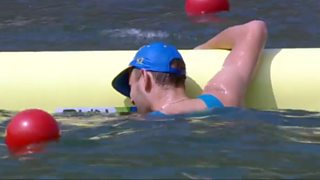
My personal favourite moment that I’ve come across so far has to be the Kazakhstan rower Vladislav Yakovlev falling out of his boat (above) shortly after the start of his race - twice in two days!
I’m impressed by the dedication of the people working across the Olympics. So many people are willing to give up their normal BBC jobs and work night shifts for two weeks (to be in sync with the Rio time difference). Luckily for me, the rowing and sailing are early events in Rio’s daily schedule so I am spared painful finishes at four or five in the morning.
I’m also impressed by the technological changes in broadcasting that have happened since the last games. Whereas London 2012 Olympics was labelled the first ‘digital Olympics’, Rio 2016 can claim to be the first truly ‘mobile Olympics’ and the first games to harness virtual reality. As well as filming the Rio opening ceremony in 360 degree video, BBC Sport released an app that allows viewers to watch their favourite events live on VR headsets.
This revolutionises audience’s viewing habits. I’m excited to see where such innovations will lead to with Tokyo 2020. I’m already looking forward to my next trip to sun-drenched Salford.
