Trusted guides - a new role for journalists?

Charles Miller
edits this blog. Twitter: @chblm
With professional news content so often jostling for attention in the chaotic world of social media, the role of the journalist has changed:
“As journalists and news organizations, realise you don’t control the narrative,” said Charlie Warzel, senior technology writer at Buzzfeed, “we’re not gatekeepers, we’re guides.”
That was his message to BBC Fusion’s Social Media and Broadcasting conference. Warzel presented an alarming glimpse of the future - much of it as predicted by Aviv Ovadya, a technologist at the University of Michigan’s Center for Social Media Responsibility.
Ovadya describes himself as “a misinformation engineering and design consultant”. That means researching and warning about ways in which social media can be misused.
Charlie Warzel said that Ovadya and others he’d studied predict a “coming crisis” in media. With the current news about Facebook and Cambridge Analytica, you might think it's already upon us. The conference themes around social media were timely - whether in relation to privacy or fake news.
On the latter, today’s fears may seem mild compared to future dangers of video manipulation, for instance. Software already developed allows the creation of fake videos that substitute faces, lipsync footage to new audio tracks and manipulate real footage with animated elements.
Warzel showed how an animated insect could be made to ‘land’ on the leaves of a plant, shot in real video and - extremely convincingly - make the plant sway in response to the tiny weight added to the leaf. And that can all be done using technology that you don’t need to be a Pixar engineer to operate.
The side of social media that’s to do with fakery is “so savvy”, Warzel warned, that “the way we cover the information wars is crucial”. With acknowledgement to Stranger Things, he referred to it as the world of “new media upside down”.
Afterwards I asked him what “infowars” mean for public service organisations like the BBC:
Watching Warzel’s presentation, it was easy to believe we live in a malign online world. I asked him how real the dangers are in most people’s everyday online experiences:
What’s important, Warzel says, is that, whether as journalists or ordinary users, we don’t just glaze over and stop using our critical faculties because it’s all so confusing: “you just start to give up - and that is probably one of the scariest things”
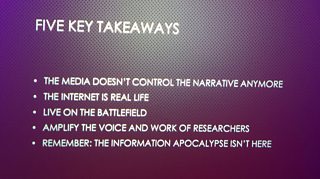
Ending on a positive note, he left his audience with some key messages to remind us that the infowars are not lost - yet: