Who needs the press? Reporting Trump could be a very different assignment

Cathy Loughran
is an editor of the BBC Academy blog
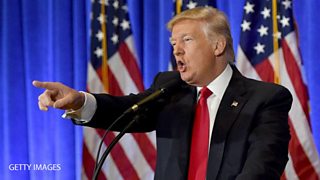
President-elect Trump takes questions at last week's extraordinary press conference
It’s no surprise that, a day after it was posted on YouTube, Alec Baldwin’s hilarious Saturday Night Live parody of last week’s Donald Trump press conference had clocked up almost five million views.
Journalists who attended the real thing also described “a theatre of the absurd”: “Just over a week from his inauguration, Mr Trump is still the same man he was on the campaign trail and on the reality show set,” wrote the BBC’s senior North America reporter Anthony Zurcher.
Chief reporter for Guardian US Ed Pilkington was sanguine: “Not for the first time in the course of 18 months of Donald Trump’s wild ride to the White House - and surely not for the last - the world’s media found itself gathered at his feet, dutifully soaking up his scorn like naughty children.”
The president-elect’s “Your organisation is terrible… You are fake news... ” sparring session with Jim Acosta, denying the CNN reporter his question from the floor, will surely enter the Washington archives.
But if the impression left by a new radio documentary on Trump’s presidency and the media is anything to go by, there is little cause for mirth among the White House press corps.
The President and the Press, presented by BBC North America editor Jon Sopel, paints a picture of journalists “bracing themselves” for a whole new era: a presidency where the country’s leader may tweet policy before breakfast, rather than hold a press briefing. The fear is that that could change the very nature of the job the Washington pack are used to doing, Sopel says.
Ann Compton, recently retired White House correspondent for ABC News and veteran of seven presidencies, certainly thinks so. “The stunning change for the White House corps is a digital age that has taken the tools of the journalist and put them into the hand of politicians and presidents, who can tweet from their own pockets,” she tells the programme.
Anyone who is a witness to history can now publish, she says: “But it is only with the 2016 US election campaign - and to an extent, the latter stages of the Obama administration - that presidents and candidates have figured, ‘Who needs the press? We’ll just do this ourselves.’”
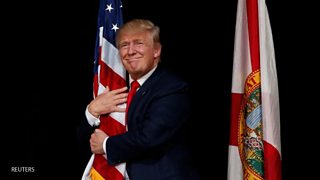
Candidate Trump on the campaign trail: Hostility to press harks back to Nixon
Sopel interviews other Washington insiders whose views vary as to how Donald Trump will communicate once he’s installed in the Oval Office. Bill Clinton’s former press secretary Mike McCurry can see advantages in getting the president’s “innermost thoughts at 6.30 every morning” but envisages “big challenges”, not least for White House spokespeople, if President Trump continues to “disrupt 40 years of progress” in 140 characters, as when candidate Trump tweeted his thoughts last month on nuclear arms expansion.
George Condon, White House correspondent for Washington’s National Journal, argues that presidents just can’t behave in that way: “He will have to be much more nuanced and careful. There are enormous consequences to what a president says. [Trump] is going to learn that.”
Condon also senses trouble ahead: “It’s not going to be a lot of fun… if there are different definitions of what a free press is supposed to do,” he says. “If you come into the White House and you think you’re not supposed to check sources or worry about whether something is accurate - and as long as it pushes your agenda it’s good - then we’ll have disputes with this White House.”
Produced by Linsea Garrison, the 50-minute BBC World Service documentary contains some fascinating archive clips from past White House ‘pressers’, including Bill Clinton being put on the spot over Monica Lewinsky.
There is some graphic and moving testimony from 89-year old Sid Davis, former White House correspondent for Westinghouse Radio, who witnessed both the 1963 Kennedy assassination and, hours later, the swearing in of Lyndon Johnson on Air Force One. And Ann Compton relives her extraordinary 10 hours as a pool reporter, following the 9/11 attacks.
The programme also features clips of Trump taking swipes at sections of the press for alleged “fake news” during his campaign. For academic, author and former investigative reporter Mark Feldstein, Trump’s declared hostility towards some mainstream media harks back to the notoriously bad relationship that Richard Nixon had with the press.
“Since Nixon, presidents have been careful to hide their [hostility], be more covert in their attempts to control the message. Trump has made no such efforts - openly, joyfully, gleefully baiting the news media.” Feldstein observes.
Sopel concludes that the White House press corps are preparing for “a new chapter, where many voters are just as likely to believe a totally fictitious account that’s appeared on their Facebook feed as they are a report, meticulously researched by investigative journalists”.
And that is leaving a lot of people “very fearful,” the BBC man suggests.
Ann Compton’s antidote? “Make sure that the job we do… is so accurate, so careful, so respected by those we’re trying to reach, that fake news and wishful thinking will take a back seat.”
Should the time-honoured White House lunchtime press briefings continue, BBC News reporters will no doubt continue to occupy their allocated spot - as Sopel describes it, “in the back row, in the cheap seats”.
Yet perhaps there’s a hint of tensions to come. When BBC international correspondent Ian Pannell stood to pose his question in Washington last Wednesday, announcing his media credentials, Donald Trump’s terse reaction was clear for all to hear: “BBC News. That’s another beauty… ”
The President and the Press is a Wise Buddah production for BBC World Service. Listen to the documentary on BBC iPlayer Radio.
How to attend a press conference: Wear red, watch the body language
