360, immersive and social: Creating videos for a planetarium dome

Laura Taflinger
Digital content producer, BBC Academy
You may have already experienced immersive 360-degree video or virtual reality experiences in a headset. Even YouTube and Facebook provide 360 video capabilities for viewing on desktop computers and mobile devices.
But what if that same content was projected onto a planetarium, turning an individual immersive experience into a bigger, much more social one?
At the recent Digital Cities Bristol 2016, the Creating content for the Data Dome event drew a packed Friday night crowd to the At-Bristol Science Centre.
The planetarium was upgraded and relaunched in late 2015 as the Data Dome, the only 3D, 4K (screen resolution) presentation space in the UK. Now At-Bristol and Bristol Is Open want to encourage producers working in video, VR and gaming to make content for the dome, so this event showcased examples of what can be done, and offered help to potential content creators.
Seamus Foley, digital producer for At-Bristol, outlined the challenges they’d faced in setting up the dome: the incredibly high screen resolution and data rate; translating 360 content into something that can be projected onto a 180-degree half-dome; and getting a ‘mini supercomputer’ to allow real-time interactivity.
“We’re at the point now where the technology kind of works, but as we all know, technology is nothing without story,” Foley said. “We need stories for this dome. We need to make people want to come here to experience stuff.”
In fact, an inspiring variety of dome content was on display, including:
- Bristol City Council’s visualisations of city data, such as air quality and traffic congestion
- A work in progress from production company BDH, involving CGI shots of foetal development in the womb (related to the special effects work they did for the BBC’s Countdown to Life series)
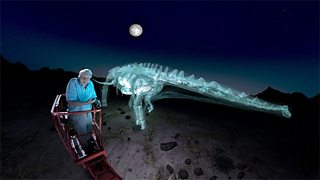
- David Attenborough and the Giant Dinosaur 360 video, by the BBC Natural History Unit (above)
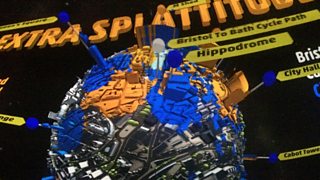
- Splat Bristol, a multiplayer game from developers Opposable VR, controlled by smartphones (below)
- A VR exploration of a Rolls-Royce jet engine, by ZubrVR and Calvium.
BBC digital producer Sam Hume pinpointed a clear benefit of showing content in this environment:
“We shot David Attenborough with a 6k Red Dragon camera, and then we composited him onto this CGI landscape that [production company] Hello Charlie built. It was quite a technical triumph,” he said.
“But when you’re putting things on YouTube or Facebook, you’re reliant on people’s personal internet speeds. So if you throw too much data at them, it’s going to buffer, or lose quality, whereas in places like the planetarium, we can deliver the highest grade we possibly can.”
Anil Glendinning, creative director at Opposable Group, said they created the Splat Bristol game after being inspired by Bristol’s Big Green Week and wanting to explore how “working together can have a transformative effect on our environment and our city”.
“VR is very immersive, but it can also be a bit lonely. You’re in there by yourself. We found that the Data Dome gives us some of that immersive experience – this high-quality screen wraps all around you – but at the same time it’s social. You’re in there with your friends, family or colleagues. This game is all about being together and working together towards a common goal.”
Zubr VR founder Jack Norris demonstrated how a VR model of a Rolls-Royce jet engine can be rotated and explored in the dome. He was excited about future possibilities:
“Obviously pre-rendered material has its advantages, you can spend time crafting the content,” Norris said. “But if you’re more used to a real-time environment and you understand the advantages of interaction and gamification, we would love to see those things coming together a bit more.
“There’s no reason why you can’t take your 3D scans, for example, or stuff that is traditionally used for pre-rendered media, and show it in a real-time environment.”
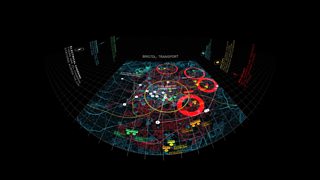
Bristol Council's visualisation of city data like congestion, as viewed in the dome.
Foley emphasised why games can make good dome content:
“Hopefully you can see there’s a lot of potential here if you’re a Unity developer, for instance. You can get your content up on the dome, you can make it interactive, you can make it multiplayer, you can add motion and have people control it themselves with a Kinect,” he said, stressing that the same advantages could apply to content on other game development platforms too.
For Suzanne Wilson, city innovation service manager at Bristol City Council, the Data Dome was the perfect local asset: “It sort of personifies the sweet spot we have in Bristol where we bring together technology and creativity. It’s when those things come together that the magic really happens.”
So how can producers make their own magic happen in this new presentation space?
At-Bristol has created a free plugin toolkit that will allow games created in Unity to be used in any dome. Producers can also test out their content at the dome any weekday between 9-10:30am, by emailing Seamus Foley to book a session.
What kind of content would you like to see in a dome? Tweet us your suggestions or connect with the BBC Academy on Facebook.
Virtual reality, 360 video and the future of immersive journalism
360 video in news: Not just watching by experiencing
Covering Calais with a BBC 360 filming experiment
