Reporting on Brexit (and Trump): Political journalists take stock

Cathy Loughran
is an editor of the BBC Academy blog
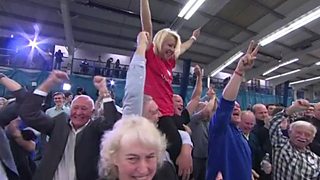
Leave supporters celebrate in Sunderland as the first EU Referendum results come in
This week’s ‘Eye of the storm: Reporting on Brexit’ debate at City University was planned long before the US Election result, but Trump’s world-shaking victory was inevitably on the table too as three leading political journalists discussed the experience of, and fall-out from coverage of the EU Referendum.
It was an evening for the drawing of careful distinctions between three familiar but different and easily confused ideas - objectivity, impartiality and balance - and a relatively new one: equivalence.
What was perhaps reassuring, from the start, was the extent to which the expert panel had been left reeling by the two campaigns. As BBC deputy political editor John Pienaar put it: “I realised that not just politics had taken a different course, but the way we perceive politics is now different.”
Referring to the no-holds-barred campaign in the US, he said: “The American dream died in the run up to the election… Brexit too was a quantum shift in the way we see our lives and our society.”
More to the point, for the packed London audience that included many journalism students, the Referendum had been “a defining moment in how we see our job of reporting [political campaigns]”, Pienaar said.
Contributing in no small way to the post-Referendum rethinking that is inevitably going on, is the question of ‘balance’ in broadcast coverage.
In the wake of the Leave vote there has been criticism from the likes of Lord Puttnam that legally required impartiality standards, particularly from the BBC, had left journalists “hamstrung” in their aim of getting to the truth. BBC insiders Justin Webb and John Simpson also argued that traditional impartiality had allowed audiences to be lied to and called for some fresh thinking.
While accepting there was no room for the BBC to be complacent, BBC News director James Harding vigorously denied suggestions that “false balance in which fanciful claims got the same billing as serious insights” were true. In fact, research suggested the BBC had been the British public’s most trusted source of Brexit coverage, he said.
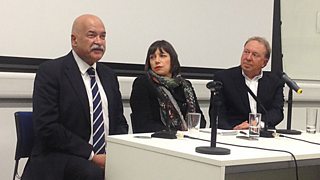
John Pienaar, Beth Rigby and Steve Richards reflect on the coverage
Panellist Beth Rigby, senior political correspondent at Sky News, accepted the broadcast journalist’s dilemma here: “We don’t set the political arguments, we report them… We have to try to be balanced, but there probably is a little scope [to be less rigidly balanced],” conceded the former FT writer, highlighting the freedom of the British press to be politically partial, exercised with relish in the Referendum campaign.
The CBI, for instance, had been unhappy at broadcast coverage, she said, because of perceived equal weight given to opposing views from the business world, when “big business was overwhelmingly in favour of Remain”.
And even when broadcasters strove for genuine balance, they “still get trolled by either side”, she complained: “But if you’re equally trolled, you’re doing OK.”
Pienaar was also uneasy. There was “a danger of confusing balance with equivalence”, he warned, admitting to not being “100% happy” with BBC coverage. He wasn’t sure either what he and his colleagues could have done differently, however, but was “concerned” at the new challenges the Referendum had raised.
“[As a journalist] you’re taught not to thrust your opinions,” said Pienaar, whose own pre-vote tour of the UK led him to expect a Leave result, he told the audience, and whose best guess, at a private dinner ahead of the polls, had been a 52-48 Leave-Remain result - winning him a “magnum of Bollinger”, he revealed.
For political columnist and broadcaster Steve Richards, the “framing” of the media debate by politicians during the referendum campaign had been a decisive factor “appealing to emotions in dangerous ways”. Even rigorous fact-checking by journalists could be “contentious” in this context, he believed. His solution? Don’t hold referendums.
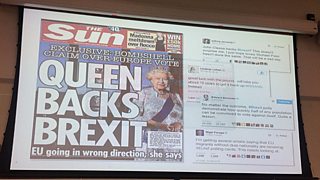
One of the pro-Brexit tabloid headlines that was a backdrop to the debate
Was the view that the ‘liberal elite media’ misread what was really going on during the EU and US campaigns fair, a questioner wanted to know.
Richards rejected the idea that, because “some outsider says ‘I’m speaking for the people against the elite’, anyone elected or expert is therefore part of a cocooned bubble”.
Rigby went further: “I find it offensive when we get grouped into the establishment, when our job is to challenge the establishment,” she said.
Another warning from Pienaar: “I am wary of too much equivalence (that word again) between Trump and the Referendum,” although both Hillary Clinton and Remain had been “defeated by a mood [not an ideology] that they arguably still did not understand”, he said.
“The US campaign was a search without bottom for the lowest common denominator. The Referendum was the worst advert for British politics in 30 years, but still not as bad,” the BBC man maintained.
What about the role of social media in both outcomes?
Referring to fake or partial news on social networks, the Sky correspondent feared that “people are now making massively important judgements [based] on a pack of lies”.
Richards was less convinced. He did not view social media as “mainstream” at the end of 2016: “It will be, but not yet,” he said.
Pienaar argued it was the job of journalists to “keep things in perspective”: “A tweet from ‘angry Bob’ is not the same as a tweet from Sky News or the BBC.”
The influence of British newspapers in setting the broadcast news agenda was also discussed in the context of Brexit. No one on the panel denied the power of the daily press to lead where networks often followed - to a “surprising” extent, Rigby felt.
“Broadcasters have a duty to generate the agenda more - and they should because they have more access [to politicians],” she said.
While the papers continued to exert influence, that had not been any greater during the Referendum, said Richards: “And even if you took the [Brexit-supporting] Mail and the Sun out of the equation, Brexit would still have happened.”
So what lessons did the bruising Brexit and Trump experiences hold for broadcasters?
“Polls will not drive coverage in future,” Pienaar predicted. It would be more about the issues than “events seen through the prism of the polls”.
“It’s better to take yourself out of the daily trench warfare,” Rigby said. “Decide today we’ll report on the single market, tomorrow the budget…”
Steve Richards envisaged social media getting even noisier, making it harder for both political leaders and mainstream journalists to stay “calm and considered” at a time when cool analysis was needed more than ever.
Session chair Richard Evans, a senior City journalism lecturer and former BBC news presenter, ended by asking panellists for the best piece of advice to journalism students.
Pienaar’s was to know the difference between scepticim and cynicism: “Be as sceptical as you like but you need to resist being cynical…because you’ll sell out your audience. Don’t assume [politicians] are lying until you know they are.”
Richards was both upbeat and challenging: “There is more need and scope for journalists than ever before. But their responsibility… is to be the one who steps back from the frenzy and considers. That is what journalism can offer in the next few years: make sense of the senseless.”
Rigby concluded: “Be dispassionate, but trust your judgement and hold your nerve. Report, yes, but you have a ringside seat so trust your own judgement too.”
