House of Saud: How to make a documentary series with no help from your contributors

Jack Burgess
is a BBC content producer
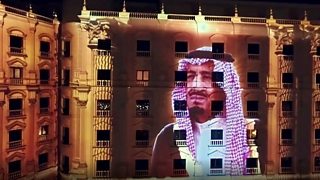
How do you create a balanced documentary series when the people at the heart of your story refuse to give you filming access, comment or cooperate in any way? How do you construct a film without being able to shoot at your key locations?
The producers of BBC Two’s recent documentary series House of Saud: A Family at War had to answer all those questions as they delved into the contentious issues surrounding one of the most powerful families ever.
Contentious? Among other subjects, the series touched on the royal family’s links with terrorist networks, endemic corruption, a much-criticised human rights record, allegations of massive bribery and shady, decades-old arms deals with the UK.
Perhaps unsurprisingly, the Kingdom of Saudi Arabia refused to respond to questions and refused filming access to the Kingdom.
I spoke to executive producer Mike Radford, who told me that the production team originally hoped to gather their material undercover. But after discussions with human rights organisations, it was decided that would be too dangerous - particularly in the light of Prince Mohammed bin Salman’s recent crackdown on corruption and dissent.
As it would be hard to tell the story from outside the Kingdom, Mike said, next best was to line up an array of highly-informed contributors with first-hand experience of the Kingdom’s dealings. There were high-profile interviews with, among others, US General David Petraeus, members of the CIA, and the lead lawyer in the 9/11 lawsuit, Sean Carter.
The three episodes also contained interviews with several people whose links to the House of Saud had placed them in situations threatening their safety. In episode two, a former programme director at defence contractor GPT Special Project Management, Ian Foxley, talks about a suspicious £1.5 million payment he discovered in a contract between the UK and Saudi Arabian governments. Once he drew attention to it, Foxley says GPT threatened him with arrest for stealing sensitive information and he fled Riyadh.
Similarly, episode three features interviews with several people who were involved in a court case against Prince Saud bin Abdulaziz Bin Nasir, in which he was jailed in 2010 for killing his manservant at a five-star hotel in London.
Sensitive interviews such as these bring challenges of their own. To get the best from difficult interviews it was important for the production team to make sure their contributors felt at ease with their surroundings, interviewers and the purpose of the programme. Establishing a rapport before filming and shooting them at their homes were two ways of doing this.
With controversial testimony at the heart of the films, it was essential to achieve balance. Mike Radford admitted that it was tricky to find people linked to these stories who would speak in favour of Saudi Arabia.
The BBC has an obligation under the Ofcom code to include a right of reply in such a programme. So each episode concludes with a statement explaining that the Kingdom of Saudi Arabia refused to respond to the issues raised or to grant filming access.
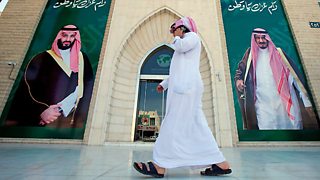
The production team explored other ways of including balance within the films. They set up an interview with the Saudi ambassador to the UN, Abdallah al-Mouallimi. He strongly contradicted Saudi Arabia’s human rights critics.
“I think our human rights record is one of the best in the world. Both internally and in terms of our own systems and as far as international agreements and covenants,” al-Mouallimi boasted.
A further hindrance to production was the problem of hiring specialist researchers in a country without an established free press.
“Arabic-speaking investigative journalists are very hard to find. That was a real handicap. We did find one in the end but it was very, very, very difficult.”
Not being able to film in Saudi Arabia made storytelling a lot more difficult.
“It left us with not many sequences to work with. How do you construct a film without sequences? Getting archive: that’s absolutely on the money. Archive has to be absolutely on point.”
An essential quality of working on a programme such as this is persistence, Mike said.
“You have to have a certain amount of courage in your convictions over this. You have to be willing to push through the initial objections if you’re sure there’s a story there. It’s important to have some determination.”
When the series started production the aim was to scrutinise the behaviour of this very wealthy family to provide a greater understanding of who they are and how they do business with governments, including ours.
The reaction from critics has been positive: the Telegraph described the series as “richly-detailed, fascinating and at times very scary” and gave credit to the production team’s meticulous research and resolve.
James Jackson wrote in the Times that despite all obstacles “the success of the current affairs documentary can be measured by how well it interrogates and explains the world in which we live. House of Saud: A Family at War is already going some way to doing that”.
You can currently catch up on the full series on BBC iPlayer.
Paul Kenyon on investigative reporting techniques
Help with investigations (BBC staff only)
