Steve Hewlett: Making the most of luck and life
Charles Miller
edits this blog. Twitter: @chblm
Steve Hewlett’s big break taught him a lesson. After leaving university in Manchester, he was teaching at the local poly and dabbling in the world of journalism, selling tips to the BBC’s regional researcher for £15 a story.
One day the researcher got a call from Panorama in London, asking her to help on a story about chemical waste from a factory near Manchester. She passed the job on to Steve, whom she described as a local freelance journalist. To be working on an investigation for Panorama was a big deal. Steve tried not to sound too surprised when he found himself speaking to the producer.
Panorama were looking for two key contacts for the story. Steve spoke to a journalist friend who was happy to give him one. For the other, he consulted the phone book, where he found the number listed.
He called his Panorama producer back, leaving a gap of a few hours so it didn’t look too easy. The producer was impressed and hired Steve to work on the rest of the story. When he arrived in Panorama’s London office some time later, he noticed in the centre of the room, a huge collection of every phone book in the country. The lesson: “do not ignore the obvious.”
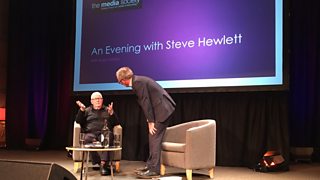
Through Panorama, Steve was offered a job on Nationwide by its then editor, Roger Bolton. The two were reunited last week by the Media Society for an event in which Roger asked Steve about his career in radio, television and newspapers, for the BBC and commercial broadcasters and as a columnist, producer and presenter, currently of Radio 4's The Media Show.
Uppermost in the minds of his audience at a packed BBC Radio Theatre, and for the BBC’s Helen Boaden who introduced him, was Steve’s current treatment for cancer. Boaden said that Steve’s doctor had told him he shouldn’t do this event. Steve himself explained that he’d reached agreement with the doctor that he could do it if he took a little break between the on-stage part of the evening and the reception afterwards, and as long as anyone with a cold or cough kept well away.
Steve’s medical condition is more than just the concern of colleagues and friends. It is also the subject of his latest piece of journalism. As Roger put it, he is acting as a reporter on his own body. The result has so far been a series of extended interviews with Eddie Mair on PM, a piece for Radio Times and a cancer diary in the Observer. The public response to his openness has been overwhelming, Steve said. It “never crossed my mind” it would have that effect on audiences.
Being so open has had the advantage that “nobody feels they’re treading on eggshells” if they talk to him about his illness. I “approached the whole thing with a kind of journalistic head on,” he says. Even as a patient, some of his professional skills have been brought into play: navigating his way through the NHS has been helped by “a bit of journalistic nous.”
Roger asked Steve about the highlights of his career. He singled out the Inside Story documentary in which he and reporter Peter Taylor negotiated the first access to the H Blocks of the Maze prison in Northern Ireland, where 450 loyalist and republican prisoners were held.
Another came when he returned to Panorama as its editor. On the evening of 5 November 1995 (a date evidently etched in his brain), a film crew was at work while Steve waited anxiously for news at home in Shepherds Bush. By midnight, he was getting worried: the interview must surely be over. Eventually he got a call from his producer: it had all gone well. He hadn’t been able to call earlier, he explained, because they’d still been at Kensington Palace, drinking champagne with Princess Diana.
That interview, a world scoop for Panorama, was watched by 23 million in the UK. But getting it shown was a triumph of careful BBC diplomacy by Steve and senior colleagues. He praised the then Director General John Birt for deciding not to tell the BBC Chairman Marmaduke Hussey about the interview. Since the Chairman’s wife was a lady in waiting to the Queen, it was likely that telling him would lead to problems and might prevent Panorama fulfilling the one condition that Princess Diana had required: that she should be able to tell the Queen in person about the interview. In careful coordination with the BBC’s publicity department, the princess told Her Majesty, and sent a text to the BBC to confirm, just before the press release about the interview was sent out.
From operating close to the heart of the establishment, Steve has also made his mark as in more subversive roles. At Channel Four, his work on Diverse Reports helped fulfil the remit to “attack or probe the liberal consensus,” as he put it. And that wasn’t just from the left: “I may the only person in TV who's made a programme that advocated capital punishment.”
Asked by Roger about his remaining ambitions, Steve said he hoped his treatment would work and “I’d like to do more of what I’m doing.” That includes making a two part TV documentary about celebrity for the BBC.
Throughout the evening, a recurring motif in Steve’s story was his feeling of how often he’d got lucky, starting when he was selected for adoption from a group of babies on account of his unusually rosy cheeks – the result of an early bout of whooping cough.
A long, appreciative round of applause at the end of the evening demonstrated the earnest hope of all present that Steve’s luck will hold - and that he’ll be up to rubbing shoulders with the Kardashians, or whatever other hardships his new series entails.
With thanks to Marcel Klebba for the photograph.
