About the BBC - BlogAbout the BBC - Blog
Local Navigation

Archives for August 2010

The Pope's Visit 2010

Blog comments are currently unavailable. Find out more.

Post categories:

Aaqil AhmedAaqil Ahmed|16:47 UK time, Tuesday, 31 August 2010

On the morning of 28 May 1982, an Alitalia 727 aircraft touched down at London Gatwick airport. Minutes later Pope John Paul II knelt down and kissed the tarmac.


What followed was an historic and demanding six-day tour of the UK that gripped the nation, and dominated the news both in the UK and around the globe.


I was a football-mad boy just about to turn thirteen and residing in Bolton when I watched his arrival in 1982. I - like others of around my age - remember being enthralled by Blue Peter and Newsround features about the visit - and who can forget marveling at the all-important Pope mobile.


I had little concept of what the Pope's visit to our shores really meant to the millions of Catholics in the UK. I just knew that this man was causing a bit of a stir when he turned up in his very different looking car. Like all things when you are a child, the fascination passed quickly, but my memory of his visit remains, and what really sticks in my mind especially is the sheer size of the crowds who came to see him in Heaton Park in Manchester.


Today - as a forty-one year-old man - I am now preparing for the first visit of a Pontiff for 28 years (and the first ever State visit) and I am in a very different place. I am obviously a lot older, I hope wiser, a father myself, and I am very proud to now be the BBC's Head of Religion and Ethics and the Commissioning Editor for Religion TV. And this papal visit by the current pope - Benedict XVI - rather than being a passing fascination, is on my mind every minute of every day, morning, noon and night. Why? Because I, along with many of my colleagues across BBC TV, radio and online, are getting ready to cover this historic State occasion with a myriad of eclectic programming.


The Pope's visit from 16 -19 September is being organised and paid for by the Catholic Church (in England and in Scotland) and by the Foreign and Commonwealth Office. It has polarised public opinion like no other before and you only have to open a paper to see that it has got the nation talking. What will happen when he gets here and, more importantly, what he may say, is sure to dominate the news agenda. His arrival on the 16 September will also mark - and be the culmination of - many months of planning and organisation (not to mention sleepless nights) for our BBC teams working on all the aspects of covering the Pope's Visit 2010.


From the production crews working on all the live events, to the news teams across the BBC, down to the documentary producers finalising programmes giving an important insight into some of the wider issues that surround the papacy of Joseph Ratzinger, this has been an extremely busy, fraught but entirely fascinating few months.


The UK has changed a lot in those 28 years since the last time we greeted a Pontiff, and the Britain that awaits Pope Benedict XVI as he ascends to the tarmac is a very different place than the Britain that awaited Pope John Paul II. It is more multicultural, secular and, thanks to the recent controversies that have rocked the Catholic Church, the current Pope will no doubt be met by some very vocal groups who are against him being here altogether. However, for the majority of the many millions of Catholics in the UK, the Pope's arrival will be much looked forward to and also celebrated.


One thing is for sure, this is a State event, that will be both newsworthy and of national interest and significance, and, as the nation's broadcaster, it is appropriate that we cover it in the best way we can - with the scale, depth and overall balance of programming across all our platforms - TV, radio and online - that only the BBC can deliver.


I hope you manage to watch some of the coverage, and you find it as fascinating as I undoubtedly will.


You can find details of all the programmes to coincide with the Pope's Visit 2010 by following the below link.


Aaqil Ahmed is Commissioning Editor for Television. Head of Religion and Ethics

Post MacTaggart Q&A with Mark Thompson

Blog comments are currently unavailable. Find out more.

BBC Director General Mark Thompson answered questions at the Edinburgh International Television Festival today as delegates reflected on his James MacTaggart Memorial Lecture last night.


In an hour-long session, Thompson answered questions from Channel 4 Newscaster Krishnan Guru-Murthy and from the floor on areas such as BBC pay and pensions, the BBC's move to Salford, NAO access, Strictly Come Dancing and BBC 6 Music.


On pay, Thompson rejected suggestions that the BBC had moved too little too late, pointing out that it had been one of the first public bodies to recognize that changes had to be made, with bonuses and pay frozen more than a year ago. The challenge for the BBC was how to attract the best people. But Thompson said working for the BBC was a privilege and there was no debate that people at the BBC should be earning less than at competitors.


He restated his commitment to transparency and public scrutiny. However in areas where the BBC is competing directly with other broadcasters, for example sports rights, he warned that disclosure could put the BBC at a disadvantage and work against the public benefit. Thompson said the public absolutely had the right to see how much the BBC spent on top talent, however, he questioned whether publishing exact salaries for artists and contributors was what the public wanted and whether it would lead to better presenters.


Thompson also defended the BBC's decision to create a new media centre in Salford, saying that bringing 2300 people to the area in a state of the art broadcasting centre would allow people to work together in completely new ways to make the best programmes in the world, redefining the BBC.


He said he understood that for staff, the fact of moving from London to Manchester was a significant deal. However, Thompson said he believed ultimately Salford would be a great place to work and this transitional period would be seen differently with hindsight. Salford would be judged when it was up and running.


On Sky Thompson said in his speech he was making the point that far from being an enemy, Sky was a real success story. But, together with the whole industry, Sky could be doing more to invest in British content.


Thompson concluded that there were significant projects happening at the BBC with which he had been personally associated with, such as the move to Salford, and he wanted to see these through.


You can follow the @bbcpress and @AboutTheBBCTwitter feeds for updates from the event.


BBC Director General Mark Thompson delivers James MacTaggart Memorial Lecture

Blog comments are currently unavailable. Find out more.

This evening the BBC Director General, Mark Thompson, delivered the annual James MacTaggart Memorial Lecture at the Media Guardian Edinburgh International Television Festival. You can read Mark's speech in full on the Press Office website.

Tomorrow morning Mark will be answering questions in a post-MacTaggart Q&A.

You can follow the @bbcpress and @AboutTheBBCTwitter feeds for updates from the event.

Laura Murray is Editor of About the BBC Blog

The Media Guardian Edinburgh International Television Festival

Blog comments are currently unavailable. Find out more.

The Media Guardian Edinburgh International Television Festival begins today. It's a huge fixture in the TV Industry calender and key figures from the BBC will be speaking over the next few days.


The Festival is developed by senior industry figures, providing an arena for the international TV and media industry to share ideas, debate the issues of the day, and build relationships.


This evening the BBC Director General, Mark Thompson, delivers the annual James MacTaggart Memorial Lecture. Then on Saturday morning Mark will be answering questions in a post-MacTaggart Q&A.


Other highlights from the weekend include various Channel Controllers including Jay Hunt (BBC One), Janice Hadlow (BBC Two), Danny Cohen (BBC Three) and Richard Klein (BBC Four) discussing their strategies, programming, risk taking and what's ahead for their channels. Peter Finchman (ITV), Julian Bellamy (Channel 4) and others from across the industry will also reveal their plans for the future of their networks.


Culture Secretary, Jeremy Hunt will have a face-to-face conversation with writer, broadcaster and media consultant, Steve Hewlett on Sunday.


A TV Question Time session will feature panelists Jana Bennett, Diane Abbott MP, David Elstein, Mariella Frostrup and Steven Moffat. Jeremy Vine chairs Build Your Own BBC, with speakers George Dixon, BBC Controller of Knowledge George Entwistle and Evening Standard Executive Editor Anne McElvoy. The session invites advocates to put the case for and against how the BBC is run.


There will also be a Doctor Who masterclass from Steven Moffat featuring actress Karen Gillan (Amy Pond), a Coronation street masterclass and Danny Cohen will chair an EastEnders masterclass marking 25 years of the soap.


For the full schedule, visit the Media Guardian Edinburgh International Television Festival website.


It promises to be a very exciting event and we will be updating the About the BBC blog and the Press Office website over the weekend with details and coverage, so check back for updates and a round-up of the festival highlights.


You can follow the @bbcpress and @AboutTheBBCTwitter feeds for updates from the event.


Laura Murray is Editor of About the BBC Blog

Bitesize and GCSE results

Blog comments are currently unavailable. Find out more.

Post categories:

John Millner|12:11 UK time, Wednesday, 25 August 2010

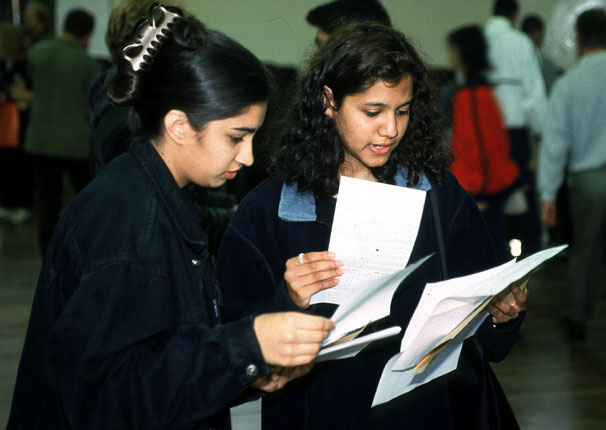
Students looking at their exam resultsIt's GCSE results week, and for 700,000 16-year olds in England, Wales and Northern Ireland it's a real rite of passage, marking the end of their statutory schooling, and a decisive milestone on the way to either continuing education or the world of work. Class of 2010 did better than any previous cohort, with almost 70% getting a Grade C or above and nearly 23% scoring an A or A*.


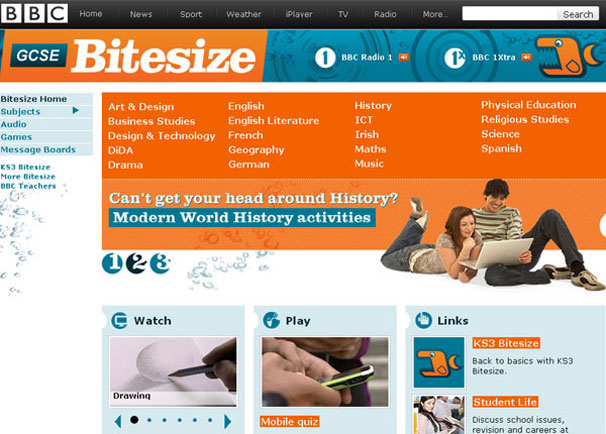
Most of these young people will have been supported in their studies by Bitesize, one of the BBC's best known online products. Bitesize is a web phenomenon. It has well over half a million users a week, and is regularly rated among the top three sites, along with Google and Wikipedia, for usefulness as a study aid.With a reach of 75% of all 11-16 year olds, Bitesize is arguablythe BBC's most successful venture ever into the teen audience. Part of this success is down to the fact that there's been a technology revolution in teaching and learning since Bitesize was launched in 1998, when the world wide web was just a few years old. Teachers now use networked or online classroom resources more than printed ones, while going online has become for most students the default way to get help with homework, coursework or revision for exams. Bitesize came at the right time and with the right functionality to ride the wave of this learning technology revolution, and the service is now an integral element - along with a wide range of non-BBC online curriculum support products - in the UK's digital learning landscape. Today there are getting on for 15,000 pages on seven separate Bitesize sites, covering the four key stages in England, Wales and Northern Ireland, plus Standard Grade and Highers in Scotland, and Bitesize TGAU in Welsh.

GCSE Bitesize homepageAnother big factor in Bitesize's success has been addressing itself directly to students.Teachers use the sites too of course, and teacher recommendation has been immensely important in spreading the word. But the Bitesize format, language and style is fundamentally student-oriented - delivering just-in-time, curriculum-tailored learning in easy steps, using rich media, interactivity, quizzes and games to make the experience engaging and fun. The Bitesize production team have developed a distinctive voice which is no-nonsense and functional but also often wry, playful, ironic. A quick scan of the secondary Bitesize message boards shows that studentsfeel at home in this environment. They feel Bitesize is their site.

They'll only continue to feel this, however, if Bitesize adapts and changes as fast as teens' online behaviours and expectations do. The Bitesize sites have re-invented themselves several times already, experimenting with different navigation styles, media, formats and platforms such as red-button and mobile. Online technologies change with lightning speed. National curricula, testing regimes and exam specifications are also entering a period of likely flux.So to stay relevant in the next decade, Bitesize must continue to evolve.

Exactly what kind of Bitesize emerges from this evolutionary process can't be predicted with certainty. I think it will be more flexible, more disagreeable, more customizable than it is now. It will support more community and creativity, become more media-rich, link more widely, and probably move increasingly onto mobile platforms.It will not develop in the direction of a managed learning environment or tracking tool for teachers; if anything, it will become even more learner-facing, more open to the web and more playful than it is now.

Bitesize faces massive challenges over the next 18 months. 2010 will be its last year in London: by this time next year the main Bitesize editorial team and their design and technical colleagues will be settling in to their new home at Media City, Salford, while attempting a complete design overhaul and migration to a brand-new technical platform. But we've a really good reason for rising to these challenges: those thousands of school students across the UK who rely on BBC Bitesize to enrich and reinforce their learning, and help them reap the benefits of a successful education.

John Millner is Learning Executive for 5-19 Learning

A new home for the BBC Archive

Blog comments are currently unavailable. Find out more.

Post categories:

Peter Skinner|08:10 UK time, Friday, 20 August 2010

A warm balmy afternoon in July 2007 had erupted into a fierce-some thunderstorm. Looking out across West London from a 3rd floor window in the Broadcasting Centre, the doom-mongerers were in full force. "Not looking good out to the West", said one and then embroidered his forecast by musing "I reckon that lightening storm is right over Brentford".

Spot on.


My phone rang "We've got another flood at Windmill Road" came the call from Paul, our Logistics Manager on site.


It was the third flood in the same summer and the 10th of the decade. The heart sank, yet more rain-water overwhelming the fragile gutters and penetrating the porous roofing of the proud old building. Internal drain manholes blasted out of their mountings and swept along by the torrents of rainwater backing up from the nearby roads as the local drains failed to cope.

More and more chaos and upheaval for the dedicated on-site team to manage. And so they swept into action, moving hundreds of tapes to safer higher areas in the archive, laying out wet and decaying material in dry rooms, wading through inches of water to save the archive, transporting damaged film to specialist recovery outfits and mopping up the sodden floors...

Windmill Road had taken another hit. The home of the BBC archive, housed in aged, inadequate conditions and surroundings, staggered and reeled..but coped.


Wind on 3 years and reach the summer of 2010....


A new purpose-built archive is close to completion at Perivale. Housing 13 archival controlled vaults to maintain and preserve the physical content plus the construction of new technical areas designed to deliver the various preservation and digitisation programmes that will enable the BBC to deliver priceless programmes back to our audience in new ways. 

A fantastic commitment, both in terms of intent and design, that underlines the importance of the BBC's output for the past 80 years and keeps it alive for future audiences, enhanced by new technologies.

The new BBC Archive Centre - PerivaleThe new BBC Archive Centre - Perivale


Five years in planning. A rollercoaster of project management, patience and delivery. Immense gratitude to colleagues across the BBC; to the Executive for supporting the vision; to the project management team in BBC Workplace; to the staff in Information & Archives for making it happen and many, many more contributors.


This is one of the biggest Broadcast Archive moves ever undertaken in the world. As I write, we have just passed the 600,000 mark for items moved from Windmill Road to Perivale. The stock migration will cover 202 working days, move 3.7million items and complete by March 2011. And we are bang on target.


Every day we move 350 shelves of content in 12 lorries handled by 40 removal staff. And these items are all 'operationally' live. If something is needed urgently, then we implement contingency processes to interrupt the move process and meet deadlines.


At Perivale, we periodically transfer members of the team from Brentford to cope with the increasing stock profile and currently await Siemens colleagues to complete the fit-out in the technical and office areas. The majority of staff will transfer by the end of the year.


Where possible, we aim to accelerate the preservation programme, increasing the volume of digitised content. Improved connectivity is a cornerstone of the planning and will allow us to meet greater demand in delivering digital content to our BBC colleagues across the network.

New technical area at Perivale and the first cans arrive at PerivaleThe new technical area at Perivale | The first cans arrive at Perivale


Even the vaults will take on a personality. Major contributors to BBC output over the years have been approached with the idea that particular vaults will be in their name and, where possible, reflect the genre of content relevant to them. Our thanks, therefore to Michael Palin, Dame Judi Dench, Stephen Poliakoff, the estates for John Reith and Dennis Potter and several more.


So, after 42 years at Windmill Road, the BBC Archive is finally moving.


Eight more months to dodge the thunderstorms that seem to target Brentford with unerring accuracy and an opportunity to finally silence my gloomy amateur meteorologist colleagues in the Broadcasting Centre!


Peter Skinner is Head of Archive Operations


BBC Genome: The Complete Broadcast History of the BBC

Blog comments are currently unavailable. Find out more.

Post categories:

Helen PapadopoulosHelen Papadopoulos|10:45 UK time, Thursday, 19 August 2010

Most people know that the BBC does not have a copy of every programme it has ever broadcast. The main reason for this is that when broadcasting began it was seen as an ephemeral medium, and there was no way to record and store what was being transmitted.

Although it became possible to record programmes in the 1950s, magnetic tape was very expensive and recording equipment bulky and complicated, and until relatively recently only those programmes that were considered worth the cost and effort of recording and archiving for posterity were retained. The head of BBC Information and Archives, Sarah Hayes, has already written about this in detail for the Internet blog back in September 2009.

However, even though we may not have a copy of each programme in the BBC's vast archive, there may still be something related to or derived from the original programme: stills, non-broadcast footage, music, documentation, props or other material connected with what was broadcast.

The skilled researchers who work with programme-makers inside the BBC and independent production companies are used to hunting for additional material and know where to look, but on the whole the public don't even know where to start. BBC Genome is our attempt to solve that problem, by creating a comprehensive, easy-to-use online catalogue of all of the BBC's programmes so that people can discover which programmes we have, which we don't have, when and where they were broadcast and even what else we've got that might interest them.

We're working on the basis that "full or near-full public access to archives is both achievable and the right ultimate goal" and, sitting at the heart of a reshaped BBC Online, BBC Genome is the first step towards that goal. It will provide a timeline from the foundation of the British Broadcasting Company in 1922 and provide details of the programmes, channels and services which map on to that timeline, bringing the broadcast history of the BBC to life.

What BBC Genome does

The BBC stores information about the programmes we make and broadcast in many different ways, each one designed to support a specific task or function, but none of these are comprehensive nor in a publicly accessible or searchable form. We want to ensure that our broadcast history becomes and remains a working asset for audiences, and at the end of last year we set about finding a way to reconstruct the BBC's broadcast history all the way back to 1922.

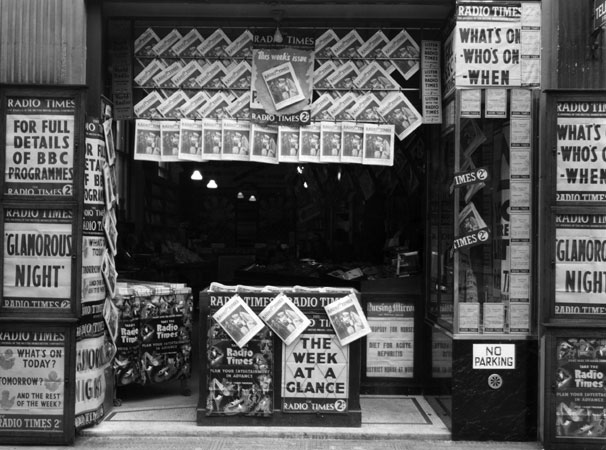
We needed to create a central core, or spine, for the catalogue of broadcast records and there was one source in particular that provided a comprehensive record of the BBC's broadcast history going back to 1923: Radio Times.

RT-Newsstand_blog.jpgIt is an ideal place to begin because we have easy access to it, it contains a record of everything we intended to broadcast - even if what actually went on air wasn't what we planned to show - and it is in a structure and format that people readily recognise, with basic but consistent details for all programmes, along with regional variations. It even lists radio frequencies!

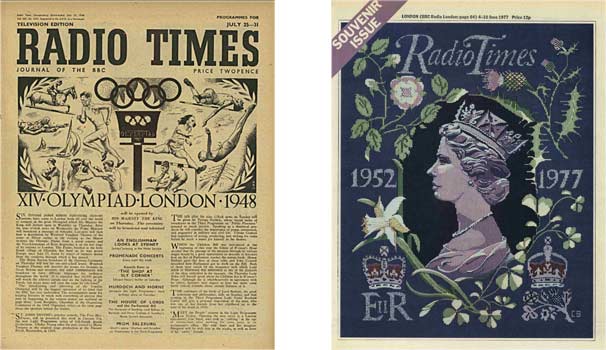
We started with a pilot project to scan two years' worth of Radio Times and extract the programme listings details from the scanned pages, in order to establish the approach and processes. Working with experts at a UK firm which specialises in projects like ours and with the British Library, every page of the 1948 and 1977 editions of Radio Times was scanned.

radio_times.jpg

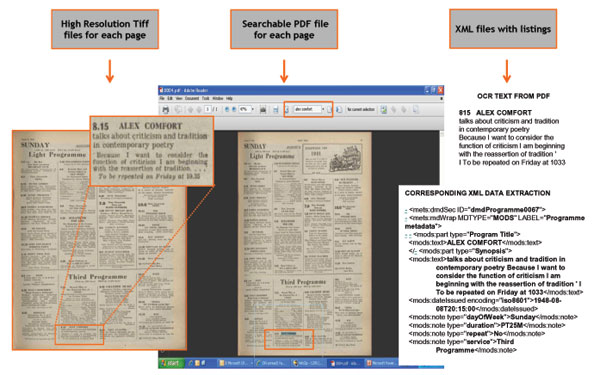
The Genome pilot: Metadata, OCR and outputs 


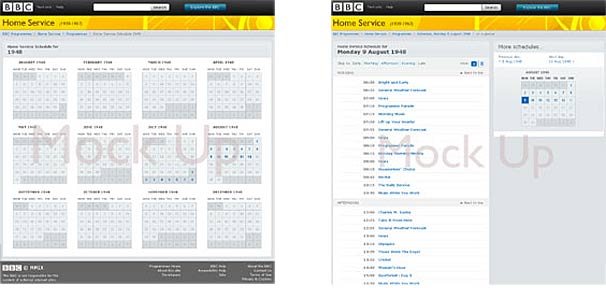
Genome_Blog_Pilot_metadata.jpgThe images were then converted into computer-readable text using optical character recognition (OCR) software before being divided into separate channel and programme listings so that we could identify details including the programme title, channel name, date and time of broadcast and a synopsis of the show. All of this information was stored in a database that we used to support an experimental website that presented the information in a form similar to BBC Programmes pages.

These are a couple of the early pages complementing the BBC Programmes services that we created from the XML files.


genome.jpgDuring the process we learned an awful lot and collaborated with several BBC departments as we worked out how to make the process accurate and repeatable. As you would expect, we set a very tough and exacting technical specification for the scanning, partly to optimise the accuracy of the OCR process, but just as importantly for long-term preservation purposes. We didn't want anyone in the BBC to have to come back and pay to scan the pages again in five, ten or even thirty years' time if we could avoid it.

At the end of the trial we knew we could extract programme records from Radio Times, but the other important part of the project was to create a BBC channel and service history. There are records for when channels and services began, ended or were rebranded, just not in a single accessible place, and we quickly discovered how complicated the BBC's broadcast history is. For example, in order to work out when regional opt-outs started we needed to search Radio Times and a host of other sources at the BBC Written Archives Centre.

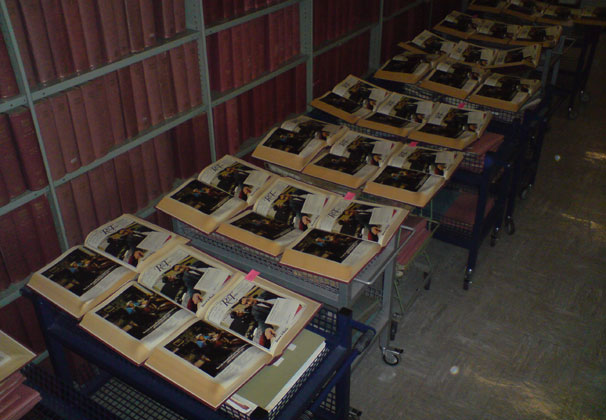
The picture below shows over 20 different editions of Radio Times all for the same week in 1971. 

Stack-of-RT_blog.jpgWhat's next for BBC Genome?

In September we will begin the full-scale project of digitising over 80 years' worth of broadcast records. That's approximately 400,000 pages of Radio Times, 3 million programmes and 300 million words to recognise through OCR.

In less than a year we expect the Radio Times digitisation project to be completed and for the first time there will be, in one place, a comprehensive record of every programme.

What you'll be able to search and discover

Initially, you will be able to search by programme title, by year, day and time. Once we fully populate the database with contributors, programme synopses and other sources of data, you'll be able to find people and places and all the programme records they feature in.

You might well discover during your searches that the programme schedules are not entirely correct. They were, of course, correct when each issue of Radio Times was published, but in the early days of radio and television technical hitches sometimes affected the schedules. Similarly, throughout the BBC's broadcast history, changes in live broadcasts and major events at home and abroad will have meant that the published schedules in Radio Times were not always accurate.

What you'll be able to access

Radio Times is owned by the BBC's commercial arm BBC Worldwide and we currently do not have the rights to show the scanned pages themselves, although we hope we may be able to in the future. However, you will be able to take a journey back in time and rediscover how the BBC's networks and programmes reflect Britain's social history. You can already access some archive materials via the collections featured on the BBC Archive site, and Genome will provide access to additional archive information.

Although the BBC only has about 20-25% of the programmes in its physical archive, this still amounts to more than a million hours of output. Radio Times will provide the programme listing and, once that's done, we will start to provide access to the programmes themselves along with other material such as scripts or photos - which will be especially useful where physical programmes no longer exist or where we don't have the rights to make the programme itself available - and begin to make it all visible from BBC Online.

Making everything available will take time, but the Radio Times programme records will soon create the spine for Genome and are a vital first step in bringing the BBC's broadcast history to life.

One last note: Radio Times was first published on 28 September 1923 and I have referred to the foundation of the BBC in 1922. Using other sources, we do plan to make programme records available from the first ever BBC broadcast on 14 November 1922 when the Marconi transmitting station 2LO was taken over by the BBC. It truly will be a complete broadcast history of the BBC!

Helen Papadopoulos is the Project Manager of BBC Genome

In Their Own Words: British Novelists, from the BBC Archive

Blog comments are currently unavailable. Find out more.

Post categories:

Roly Keating|12:25 UK time, Wednesday, 18 August 2010

This week we've published the latest of our archive collections, In their own words: British Novelists, a selection of interviews with modern writers drawn from the BBC's archive.


In order to see this content you need to have both Javascript enabled and Flash installed. Visit BBC Webwise for full instructions


The collection includes a radio interview with Virginia Woolf from 1937, an astonishingly erudite encounter between Iris Murdoch and Frank Kermode from 1965 and a 2009 interview with Zadie Smith, and offers a remarkable insight into the way writers think and the ways they have been represented by the BBC over the years.


It is the latest in a series of collections that includes stories from survivors of the sinking of the Titanic, the moon landings, British steam trains and the documents behind the creation of Doctor Who.


Some of the archive selections we publish are linked to significant anniversaries, like the loss of the Titanic, but this collection was triggered by the research done for In Their Own Words, the BBC series on writers that is being broadcast this week on BBC Four.


It offers viewers an opportunity to listen to the full versions of the interviews used in the programmes, something that would have been impossible for us to do before the advent of the internet, and shows very clearly how linear programming and non-linear access to material can complement each other, with well-chosen extracts used on air while the full-length originals are made available on the web.


I think it also offers an excellent model for how the BBC can ensure that the archive material we publish reaches its intended audience, with BBC Four curating the raw material that goes into its programmes, offering a context and providing - through the programme itself - an excellent introduction to the material that is available to be explored online.


Putting historically important material online is one of the most significant things that we're offering as we open up the BBC archive, but even that is scratching the surface.


The BBC's record doesn't just include programmes or the raw material that went to make programmes. There are photographs, props, costumes and millions of documents ranging from scripts to contracts to letters from the many people who have worked with the BBC over the years. Some are historically significant, and we want to curate them and make them available. Others may matter only to one person or one family, but they should still be discoverable.


And of course the BBC archive, rich and wonderful though it is, is only one way of looking at our shared history. We are working closely with other cultural institutions like the British Library, British Museum, Arts Council England and of course the British Film Institute in order to harness emerging digital technologies and ensure that as we all make material available online we do so in ways that work together.


We want to make sure that a search for 'Kingsley Amis' finds the material from many different archives and collections, not just the interviews on 'In Their Own Words', and we are working with our partners to ensure that we can all discover, access and engage with archive material, important collections and contemporary culture in a digital public space that is open to everyone.


This will make the internet more valuable for every one of us, and may motivate more people to go online as they realise what is out there for them. We also think that it will create opportunities for commercial development and help to fuel the creative economy, just as the invention of videotape and then DVD created a new market for BBC programmes, one that was not envisaged when television was invented.


If you want to find out more about the BBC Archive, my colleagues Adrian Williams and Richard Wright have been blogging about their work and all three of us have been interviewed for this week's Guardian Technology podcast.


Roly Keating is Director of Archive Content


Asian Network's London Mela

Blog comments are currently unavailable. Find out more.

Post categories:

Mark Strippel|11:19 UK time, Friday, 13 August 2010


In order to see this content you need to have both Javascript enabled and Flash installed. Visit BBC Webwise for full instructions


The video above shows Imran Khan performing 'Amplifier' on stage

BBC Asian Network has reached more than 500,000 British-Asians in the past 12 weeks as part of our 'A Summer Of Melas' season.

I'm pleased at those figures. That's a significant proportion of the entire British-Asian population reached by BBC Asian Network - and we still hope to build on last year's Red Button TV audience of 810,000 with a second programme starting this Monday.

London Mela crowd shot

This special season showcasing the very best in Asian music reached its grand finale last Sunday evening at the London Mela in Gunnersbury Park, Ealing, with Asian Network playing host to a record audience of 92,000. I was backstage late on Sunday evening with Sonia Deol as our Live Broadcast team fired up the audio highlights of an amazing day from the studio of Outside Broadcast vehicle Sound 4, whilst across to my left the Tommy Sandhu hosted Asian Network Main Stage was illuminated by the glow of a West London sunset and a memorable closing performance from The Raghu Dixit Project.

Watch a performance of 'Hey Bhagwan' from The Raghu Dixit Project below

In order to see this content you need to have both Javascript enabled and Flash installed. Visit BBC Webwise for full instructions


I'm often surprised that London Mela ('Mela' is an ancient Sanskrit word for 'gathering' or 'fair') doesn't register more loudly on the Summer Festival radar. 2010 marks the 8th year (and 5th year of BBC involvement) for what is undoubtedly the biggest Asian cultural event in Britain.


There is nothing else quite like it.

London Mela crowd shotLondon Mela is an annual event where British-Asians of Indian, Pakistani, Bangladeshi, Sri Lankan, Afghani and Nepali origin celebrate shared heritage and cultural DNA through music, arts, discussion and cuisine alongside a sizeable non-Asian audience interested in discovering more about a community that three-generations on is deeply woven into the fabric of Britain.

And the thread of commonality that runs through this audience is plain to see.

Since May we have taken BBC Asian Network out on the frontline to meet audiences that the BBC can find hard to reach, from our biggest Mela (105,000 Bengali's at the Baishakhi Mela in Tower Hamlets) to the smallest (15,000 predominantly Pakistani audience in Oldham). We have seen Sikh bagpipers in Glasgow and met Gujarati community groups in Leicester. We know this audience.

Sonna RehleBut it's London Mela which really embodies the purpose of the BBC Asian Network more than any other, and it's a truly stand-out event for the station and the BBC.

The idea behind our London Mela activity is a simple one. BBC Asian Network hosts and programmes a distinct zone in each quadrant across the site. The Main Stage features the best in popular Asian artists for a broad family audience (from Mumzy to Bollywood star Javed Ali) hosted by presenters including Murtz and Noreen Khan while the legendary Asian Network Mix Tent plays host to Nihal and our Specialist DJ line-up.

Asian Network's Mix Tent is a powerful magnet for young Asians and their non-Asian peers.

I watched from the sides as DJ Kayper and Panjabi Hit Squad cut-up Bhangra with Tinie Tempah's 'Pass Out' and was reminded of the importance of the BBC staying connected with this hardest to reach of audiences. We are the only radio station in the UK with a commitment to British-Asian music. And we do it so well that even Tim Westwood and Grime MC JME arrived to pay their respects alongside Panjabi MC in blessing our stage and the Asian audience.

I always take time to scan You Tube after an event to see our BBC activity as viewed from the smart-phone perspective of an audience member or DJ. This is a raw but incredible piece of footage showing the audience in a hot and rammed to capacity Mix Tent. I think it's a sight to behold.

But that's not all we do.

In Conversation TentWe raise the quality of BBC involvement through collaboration, teaming up with BBC London on the 'In Conversation Tent' featuring in depth interviews with musicians and politicians, and with the inaugural BBC Introducing stage. Bobby Friction hosted the first platform dedicated to new British-Asian talent, including several Artists pulled up through our Sony Award winning Friction show. Here's the evidence in action - by providing these platforms and spaces the BBC acts as a creative catalyst for young Asian talent.

We are also reminded that BBC Asian Network connects a national Asian community by our Planes, Trains & Rickshaws challenge. Our presenter Wax managed to attend three Melas in less than 12 hours as he joined London with station activity in Cardiff and Edinburgh (both Mela's happened on the same day) and our Live Broadcast tracked his journey throughout the day.

Almost every inch of this sophisticated platform is supported by our Interactive team - with a live webcast of the main stage, photo galleries updated and a #bbcasiannetwork twitter feed following the day as it happened. Highlights in all areas are filmed for next week's 'A Summer Of Melas' Red Button programme. Asian Network News are out in the field with the audience and backstage with the stars.

Imran Khan on stageRewind back to Sunday evening. I'm by the mixing desks at front of house as our nine-hour Live Broadcast comes to a close backstage and watch the crowds filter through the ranks of Samosa-walleh and Kulfi ice cream vendors towards the car park, hopefully switching on in-car DAB radios to catch BBC highlights of their day. I'm mindful of the fact that the majority of the 92,000 audience won't be able to listen.

British-Asians are less likely to own a DAB Radio than the rest of the UK population. And more than half of the British-Asian population live in London. Re-tuning analogue Asians into digital desis has been a major challenge since Asian Network launched as a digital station in 2002.

I reflect on the reality that this amazing day sits against a backdrop of strategic transition for BBC Asian Network which aims to tackle these platform issues. But I am incredibly encouraged by what I have witnessed this summer.

Watch live performances from Asian Network's London Mela and the rest of our 'A Summer Of Melas'.


Mark Strippel is Head of Music & Events, BBC Asian Network

BBC Internet Blog - HTML5, open standards and the BBC

Post categories:

Laura MurrayLaura Murray|10:08 UK time, Friday, 13 August 2010

"Open standards have always been part of the BBC's DNA. They are fundamental to driving market innovation and will always be important to the BBC's mission to introduce the benefits of new technology to society. Open standards have the ability to transform our lives for the better".


Over on the BBC Internet Blog Erik Huggers, Director of BBC Future Media & Technology, discusses HTML5, open standards and the BBC's use of Flash on BBC iPlayer and across BBC Online.


To read the blog in full and make a comment, head over to the BBC Internet Blog.


Laura Murray is Editor of the About the BBC Blog


BBC Online - Putting Quality First

Blog comments are currently unavailable. Find out more.

Post categories:

Erik HuggersErik Huggers|12:23 UK time, Wednesday, 11 August 2010

In March this year, the BBC announced a new strategy - Putting Quality First. These proposals, which are subject to BBC Trust approval, chart a new long-range direction for the BBC and would enable the BBC to deliver on its public purposes in the digital age. Central to this strategy is a proposal to transform BBC Online.


In its initial conclusions on strategy review, the BBC Trust said they "endorsed" the proposed budget reduction for the service, but wanted to "understand and approve the editorial changes involved".This work has now begun, so while I'm not able to outline changes in precise detail today, I hope this gives a sense of where we intend to take BBC Online as a whole.


I'm proud of what this organisation has created online. One of the first "traditional" media companies to embrace the web, I continue to be impressed with its ability to innovate and BBC websites such as News, Sport, iPlayer and others are highly valued by our audiences.


But the service as a whole has sprawled. In striving to stay relevant, we have sometimes not been clear enough about our limits and boundaries. We're getting a better sense of what BBC Online should be for and I believe it's possible to make the service better with less.


Many of you will be familiar with the headlines of the Strategy Review. By 2013, we propose a BBC Online that:


• Does fewer things better, against the BBC's five editorial priorities

• Has half the number of top-level directories (i.e. /sitename) down from the 400 we have today to 200

• Costs 25% less (i.e. the BBC Online Service Licence for 2010/11 is £135m - we intend to cut spend to £100m)

• Will send double the traffic we currently do to other websites, helping the broader UK digital economy


While it's natural that people focus on the 25% and which directories will go it's worth noting that this strategy is not called "Retreating From the Web" or "Cutting BBC Online". This is because the web is an important part of our future.


Today, around 70% of UK homes have broadband and we expect this number to rise to 90% by 2012. So in just two years the internet will have taken its place as the nation's third medium, available in almost as many homes as TV and radio.


Beyond the home computer, mobiles are already the primary point of web access for many people. With innovation from companies such as Apple, Google, Sky, Virgin, Project Canvas (in which the BBC is set to become a shareholder) and others - this may soon be true for the TV set.


As a public service media company, it's essential that we move with our audiences, but while we reach 84% of the population on TV and 73% on radio, our online reach lags behind at just 54%. Continued sprawl is not the answer; we need a focused service that gives audiences the content and services they want at their fingertips, meets our public purposes in the digital age and leaves space for others to thrive.


From building websites to managing products


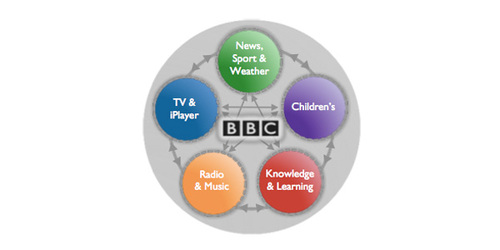
The image below gives you an idea of what we are trying to achieve.
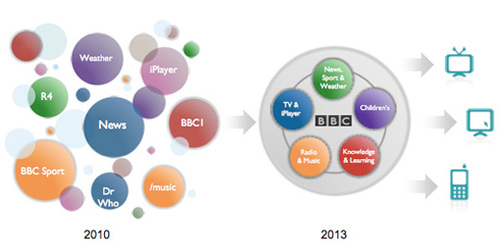


1.jpg

BBC Online started with text-based journalism on the web - similar to the service on Ceefax. Then, as the web began to mature, new media budgets were given to the BBC's divisions to go and build websites that aimed to meet our public purposes online - but with no central strategy.


Our first major change will be a shift from "building websites" to "managing products".


First I want to explain what we consider to be a "product". It's a self-contained entity within BBC Online, which unites technology and editorial to meet a clearly defined audience need. Each product has a simple and concise proposition that's easily understood by the audience, is kept up to date, fits the overall strategy for BBC Online and has clear editorial leadership.


It's a strategic approach for the service as a whole - framed by what our audiences need from the web, rather than what we produce today for TV and radio - a change in culture for BBC Online.


Audiences will see products organised into five content areas (portfolios) supported by a common technical platform.


Powerful functionality to help audiences find great content and services


Before I talk about the proposed portfolios, a word on what's going to be common across the site.


2.jpg

Under the current structure, people come to BBC Online from a range of different places, get what they are looking for and leave. By making other content elsewhere in the site easier to search for (or navigate to) we offer better value for money as audiences uncover interesting content and services that they may not have been looking for.


While the homepage provides an overview of what the BBC does, most people don't come through our front door. In addition to search, navigation, and consistent design, social functionality through BBC iD can harness the power of recommendation on networks outside the BBC.


Underpinning all of this, we'll have a common technology platform powering the whole service delivering economies of scale and cost-saving technologies such as programme-page automation.


The platform allows the service to be location-aware, providing the right content in the right language to users across the UK and globally. Dynamic content publishing makes it simple and cost-effective to repurpose content for use in mobile or TV applications and world-class accessibility features aim to build on the pioneering work the team has done to bring subtitles to BBC iPlayer.


Finally, the platform houses the BBC's rich archive content: video and radio programmes, the written archive, programme information and more can be stored and in time be made available through all the product portfolios. This is a major project that will take years to complete, but we are putting the building blocks in place now.


A commitment to deliver the best online journalism in the world


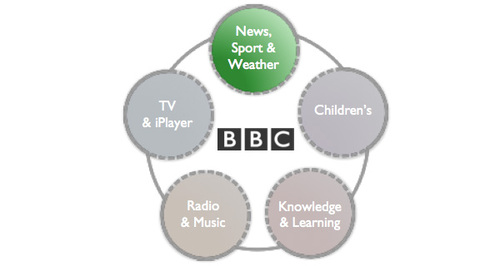
The first proposed product portfolio is News, Sport and Weather. BBC journalism stands for quality, impartiality, accuracy and distinctiveness - a major reason why the BBC as a whole is one of the most trusted and respected organisations in the world.


3.jpg

News, Sport and Weather will remain a cornerstone of the BBC's web offer, partly because the immediacy of the web lends itself well to journalism. Each will remain pillars of BBC Online, delivering the best journalism in the world for the UK and in national and global editions.


As video on the web comes of age, we intend to further enrich our web journalism with audio-visual content - drawing on our strengths in broadcasting. Already we're making progress here with the recently redesigned BBC News site and the BBC News smartphone application.


But our News, Sport & Weather products need to do a better job of sending traffic elsewhere, both internally (e.g. sending sports journalism to BBC Radio 5 Live or weather forecasts to science & nature) and beyond. Already the BBC is the second biggest referrer of traffic to online newspapers, something we want to do even better.


And sport will make a major contribution to our fifth editorial priority - major events that bring the nation and communities together. We're committed to creating compelling editorial partnerships for London 2012, and beyond.


Outstanding children's content in a safe online environment


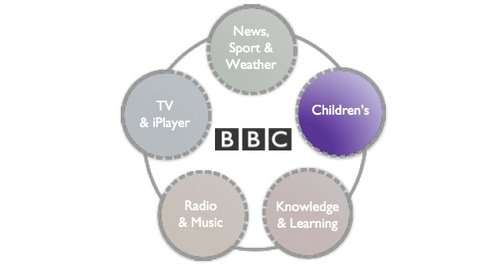
Providing outstanding children's content is another of the BBC's five editorial priorities and we will continue to deliver this in a safe, social environment.


4.jpg

As we recently announced, our FM&T product team will be joining BBC Children's in a new digital hub in Salford. The CBeebies and CBBC brands have been a huge success, and our online proposition will build stronger bridges between the two. BBC Children's will use their unique knowledge of this audience to provide links to other BBC content such as news and learning.


As children enter BBC Online through an environment familiar to them, they can quickly access a broader range of content to expand their horizons.


Knowledge & Learning to become a cornerstone of a new-look service


Despite the internet's roots as an information tool, the BBC has been a pioneer in online knowledge and learning. We have developed compelling online content for learners and teachers, and created some well-known online learning brands (such as Bitesize) in the process.
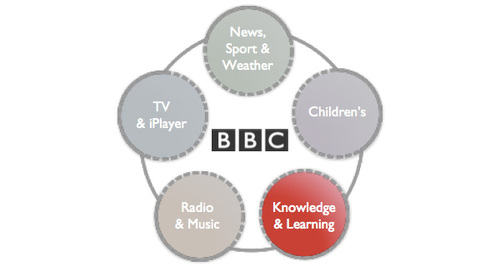
5.jpgThis new portfolio aims to replicate the success of News, Sport & Weather. We intend to enhance informal learning by creating a mix of original and archive knowledge content, focused on key areas of BBC expertise - and create distinctive formal learning propositions for two age groups: under and over 19s.


By bringing these two important areas together, presenting them clearly and coherently, and making the content easier to find and navigate to from elsewhere in the site, we intend to make knowledge and learning another cornerstone of the reshaped BBC Online.


Bringing radio & music together in one portfolio


Our Audio & Music division has been incredibly innovative in embracing emerging digital technologies, such as podcasts, live online listening, and creating an in-depth music offer, many music events websites and rich radio network websites.
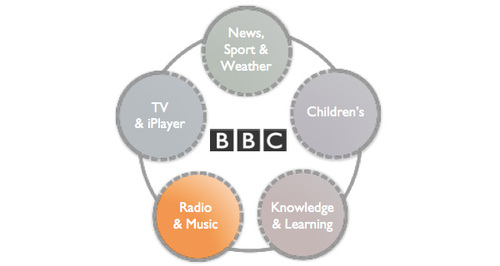


6.jpgBut BBC radio and music online remains highly fragmented and the audience doesn't move between websites as much as we'd like, or to elsewhere in BBC Online.


We intend to bring together all BBC radio and music - including network, local and nations, news, events and archive - in one coherent online package. And true to the live and interactive principles of radio, we'll focus on social media to interact with our audience in real-time.


Harnessing the passion and knowledge of BBC experts, our aim is to continue as a music tastemaker and become a hub for online music discovery - but with strong integration with Radioplayer, internal linking, and links to external music sites to broaden horizons.


A coherent TV proposition, to build on the success of BBC iPlayer


The BBC iPlayer has been a great success for the BBC, making online video consumption a mainstream activity for millions of people. At first a TV catch-up service, it's evolved into an online product for live and on-demand BBC radio and TV content.
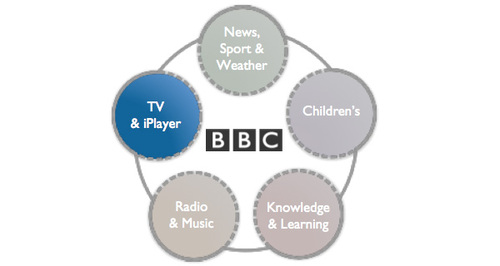


7.jpgBut as in radio and music, the journeys for audiences looking for video content can be confusing, with multiple entry points through automated programme pages, the archive site, bespoke channel and programme sites, drama and comedy and the BBC iPlayer itself.


We intend to create a coherent TV & BBC iPlayer proposition, pulling all these TV propositions together, optimised to help audiences find, watch, share, and interact around our TV-related output.


Not only will this new-look portfolio be richly interconnected with BBC Online's other four product portfolios, but we'll be sending traffic to services outside the BBC through the metadata partnerships announced at the launch of the new BBC iPlayer beta in May.


Broadening audiences' horizons - aiding content discovery beyond the BBC


One of the wonders of the web is its ability to inform, educate and entertain every person in the world, right down to the exact specific interests they have. It truly is a platform that can be customised for anyone.


But the BBC cannot and should not do everything.


In news, rival media outlets will take a different editorial position on the news agenda. There's an inherent public service in highlighting these other points of view.


Other cultural institutions, such as the British Museum and British Library have rich and different web content than we are able to provide, and equally, there's little value in the BBC duplicating the public service information on offer elsewhere. We can work together to create compelling public service partnerships.


Collectively, these new portfolios would combine to create a far more focussed, smaller, higher-quality BBC Online that will serve our audiences well, leave plenty of room for others and double the traffic we send externally by 2013.


Today, I've updated the BBC staff on our intentions for the service. By properly harnessing the incredible talent we have in this organisation, I believe we can make BBC Online an even better service for our audiences, and spend less in the process.


Erik Huggers is Director of BBC Future Media & Technology




RAJAR radio listening figures out today

Blog comments are currently unavailable. Find out more.

Post categories:

Margo SwadleyMargo Swadley|10:33 UK time, Thursday, 5 August 2010

In an age when we have so much media competing for our time, it is a testament to radio that more of us than ever are listening to it. Reach for quarter 2010 was at an all time high with 46.8m people listening weekly.


My name's Margo Swadley and along with my team at the BBC, it's our job to analyse the radio listening figures that are released every quarter by the industry body, RAJAR.


April to June 2010 figures out today show that it's been a strong quarter for radio and for BBC national speech networks in particular. No doubt the general election and World Cup helped attract listeners - Radio 4 and 5 live both hitting their highest ever weekly reach (10.4m and 6.8m respectively). Reach being the number of people who listened to a station for more than 5 minutes each week.


It was also a strong quarter for commercial radio with significant increases in reach for both local and national commercial.


From quarter to quarter we are continuing to see a growth in digital radio listening. Digital radio reach is now at 38.7% and DAB radio reach is at 23.5%. On the digital only stations, 6 Music, Asian Network and Radio 7 were all up on last year's listening figures.


Claimed mobile listening was steady on the quarter, but with the introduction of live radio listening on mobiles, we'll be watching it closely over the next few quarters.


Margo Swadley is Head of Audiences for Audio & Music


About this blog

Senior staff and experts from across the organisation use this blog to talk about what's happening inside the BBC. We also highlight and link to some of the debates happening on other blogs and online spaces inside and outside the corporation.

Here are some tips for taking part.

This blog is edited by Jon Jacob.

Subscribe to this blog

You can stay up to date with About the BBC via these feeds.

If you aren't sure what RSS is you'll find our beginner's guide to RSS useful.

[an error occurred while processing this directive]

Follow this blog

Other BBC blogs

More from this blog...

Categories

These are some of the popular topics this blog covers.