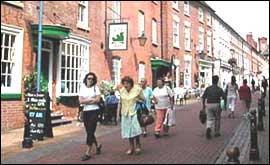
|  | "You do guided tours of Wolverhampton?" someone said to me incredulously the other day. "How long do they take, five minutes?"
"No, I explained, its difficult to do much in under an hour. Two is better."
 | | Ian Jelf |
And thats the problem with being a tour guide in places not readily associated in tourism. People dont take you seriously. Unless, of course, you can convince them to come one on of these walks (I prefer that term to "tours", which smack of herding disinterested people around things they dont want to see; I deal with "visitors", not "tourists"). Like anywhere, Wolverhampton has a fascinating past (and an optimistic present) and, to try and prove that to you, lets take an imaginary "on-line" stroll around just one part of it
. Wolverhampton began as a small Saxon Settlement called "Heante Tun", meaning the "High Enclosure". But, in the year 994 it received a Charter from King Ethelred the Unready at the behest of a local noblewoman, Lady Wulfruna. Subsequently, the settlement was known as "Wulfrunas Heane Tun", which became "Wolverhampton". 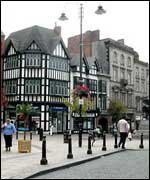 | | Queen Square |
The town remained important through the Middle Ages and as a religious and market centre, but it was really with the coming of the Industrial Revolution that development really began to take place. The towns population rocketed, based on heavy industry, brewing and lock-making. To celebrate the fortieth anniversary of her accession to the throne, HM The Queen announced that she was conferring the status of "City" upon the Borough of Wolverhampton. Our wander around the City Centre begins at Queen Square. This was known as the "High Green" until the visit of Queen Victoria to the town in 1866, to unveil the statue of Prince Albert in the centre.
It was her first public appearance following the death of Prince Albert five years before and surprised many people. Local people have all sorts of stories about the statue, including that the sculptor committed suicide as the horses legs are shown incorrectly; none of these stories are true, though! 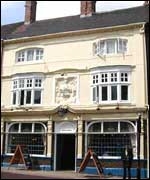 | | The Old Still Inn |
A stroll around the corner brings us to the amazingly intact Georgian King Street, restored in the 1980s after many years of semi-dereliction. A lovely old pub called The Old Still Inn stands at the end. This was the childhood home of Dame Maggie Teyte (1886-1976), a Wolverhampton girl who became a world famous opera singer. Our next stop is Queen Street, lined with several interesting buildings. Although Snapes Tea Shop, a real Wolverhampton institution is no longer in business, there are still several interesting buildings here. Here, for example, are the headquarters of the Express & Star, one of the most widely read provincial newspapers in Britain. The newspaper, which pioneered new print technology in the 1980s, was actually founded by the Scottish-American philanthropist Andrew Carnegie to further his republican cause. 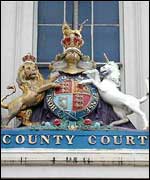 | | County Court Royal coat of arms |
Further along the street, the former County Court Buildingwith its magnificent Royal coat of arms was built in 1813 as Wolverhamptons first subscription library. The upper floor (the assembly Rooms) was added later. The Dispensary (1828) dispensed medication to deal with unsanitary condition in the town in the 19th century, including the Cholera epidemics of the 1830s and 1840s which swept through the area. The Mechanics Institute (now the Army Careers Office) was what we would now call an Adult Education Centre and home to the towns first free Library. Opposite the end of Queens Street is the former Birmingham & Shrewsbury Station (now officially known as the Queens Building). This was built in 1851 by the Birmingham & Shrewsbury Railway Company (later LNWR, later LMS) as the entrance to their High Level Station. After being derelict for many years, it now houses the travel information centre and café for the Bus Station. 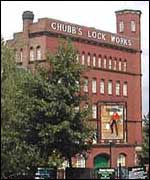 | | The Lighthouse |
Just off to the left is the former Chubb Building, now known as The Lighthouse Arts Centre. South Staffordshire, especially Wolverhampton and Willenhall, have long been associated with the lock-making industry. In 1898, Chubb & Sons built this imposing red brick works to the designs of a well-known and prestigious London architect, C. H. M. Mileham. Today it has been converted into a cultural and media centre called "The Lighthouse", complete with cinema, exhibition hall and a wonderful roofed over atrium. Continue the 'walk' on page 2 |