| 13 November 2014 |

| |
| BBC Homepage | | |
| |||
| Contact Us | | |
Local HistoryYou are in: Black Country > History > Local History > Stourbridge caverns close 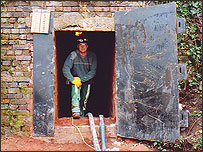 Entrance to the caverns Stourbridge caverns closeBy Brett Birks The famed archaeological site under the ring-road is being filled with sand and sealed off due to fears about its stability. See photos! The sandstone caverns, which date back to 1850, were used by the local community as an air-raid shelter during the Second World War. Located beneath Duke Street and the King Edward VI Grammar School, the tunnels have raised safety concerns after recent inspections found their structure had been weakened by water build-up. 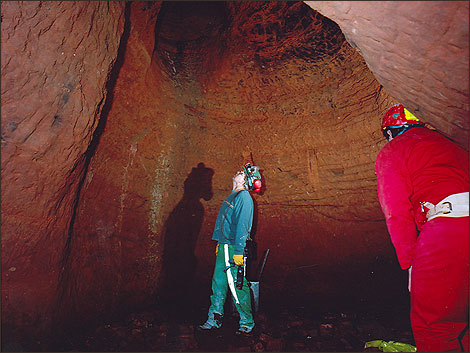 Look up - inside the caverns Consequently, Dudley Council have opted to fill in the caverns with sand and seal off the site, for fear that their instability may threaten the three lane ring-road above. Project Manager Roger Morgan, who's in charge of the operation, said: "The caverns are unique to Stourbridge and part of local history. We are trying to protect local heritage but have to be mindful of health and safety and public protection. "The environment in the caverns has changed. There has been a build up of water there resulting in deterioration. This water would prevent us from carrying out future inspections and there is potentially an impact on road users should the tunnels collapse." 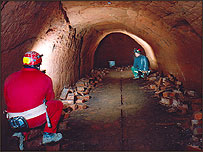 Engineers at work HistoryThe caverns were built in 1850 underneath the old North Worcestershire Brewery which rested on the site. When the brewery closed, North Worcestershire Glassworks made use of the tunnels until they were filled with ash after the First World War. In 1939, the council and local community cleaned out the site and built new access points transforming it into a 1,000 seat air raid shelter. Pupils from Kind Edward VI made use of the facilities during air-raids in the early 1940s. After the war, the caverns – which consist of a linear 50 metre corridor and nine 15m long rooms either side - were closed and abandoned. They were rediscovered in the early 1990s by local engineers and have become an area of great archaeological interest. 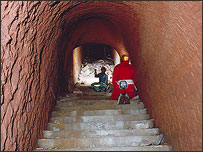 The entrance FutureDespite being sealed off and closed, Roger Morgan insists that by not using concrete fill-in, there is potential for the tunnels to be re-opened in the future. "We are installing natural sand into the tunnels because we are very mindful of their historic value," he said. "We are not using concrete. The sand is clean and natural and can easily be flushed out. This way perhaps future generations may be able to dig it out and go back in. "At the moment, it's just so difficult for us to secure the heritage money that would be necessary to maintain the caverns so the decision was made to close them." 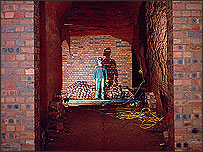 Air raid shelter Archaeologists from the University of Birmingham were allowed into the tunnels prior to their closing. They conducted extensive laser research which they hope will lead to the production of a three dimensional virtual recreation of the caverns. Dudley Council aims to have completed work on sealing off the Stourbridge caverns by January 2009. To see more photos of the Stourbridge caverns, click the link below:last updated: 01/12/2008 at 15:00 SEE ALSOYou are in: Black Country > History > Local History > Stourbridge caverns close |
| | About the BBC | Help | Terms of Use | Privacy & Cookies Policy |