| 28 October 2014 |

| |
| BBC Homepage | | |
| |||
| Contact Us | | |
AlbionYou are in: Black Country > Sport > Football > Albion > WBA FC history 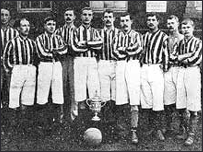 Victorious versus Villa: WBA FC 1892 WBA FC historyWest Bromwich Albion are one of the oldest and proudest names in English football aswell as being members of a select group of clubs to have won all three major domestic honours. The club formed in 1878 as West Bromwich Strollers changing to West Bromwich Albion in 1881. In 1888, Albion joined neighbours Aston Villa and Wolverhampton Wanderers as founder members of the Football League. That year saw them reach the FA Cup Final for the third season running and, after losing the previous two, beat Preston to take the trophy for the first time. The Cup was won again in 1892 – a three-nil victory against Villa. The following year, 1893, provided at least one memorable fact for Baggies fans of all vintages: Albion beat Wolves 8-0 at Molineux in a league game, a record win against the old enemy that is unlikely to be surpassed. Picking out one or two other nuggets before the end of the First World War: in 1900 Albion moved to The Hawthorns with the first game ending 1-1 against Derby County whose England player Steve Bloomer scored the first goal with Charlie Simmons equalising; and in 1903 Jessie Pennington joined the club for whom he made almost 500 appearances between 1903 and 1922. In 1920, WBA won the league title for the first time totalling 60 points and scoring 104 goals, 37 of those for top scorer Fred Morris. Two years later, The Hawthorns staged its first international game which ended England 2 Northern Ireland 0. 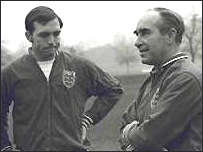 Jeff Astle with Alf Ramsay In the 1935-36 season, WG Richardson scored a record 40 goals for the club, 39 of them in the league. Coincidentally, goals seemed to be going in at the other end when - a year later - the Baggies suffered a 10-3 record league defeat at Stoke City. In 1950, Albion enjoyed happier dealings with the Potteries when Ronnie Allen signed from Port Vale for £20,000 before scoring on his debut against Wolves. The magnitude of that fee is highlighted by considering in 1957, WBA installed floodlights at The Hawthorns at a cost of £18,000.  Tributes to Astle from fans Another memorable signing came in 1964 when Jeff Astle arrived from Notts County for £25,000. Astle “The King” went on to become one of the club’s finest goal-scoring strikers. He scored 174 goals in 361 senior appearances for the club. None of his goals were more important than the winner in the 1968 FA Cup final which not only secured his status as a West Brom great, but also guaranteed him a place in FA Cup folklore as he became the first player to have scored in every round of the competition in one season. Astle died in January 2002. 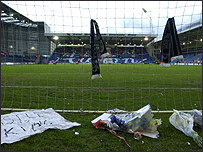 Tributes to Astle - The Hawthorns The 60s also marked the emergence of Tony “Bomber” Brown, another prolific marksman for the Baggies. In truth, the two England internationals were rarely off the scoresheet as Albion made Wembley their second home, reaching the League Cup Finals of 1967 and 1970, and winning the FA Cup for a fifth time in 1968 when Astle’s extra time winner saw off Everton. The Baggies had completed a full set of domestic honours in 1966 when they won the League Cup in a two-legged final against West Ham United. The club lost its top flight status in 1973 before returning under the guidance of player-manager Johnny Giles who, along with successor Ron Atkinson, re-established the Baggies as a major force. This was a new era of entertainment at The Hawthorns with the "Three Degrees" of Cyrille Regis, Laurie Cunningham and Brendon Batson starring as the first high-profile trio of black players in the domestic game. Worse followed with a 4-2 FA Cup humiliation at the hands of non-league Woking in 1991 and relegation to Division Three. The renaissance engineered by Gary Megson, however, saw Albion back in the top flight in 2002 as the club started to come to terms with a changed footballing landscape precipitated by the creation of the Premier League in the early 1990s. Sadly Albion were relegated from the top flight in 2006. After finishing fourth in the league the following season, they reached the Championship play-off final, but just lost out 1-0 to Derby County at Wembley. last updated: 12/03/2008 at 14:06 You are in: Black Country > Sport > Football > Albion > WBA FC history |
| | About the BBC | Help | Terms of Use | Privacy & Cookies Policy |