What is duration?

The length of time each note is played for. is the length of time each note is played for.
You can have notes that are long or short in duration.
When you combine notes of different durations, you can create a A pattern of sounds of different durations..
Listen carefully to this opening of Beethoven's 5th Symphony:
There are four notes. Can you describe the duration of each of those notes?
It has three short notes followed by one long note.

How do you change the duration of a note?
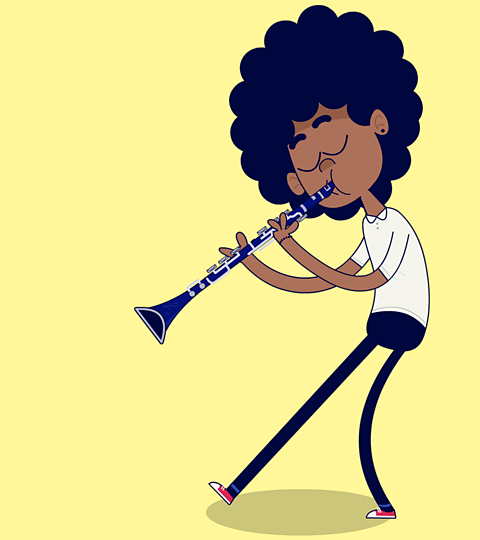
You can change the duration of a note in different ways, depending on the instrument you are playing.
To play a long note on a A musical instrument that you blow into such as a flute or clarinet. or Musical instruments made out of brass like a trumpet or trombone. instrument, you have to keep blowing into it.
On a piano, the duration of a note depends on how long you press down the key.
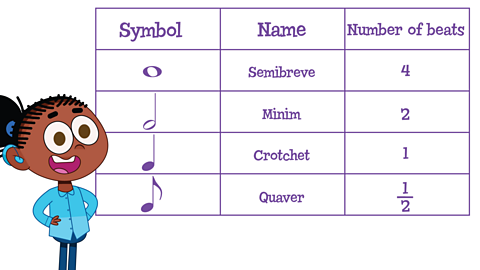
In music notation, there are symbols that tell us the duration of the notes.
Each symbol tells us to play a note for a different duration - by learning these symbols, we know how long to play the note for.
What is tempo?
The tempo is the speed of the music. It is how fast or slow the pulse is.
It's measured in beats per minute (BPM).
- 60BPM is one beat per second.
- 120BPM is two beats per second.
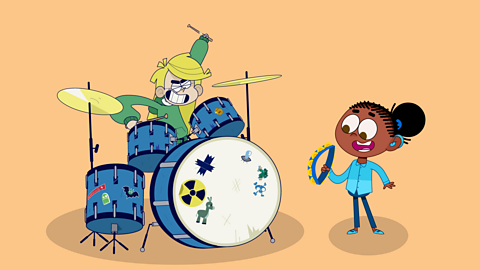
Different styles of music often have different tempos.
Usually a slow or sentimental song. often use a slow tempo. Dance music has a faster tempo that might make you want to get up and move.
Describing tempo
You will often see Italian or German words used to describe tempo.
The tempo of the music can be fast (allegro) or slow (adagio) or anything in between.
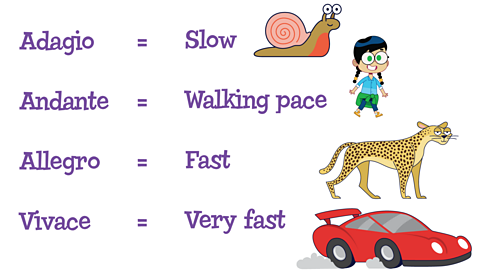
Composers sometimes like to change the tempo in a piece of music. It helps them change the feel of the music.
- If music gets faster this is called accelerando.
- If it gets gradually slower it is called ritardando.
Watch: Duration and tempo
Watch Lightning Jelly learn more about duration and tempo from Beethoven.
See if you can spot some of the words used to describe tempo.
GIRL 1: Hey! We’ve really got a beat going now!
BOY 1: HUH? My beats don’t sound quite right. What’s going on?
GIRL 1: Beats me!
GIRL 2: I told you guys we could do it. Our song is going to knock Mr. Piper’s socks off!
GIRL 3: Too bad it’s about as exciting as his sweatshirts.
BEETHOVEN: SILENCE! That does not sound like my fifth symphony. YOU need duration and tempo!
BOY 1: Beethoven! I… I was just…
BEETHOVEN: SILENCE! Let me explain… Now THIS is Beethoven’s fifth symphony, short short short LOOOONG!
BOY 1: AH, so the notes are different lengths?
BEETHOVEN: Speak up, mister whisper! I’m a trifle deaf.
BOY 1: I said the notes are…
BEETHOVEN: SILENCE! The notes are different lengths. Some are short and some are LONG!
GIRL 1: Okay, I got it! So… short.
GIRL 3: And long…
GIRL 2: So that’s duration but what about the other thing, tempo?
BOY 1: Oh! I know this! Tempo is the speed of the
BEETHOVEN: SILENCE! Tempo is the speed of the music. And to demonstrate meet my friend Zorba the Greek!
GIRL 3: Zorba the who?
BOY 2: Ooh! I know that one! It’s nice and slow.
ZORBA: Adagio! But it doesn’t stay that way for long! The tempo speeds up. Accelerando!
BEETHOVEN: Now we are playing really fast! The term for that-
BOY 1: SILENCE! The term for that is ALLEGRO!
BEETHOVEN: Haha! I like you!
GIRL 2: Hey Beethoven, what’s your favourite fruit?
BEETHOVEN: BA-NA-NA-NAAAAAAA!
Activities
Race Across the Continents game - new update! game
Help this team of adventurers race their way to victory. Explore the globe in this exciting game update to discover new audio voiced by Ade Adepitan and fun animations. Challenge yourself with brand-new achievements and become a high-flyer!

More on Playing and Performing
Find out more by working through a topic
- count4 of 4
- count1 of 4

- count2 of 4