How does a flower reproduce?
Each part of a plant has an important job to do, from the roots to the shoots, to the leaves and even the flower.
Flowers aren’t just the part of a plant that looks pretty, they actually play a key part in the life cycle of a plant.
To understand how, we need to understand three important things:
- pollination
- seed formation
- seed dispersal
Pollination
Flowers are full of pollen which is a yellow powder that you find in the centre.
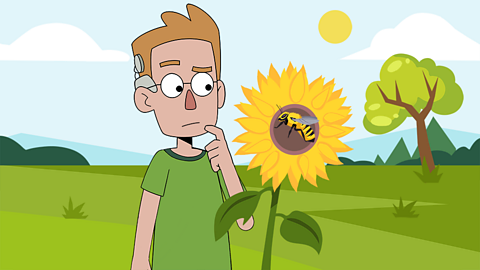
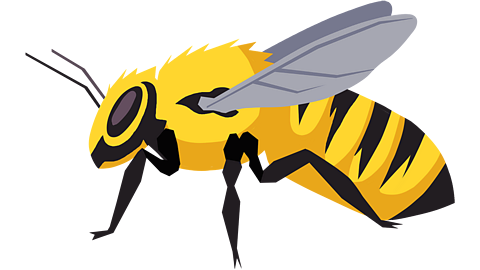
To make a seed, a flower needs to be pollinated. This means that the pollen from one flower needs to travel to another flower. This is usually done by insects such as bees, which climb inside the flower to get to the nectar and pollen to take back to their hive. They are called pollinators.
The bees then fly to a different flower to get more nectar taking the pollen from the other plant with them. The insects are attracted to a flower by its brightly coloured petals, its sweet smell and its tasty nectar.
Flowers produce seeds
When pollen has moved from one flower to another, the flower that loses pollen will start to die. It no longer needs its colourful petals, scent or nectar. But before it dies, the flower will produce seeds.
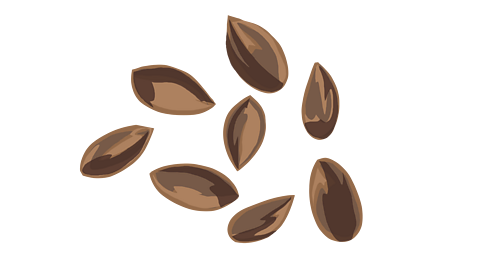
Seed formation
When the pollen from two different flowers mixes together, seeds can be created. The flower that has lost the pollen begins to die. It no longer needs it colourful petals, scent or nectar.
The flower that the pollen was taken to will produce seeds. Some seeds might be used by people to make food, like corn and oats that are used to make bread and cereals.
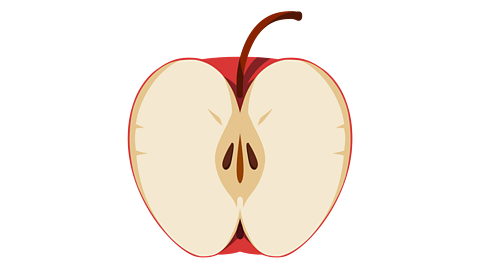
Some seeds are surrounded by fruit such as apples, plums and pears. Others might be spread by the plant to create new plants.
Seed dispersal
Plants need their seeds to be spread to different places so that more plants can grow and they won’t be competing for water, light or nutrients. When the seeds of a plant are spread to different places this is called seed dispersal.
However a seed is spread, it will germinate and grow into a new plant when the conditions are right.
Why are bees so important?
Pollinators, like bees help plants to reproduce and this is really important for all living things on our planet. To encourage bees to visit them, flowers have colourful petals and an attractive scent. Some flowers give the bees a sugary reward called nectar too.
Watch: The journey of a bee
Follow the journey of these bees as they pollinate flowers.
Plants can’t move. They need bees to spread their pollen and help make new seeds.
Bees love nectar. So flowers offer up their nectar as a reward for visiting them.
And they’ve got many ways of showing what's on offer.
Bees find the smell of flowers rather lovely.
Not to mention their amazing shapes.
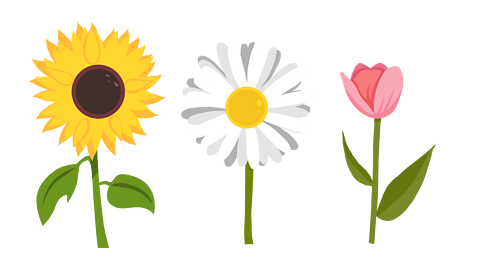
From flat sunflowers… …to tube shaped honeysuckle.
And they can't resist the wonderful colours of flower petals!
Most of the food humans eat comes from plants.
So bees are important for us too.
Fruit grows from a pollinated flower and vegetables from all sorts of… well, vegetation.
We even need plants so that animals we rely on for meat, cheese and eggs have something to eat.
These plants rely on bees to reproduce.
Without bees, very soon we’d have very little food.
So next time you see a bee, just let it buzz about and find a flower.
You might even want to plant your own flowers to help them out too.
Fascinating facts
It’s estimated that more than 70% of the flowering plants on Earth need pollinators to produce fruit and seeds.
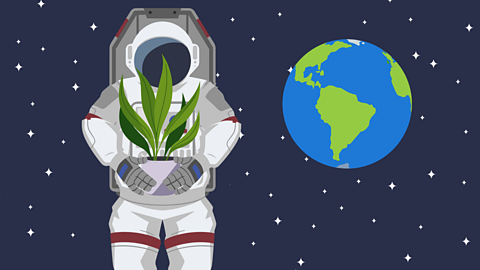
Plants don’t just grow on Earth, they are even being grown in space! Scientists aboard the International Space Station often conduct experiments to see how being in space affects the growth of plants.
Bees communicate by moving in specific patterns. They beat their wings rapidly to make noise, and release pheromones which leave chemical messages for the other bees in the colony. When they do this, it can look like the bees are dancing!
Beetles pollinated the very first flowering plants many millions of years ago at the time of the dinosaurs.
Most plant life begins life as seeds, but some like onions and potatoes start as bulbs.
Plants that are pollinated using the wind grow in large tight groups to increase their chances of reproduction.
All animal life relies on plants for either oxygen, habitat, shelter or food.
Almost all plant life on Earth depends upon photosynthesis for food.
Types of seed
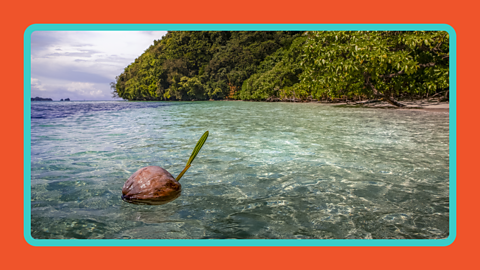
Image caption, Plants growing near a river or the sea may use the flowing water to transport their seeds.
Coconuts are seeds which are spread by the sea. Some seeds also float and can be carried away from the plant they grew on by a stream or a river, to wash up somewhere new to grow downstream.
1 of 6
Did you know?
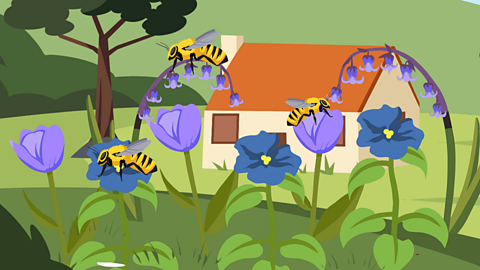
Bees can see in colour, and are really good at spotting the colour flowers that they like the most.
Bees love purples and blues and find it tricky to see red flowers.
This means that a garden full of purple flowers will have more bees visiting that a garden full of red flowers!
Spreading seeds
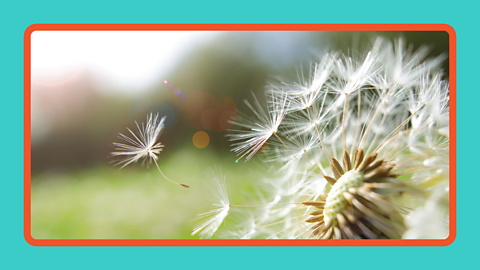
Plants spread their seeds in lots of different ways. This is called seed dispersal. Some seeds are transported by the wind and are shaped to float, glide or spin through the air.
Watch: How flowers spread their seeds
Discover the different ways plants spread their seeds.
A seed contains everything a new plant needs to start growing. The moment a seed starts to grow is called ‘germination’.
Some people plant seeds in pots or in gardens to germinate.
Plants in the wild have many different ways of scattering their seeds, this is called ‘dispersal’.
The wind disperses lots of seeds that are light or can catch the breeze. But only some find a good spot to germinate.
Some plants use water to disperse seeds that float. These seeds can be carried downstream to new germination spots.
Some seeds grow, safely protected in fruit. When animals or birds eat the fruit they also swallow the seeds.
So when that happens, the seed is dropped somewhere new.
Some seeds get tangled or stuck in fur or feathers, then fall off later in a different place.
Seeds are dispersed in amazingly different ways so the next generation of plants can grow and flourish.
Did you know?
Nearly 90% of all wild plants need animal pollination to reproduce!
Important words
Dispersal – When the seeds of a plant are spread to different places, this is called seed dispersal.
Flowers – Flowers are brightly coloured to attract insects which then pollinate the seeds and help it to reproduce.
Fruit – Some plants produce fruit, which also contains seeds, that attracts animals to eat it and deposit the seeds somewhere else.
Germinate – This is the process of a plant first starting to grow.
Life cycle – When a plant grows from a seed or bulb into a mature plant, goes through the process of seed formation and dispersal before eventually dying.
Pollination – Flowers are full of pollen, which is a fine yellow powder found in the centre and is used when plants reproduce.
Pollinator – To make a seed, a flower needs to be pollinated by an animal, such as a bird, a bat, a bee or a butterfly.
Reproduce – The process by which new plants are created from one or more parent plant.
Seed – The part of a plant that reproduces to grow into a new plant.
Seed formation – When the pollen from two different flowers mixes together, then seeds can be created.
Seed dispersal – When the seeds of a plant are spread to different places.
Activities
Activity 1 – Order the pollination process
Activity 2 – Bees and flowering plants quiz
Activity 3 – Pollination activity sheet
New game! Horrible Science: Stinky Space. game
Join Pipette on her epic mission and learn some revolting facts about space along the way.
More on Plants
Find out more by working through a topic
- count1 of 6
- count2 of 6
- count3 of 6
- count4 of 6