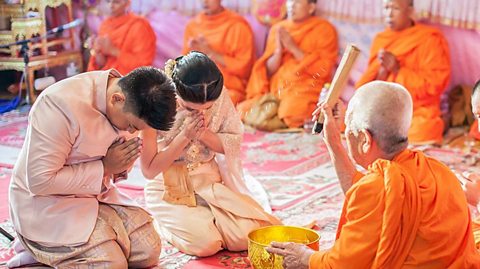
Key points about Buddhism, peace and conflict
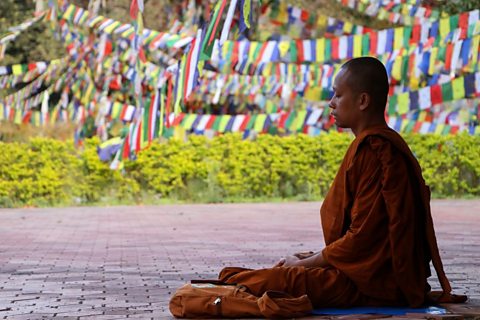
A Sanskrit term meaning ‘non-harm’, used in Buddhism, Hinduism and Sikhism. is a key principle in Buddhist ethics and is expressed in the first of the Five Moral Precepts: to avoid harming any living being.
Nothing in the Buddha’s teachings supports the use of violence to resolve conflict and most Buddhists would strongly oppose aggression, terrorism, declarations of war and the use of weapons of mass destruction.
Many Buddhists believe there is no justification whatsoever for use of weapons or violence. However, there have been instances where Buddhists have engaged in war and violent protests.

Remember
Rather than rules, the Buddha gave his followers ethical principles such as the Five Moral Precepts. There are many traditions within Buddhism, with varying versions of his ethical principles, including those found in the thematic study of religion, peace and conflict. Individual Buddhists are responsible for their personal interpretations of these principles.
Key concepts in religion, peace and conflict
The key terms below will appear repeatedly through the theme of Buddhism, peace and conflict.
Religion, peace and conflict key terms quiz
For your exam on religion, peace and conflict, it is important to know the definitions of key terms. Take the quiz below to test your knowledge.
War
Causes of war
War is an organised conflict, usually consisting of intense violence carried out by one state or states against another state or states.
The causes of war and conflict are often complicated and interlinked. Buddhist teachings say they may include one of these three elements:
- Greed: Buddhist teachings warn against greed. It is one of the Three Poisons that the Buddha taught lay at the root of all human suffering.
Self-defence: Self-defence would be accepted by many Buddhists as a justification for an armed response in some situations, especially if a country were under attack. Many traditionally Buddhist countries have an army and have been involved in warfare.
Retaliation: Retaliation and revenge are seen by many Buddhists as creating a cycle of violence and hatred in which no-one wins. The Buddha taught the importance of holding a bigger perspective, seeing beyond one’s own interests, or those of one’s country or community.
Buddhist attitudes to conflict
Central to Buddhist ethics are avoiding harm whilst practising kindness and solidarity with all other living beings. The Buddha taught the importance of Mindfulness, Loving kindness. and Compassion.. This applies to other people even if you dislike or disagree with them.
The Kakacupama Sutta is just one of many Suttas are the Buddhist scriptures that contain the teachings of the fully enlightened Buddha. in which the Buddha speaks of the importance of maintaining an attitude of loving kindness towards others no matter how they behave. Therefore, most Buddhists strongly oppose war and the use of violence.
According to the Buddha’s teaching of karma, all intentional words, thoughts and actions have consequences. Skilful actions will have positive consequences and unskilful actions will have unpleasant consequences. Most Buddhists see the act of war as Actions that are perceived to be bad in terms of their outcomes; skilful living are actions that are perceived to be good within Buddhism., except perhaps where a state defends itself from attack.
Conduct in war
The Buddha’s teachings on peace and non-violence do not include any justification for violence. Therefore, there is no Just War theory in Buddhism. However, his teachings do include a version of the To treat others as one would want to be treated by them. found in many faith traditions.
Hate is not conquered by hate. Hate is conquered by love. This is an eternal law.”
Dhammapada 5
The Buddha also taught that violence could never lead to lasting peace. Although most Buddhists believe that the use of violence is incompatible with their religion, they may also accept that in certain circumstances war is necessary.
Buddhism and conflict
Buddhists recognise that they are human and until they reach When a Buddhist finds a state of perfect of wisdom and compassion, said to bring an end to suffering and the cycle of rebirth., they will still to some extent be affected by the Three Poisons.
Therefore, despite the Buddha’s teachings on peace and non-violence, there have been situations in which Buddhists have engaged in conflict and war. For example:
Some Japanese Zen masters have been greatly criticised by other Buddhists for approving acts of brutal aggression by Japanese armed forces in World War II.
In the 20th century, civil war arose in Sri Lanka between the majority Sinhalese (Buddhist) - dominated government and Tamil (Hindu) rebels who wanted a separate state.
From 2017, some Buddhists is Myanmar have engaged in extreme violence against the country's minority Muslim population, the Rohingya people. The violence has been encouraged by a minority of extremist Buddhist monks and the country's non-democratic military government.
Violence and violent protest
Ahimsa, or non-violence, is a key principle in Buddhist ethics and is expressed in the first of the Five Moral Precepts: to avoid harming any living being.
Therefore, most Buddhists would favour non-violent forms of protest. However, some Buddhists feel that it is sometimes necessary to use weapons, for example in peace-keeping forces, in defence of democracy, and where it could prevent even more serious harm.
Terrorism
Terrorism is illegal and the UK’s Terrorism Act 2000 defines it as:
The use or threat of serious violence against a person or serious damage to property where that action is: designed to influence the government or an international governmental organisation or to intimidate the public or a section of the public; and for the purpose of advancing a political, religious, racial or ideological cause."
- 11 September 2001, suicide attackers seized US passenger planes and crashed them into two New York skyscrapers, killing 2,977 people.
- 22 July 2011, Anders Breivik killed 77 people in Norway by firstly detonating a van bomb and then carrying out a mass shooting.
- 14 October 2017, at least 587 people were killed in a truck bombing in Mogadishu, the capital of Somalia.
Many Buddhists see terrorism as an act that is carried out in anger and because of injustice, leading to more problems and further destruction. Some Buddhists stress the importance of trying to discover the root causes of terrorism.
Nuclear war and weapons of mass destruction
Weapons of mass destruction (WMDs) can kill lots of people and include chemical, biological, radiological and nuclear weapons.
Nuclear weapons are enormously powerful explosives that use a nuclear reaction. The explosions they produce are so powerful that one nuclear bomb can destroy a large city, which Does not show any careful thought, choice or planning. kills huge numbers of people.
No religion agrees with the use of weapons of mass destruction.
Most Buddhists are opposed to nuclear weapons because of the enormous suffering and destruction they cause.
For peace, the basic thing to do is not to remove nuclear weapons, but to remove the fear, anger and suspicion in us. If we reduce them, reconciliation is easy."
Thich Nhat Hanh, Vietnamese Buddhist Peacemaker
Case study – Hiroshima and Nagasaki

On 6 August 1945, the USA dropped an atomic bomb on the Japanese city of Hiroshima. The blast devastated an area of five square miles, destroying more than 60 percent of the city’s buildings and killing around 140,000 people.
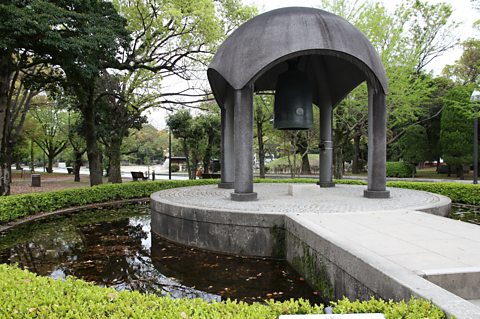
Three days later the USA dropped a second atomic bomb on the Japanese city of Nagasaki, killing around 74,000 people.
The nuclear radiation released by the bombs caused thousands more deaths from radiation sickness in the weeks, months and years that followed.
Justice
The Buddha taught that life can feel unfair, but it isn't always somebody's fault. This is known as Suffering. and the Buddha taught that people need courage and compassion to help accept and live with this.
However, some of the unfairness in life is injustice created by humans motivated by the Three Poisons of greed, hatred and ignorance.
Many Buddhists seek non-violent methods to achieve justice, as they believe that using violence to try and achieve justice will only create more dukkha.
Victory brings hate, because the defeated are unhappy. Those who surrender both victory and defeat find joy.”
Dhammapada 201
What non-violent methods may some Buddhists use to resolve disputes?
Behaviours and qualities could include talking, listening, negotiation, generosity, kindness and open-mindedness.
GCSE exam-style question
Which one of the following is the term meaning to bring about what is right and fair, according to the law or making up for a wrong that has been committed?
a) peace
b) reconciliation
c) compassion
d) justice
Feedback:
d) Justice is the term meaning to bring about what is right and fair.
Attitudes to peace and pacifism
Peace is an absence of conflict, the opposite of war, which can be a basis for greater happiness and harmony for all in society.
Many do not know that we are here in this world to live in harmony. Those who know this do not fight against each other."
Dhammapada 6
The Buddha taught that causing harm hinders a person’s progress towards Enlightenment and causes suffering.
It is better to conquer yourself than win a thousand battles.”
Dhammapada 103
He taught his followers to practise the Five Moral Precepts in every aspect of daily life, in their actions, communication and thoughts.
According to the Buddha, how are meditation and peace interlinked?
Even the gods envy those awakened and mindful ones who are intent on meditation, wise, delighting in the peace of the absence of desire.”
Dhammapada 181
For many Buddhists this means that those who train in mindfulness, loving kindness and compassion will be less and less motivated by the Three Poisons and may be able to have a positive impact in situations of conflict.
Pacifism
Pacifism is the belief that the belief that war and violence are unjustifiable and that all disputes should be settled by peaceful means.
Based on the Five Moral Precepts many Buddhists believe that violence should not be used to settle disputes.
People are not great because as warriors they fight and kill living beings, but because they hurt no living thing.”
Dhammapada 270
However there are varying views on pacifism within the religion.
Some Buddhists will take an absolute pacifist approach by rejecting all violence. Other Buddhists may take a relative pacifist approach and feel that violence is sometimes justified, for example to prevent further attacks or to try and prevent further suffering.
Even if thieves carve you limb from limb with a double-handed saw, if you make your mind hostile you are not following my teachings.”
Majjhima Nikkaya 1
What does the Parable above teach Buddhists about the use of violence?
The Parable of the Saw uses an extreme example to teach that non-violence is not just about not hurting people physically or with words - we also need to become aware of our thoughts. Even to think unkindly or hatefully will cause us and others harm and lead us away from the perfect wisdom and compassion of Enlightenment.
Peacemaker Case study - Thich Nhat Hanh
Buddhist monk Thich Nhat Hanh was a Buddhist teacher, author and peacemaker. He used non-violent methods to oppose the Vietnam War and was later exiled from Vietnam due to his efforts.
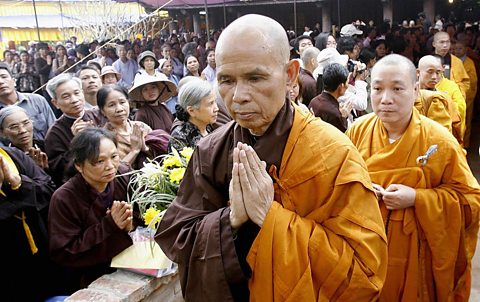
During the height of the war, he met with Dr Martin Luther King Jr, persuading the civil rights leader to speak out against the conflict in Vietnam.
Dr King later nominated Thich Nhat Hanh for the Nobel Peace Prize, describing him as "an apostle of peace and non-violence".
GCSE exam-style question
Describe two Buddhist beliefs about the importance of peace-making.
Answers could include:
The Buddha taught that peace and happiness begin in the human heart and can be cultivated through meditation and the practice of the Five Moral Precepts, which express the principle of ahimsa, or non-harm.
According to the Buddha, trying not to harm yourself or others will bring inner peace. Where a person does cause harm they can make peace by accepting the consequences, apologising and making amends.
The ultimate peacemaker would be an Enlightened person, such as the Buddha. In their perfect wisdom and compassion, all their actions would naturally express ahimsa, the Five Moral Precepts and be free of the Three Poisons - greed, hatred and ignorance of the nature of reality.
Useful quotes about peace and conflict from Buddhism
1 of 5
Forgiveness and Reconciliation
Video
Watch the video below to compare Buddhist, Jewish, and Hindu attitudes towards whether religious people should always forgive.
Buddhist presenter: Hello, I'm a Buddhist.
Hindu presenter: I'm a Hindu.
Jewish presenter: And I'm Jewish.
Buddhist presenter: And today we're talking about forgiveness
Hindu presenter: And how hard it can be to forgive other people when you've been treated unfairly.
Jewish presenter: But should we as religious people always forgive?
Buddhist presenter: One of the most important Buddhist teachings is 'Ahimsa', which means 'non harming'. It's all about living a non-violent life and avoiding anything that might lead us to violence. Forgiveness is a big part of that. We're taught to let go of the need for revenge and other feelings that might lead us to harm someone.
Hindu presenter: The principle of Ahimsa originally comes from Hinduism. It's one of the 'yamas', the good qualities we should try to develop. And another is “kshama”, which means forgiveness.
Jewish presenter: Jews also believe that non-violence is the ideal and that forgiveness is important, so important, we have a special day devoted to it every year called 'Yom Kippur', which is Hebrew for, 'the Day of Atonement'. We fast and ask God to forgive us for all the things we've done wrong. But during the ten days before Yom Kippur, we should go and ask for forgiveness from any people we think we've wronged.
Buddhist presenter: The Buddha's advice was to forgive and move on. He described how some people dwell on their grudges, 'He abused me. He struck me. He overcame me. He robbed me. In those who do not harbour such thoughts, hatred will cease.' Instead, the Buddha taught that we should try to develop 'metta', loving kindnessand 'Karuna', compassion for other people, even people who've hurt us.
Hindu presenter: But forgiveness is difficult. Mahatma Gandhi was a Hindu who used non-violent protest to campaign for an end of British rule in India. He said, 'The weak can never forgive. Forgiveness is an attribute of the strong.'
Jewish presenter: And there are examples of people showing incredible forgiveness,even in the most unthinkable situations. Eva Mozes Kor was a survivor of the Holocaust. Both her parents and two of her sisters were murdered at Auschwitz.Eva later spoke about the healing power of forgiveness. 'I believe forgiveness issuch a powerful thing', she said. 'It's free, it works, it has no side effects, and this is what our world needs besides punishment'.
Buddhist presenter: But should we always forgive whatever the situation?
Hindu presenter: Is that fair?
Jewish presenter: It means letting go with feelings that, you could argue, are totally justified.
Buddhist presenter: Don't we need to feel that justice has been done before we can forgive?
Hindu presenter: But forgiveness isn't about justice. It's a personal thing. I was hurt by a friend that I trusted. I was upset and angry with them. I didn't want to talk to them. I just wanted them out of my life. But that didn't make me feel good either. I realised my anger was just eating me up. I thought for a long time and decided to forgive them. Not because I didn't feel wronged, I did, but to make me feel better, to release my anger and to restore some balance in my life.
Jewish presenter: So we all agree that forgiveness on a personal level is what our religions teach us.
Buddhist presenter: And that can sometimes feel like a really hard thing to do.
Hindu presenter: But forgiveness allows us to let go of painful feelings that only do harm to ourselves.
Jewish presenter: And even if I've chosen to forgive someone, it doesn't necessarily mean they won't face justice for what they've done.
Buddhist presenter: They might even learn something from being forgiven. But what do you think?
Forgiveness is an important teaching in Buddhism. The Buddha taught that when a person suffers because of others, it is important that they show compassion for themselves and allow time to recognise the anger and pain they may feel.
Through the teaching of The teaching of no fixed self, one of the three marks of existence. the Buddha taught that the concept of self is not a fixed state and it changes all the time. Holding a fixed view of oneself or others causes suffering and prevents reaching Enlightenment.
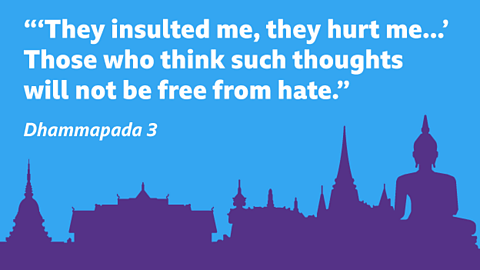
They insulted me, they hurt me, they defeated me, they robbed me. Those who think such thoughts will not be free from hate.”
Dhammapada 3
Reconciliation
Reconciliation is making up and rebuilding relationships between two sides after a conflict. More than just apologising, it means actively working towards peace and moving on from conflict. Tibetan Buddhist leader the Dalai Lama has stated that peace can only happen where there is mutual respect.
However difficult it may be, Buddhist teachings emphasise the importance of letting go of blame and resentment. These emotions are poisonous and keep a person stuck in a fixed self-view as a victim, which will cause them suffering. They prevent an individual from taking responsibility for developing helpful qualities such as kindness and generosity, and thus from developing healthy relationships with others.
Through the story of Devadatta, what did the Buddha teach about forgiveness and reconciliation?
The Buddha showed the importance of forgiveness and reconciliation in this traditional story. His cousin, Devadatta, spread rumours about him and then attempted to kill him because he was jealous of the Buddha’s status. Despite everything, the Buddha refused to show any hatred towards his cousin.
Reconciliation Case Study - Maha Ghosananda
In the 1990s, Maha Ghosananda, a senior Buddhist monk, led a series of non-violent marches through Cambodia to encourage reconciliation and peace after many years of civil war.
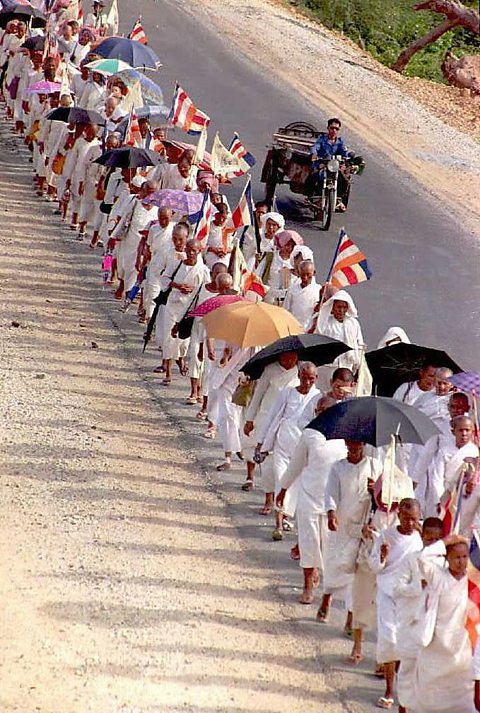
He said,
“If I am good to someone, he or she will learn goodness and, in turn, will be good to others.”
He believed that violent behaviour should be condemned but not the person who did it.
Holy war
A holy war, or a religious war, is a conflict usually arising between those of different religions, often authorised by a religious leader.
The Buddha’s teachings offer no justification for a holy or religious war, even to protect Buddhist tradition and culture. After all, the Buddha taught his followers to practise loving kindness towards everyone, including those we dislike, or with whom we disagree.
However, there are examples of Buddhist-led violence and war.
Buddhism scripture quiz
More on Buddhism
Find out more by working through a topic
- count1 of 2