Who was Alfred the Great and why was he important?

Alfred the Great was King of Wessex from AD871-899.
He played a key role in the Anglo-Saxon and Viking struggle for control of England. Alfred built burhs (walled towns) and warships. He also encouraged learning and the rule of law.
Alfred’s reign was an important turning point in the creation of the kingdom of England.
Timeline: The Anglo-Saxons

Image caption, Click the arrows to learn more about the Anglo-Saxons!


1 of 8
Important words for the Anglo-Saxons
| Keyword | Definition |
|---|---|
| Witan | The council who advised Anglo-Saxon kings. |
| Danelaw | The area of northern and eastern England that belonged to the Vikings. |
| Burh | A fort or walled town. |
Why was Alfred called ‘Great’?
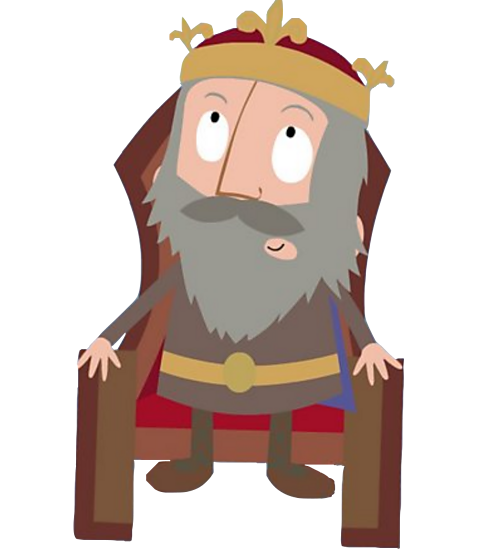
One of the most famous Anglo-Saxon kings was Alfred, one of the only kings in British history to be called 'Great'.
His father was king of Wessex, but by the end of Alfred's reign his coins referred to him as 'King of the English'.
He fought the Vikings and then made peace so that English and Vikings settled down to live together. He encouraged people to learn and he tried to govern fairly.
Alfred was not called ‘Great’ in his lifetime. In fact, he only became commonly known as ‘Great’ in the 16th century – 700 years after he lived.
Watch: Who was Alfred the Great?
Who was Alfred, and why was he so great? Find out about King Alfred's life.
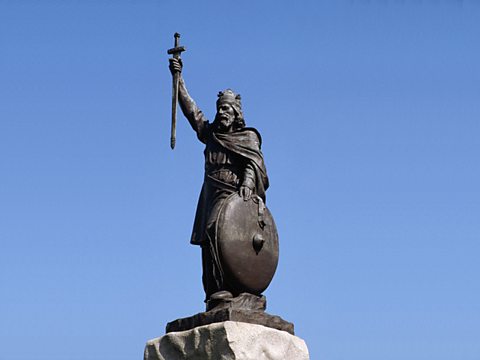
Excuse me. Yes, you. Did you know that is the statue of Alfred the Great? Ever wondered why he was so great? Well, let’s start at the beginning.
This is a great-o-meter to help you keep score. Plus meet the man himself, Alfred, born in 849 and the youngest of five brothers. He was never expected to be king. What do we think now, great or not?
Alfred learned to read after his mother challenged her sons in recite a poem by heart from her favourite book.
Excellent, we are on our way to greatness. Despite suffering from illness all his life, he outlived all his brothers and takes the throne in 871.
However, he had to immediately defend his throne from Guthrum, a Viking warlord.
Alfred flees and hid in the Somerset Levels. So far, Alfred the not so great.
But eventually Alfred regrouped and raised an Anglo-Saxon army that defeated the Vikings at the Battle of Edington.
Alfred and Guthrum agreed to peace and to divide up the country.
Alfred kept Wessex in the southwest, Guthrum took the Viking lands in the North East, known as the Danelaw.
Over time Alfred brought the English kingdoms together and his coins call him the King of the English.
However, his defining moment of greatest was when he translated books from Latin, which only a few people could understand, into English, so more people could read them.
Beginning a new age of literacy and knowledge. For which he became known as Alfred the Great. Do we agree that Alfred was great? But not modest.
Well, that was great, I greatly appreciate you joining me on this journey – oh, I think Alfred may want his crown back.
Stories about Alfred the Great
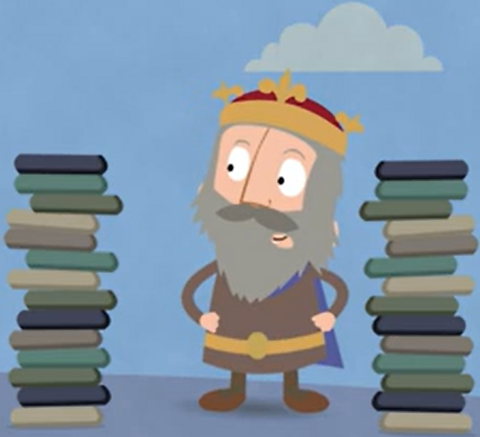
A lot of what we know about Alfred the Great comes from stories that have been written about him.
One story says that Alfred went to Rome at the age of four to meet the Pope. When he came home, his mother promised a book of English poetry to the first of her sons who could read it to her. With the help of his tutor, Alfred memorised the book so he could recite it by heart and won.
Later in his life the young King Alfred had to hide from the Vikings on a marshy island called Athelney, in Somerset. A famous story tells how, while sheltering in a cowherd's hut, the king got a telling-off from the cowherd's wife. Why? He accidentally let her cakes (or bread) burn on the fire when he forgot to watch them!
Listen to passages from the Monk Asser's biography of Alfred called 'The Life of King Alfred'
Narrator: In the year of the Lord’s incarnation 849, Alfred, King of the Anglo-Saxons, was born at the royal estate of Wantage in the district known as Berkshire.
King Alfred was the son of Athelwolf. Alfred’s mother was called Osburh. A most religious woman, noble in character and noble by birth.
Presenter: That’s how the monk Asser records the birth of Alfred, the Saxon child who would lead the fight against the Vikings, promote learning throughout his kingdom he ruled and try to unite the Anglo-Saxons as one people – the English. And because Asser wrote the biography Alfred is one of the few Anglo-Saxon children we know something about.
According to Asser, learning was something which fascinated Alfred even when he was very young. Asser tells the story of a book, given to Alfred by his mother.
Narrator: One day when his mother was showing him and his brothers a book of English poetry which she held in her hand she said 'I shall give this book to which one of you can learn it the fastest.'
Spurred on by these words, or rather by divine inspiration, and attracted by the beauty of the initial letter in the book, Alfred spoke as follows in reply to his mother.
‘Will you really give this book to the one who can understand it the soonest and recite it to you?’
Whereupon smiling with pleasure, she reassured him saying, ‘Yes I will.’
He immediately took the book, went to his teacher and learnt it.
THEY SPEAK SAXON
When it was learnt, he took it back to his mother and recited it.
Presenter: It doesn’t say Alfred read the book. It says he learned it. In Anglo-Saxon times, that's how children were educated - by memorising things.
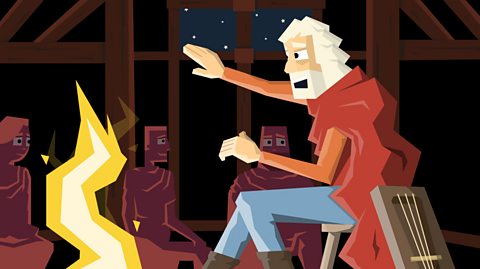
Memorising and reciting poetry was a very popular activity for the Anglo-Saxons. Books were incredibly rare so there really wasn’t much need for people to read.
When Alfred finally did learn to read at age 12, he wasn’t taught in a school, he was taught by a tutor.
In Anglo-Saxon times there were few schools in England and only a handful of people went to them. The first schools were established around the 6th or 7th century.
They were attached to churches and monasteries and trained boys and girls for the religious life.
They learnt to read and write in Latin, studied music and religious writing.
Anglo-Saxon times in many ways were very good times to be a girl.
Although very few boys and girls were educated in the religious schools, the Anglo-Saxons believed it was just as important for girls to be educated as it was for boys. All Alfred’s children learned to read and write.
Learning from a book was only part of Alfred’s education. A noble boy was expected to learnt the skills he would need as an adult in battle.
Alfred was expected to grow up to fight and rule with justice. Many of these skills were physical, so much of his childhood was spent outdoors doing archery and sword-fighting.
How did he rule?
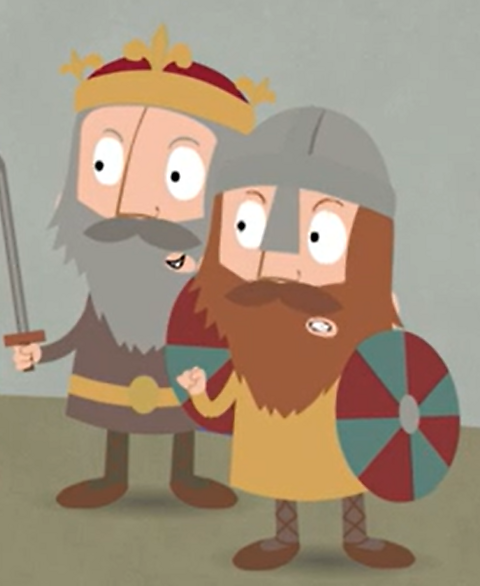
Alfred became king in AD871.
During his reign he was advised by a council of nobles and church leaders. This council was called the Witan.
Alfred made good laws and believed education was important. He had books translated from Latin into English, so people could read them. He also told monks to begin writing the Anglo-Saxon Chronicle.
To help protect his kingdom from Viking attacks, Alfred built forts and walled towns known as ‘burhs’.
He also built warships to guard the coast from raiders and organised his army into two parts. While half the men were at home on their farms, the rest were ready to fight Vikings.
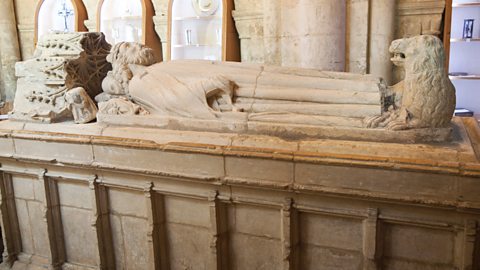
Alfred died in AD899 and was buried at his capital city of Winchester.
Who was Athelstan?
Athelstan was Alfred the Great’s grandson. He reigned between AD924 and AD939 and was the very first ‘King of all England’.
Athelstan was a fierce soldier. One of Athelstan’s most famous victories was at the Battle of Brunanburh. He defeated an invasion by the king of Scotland, who attacked with help from the Welsh and the Danes from Dublin.
Athelstan wasn’t just a soldier though: he worked hard to make his kingdom strong by writing laws and encouraging trade.
Think like a historian

Have a look at the thinking points below and think about your answer to each question. You could even write them down on a piece of paper or discuss them with somebody else if you want to.
Why do you think Alfred is one of the few British kings to be called ‘Great’?
Why do you think Alfred wasn’t called ‘Great’ until 700 years after he died?
Did you think about all the different things Alfred achieved during his reign? He was not just interested in defeating the Vikings. Alfred was also interested in learning, literature and ruling fairly.
Perhaps you thought about how history is always changing. How we remember people in the past changes over time. We might remember people in different ways and for different reasons.
Activities
Activity 1: Timeline of Kings
Click on each of the kings below to find out who they were and how they ruled.
Activity 2: Quiz – Alfred the Great
Teaching resources
Are you a teacher looking for more history resources? This collection of seven animated dramas explores the time of the Anglo-Saxons in England, including the story of Beowulf.
BBC Bitesize for Teachers has thousands of free, curriculum-linked resources to help deliver lessons - all arranged by subject and age group.
Horrible Histories: Raid and Trade game! game
Play Horrible Histories: Raid and Trade KS2 History
More on Anglo-Saxons
Find out more by working through a topic
- count5 of 8
- count6 of 8
- count8 of 8