The basics
- Ten to the power of five can be written as \(10^{5}\).
- It means \(10 \times 10 \times 10 \times 10 \times 10 = 100000\)
- \(2^{3} = 2 \times 2 \times 2 = 8\)
Indices
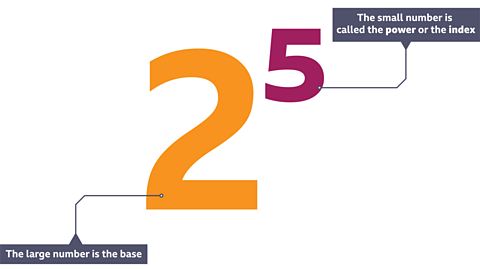
The power or index represents how many times the number is to multiplied by itself.
\(2^{5} = 2 \times 2 \times 2 \times 2 \times 2 = 32\)
Example
Calculate \(5^{2}\).
Answer
\(5^{2} = 5 \times 5 = 25 \)
Example
Find the value of \(4^{5}\).
Answer
\(4^{5} = 4 \times 4 \times 4 \times 4 \times 4 = 1024 \)
Calculating indices
Any calculations must follow the correct order of operations:
- Brackets
- Indices
- Division
- Multiplication
- Addition
- Subtraction
Example
Calculate the value of \(2^{3} \times 3^{2}\).
Solution
Following order of operation, the indices are calculated first before multiplying.
- \(2^{3} \times 3^{2} = 8 \times 9 =72\)
Example
Calculate \(6^{2} – 2^{4}\).
Solution
\(6^{2} – 2^{4} = 36 – 16 = 20\)
Example
Find the value of \(4^{3} \div 2^{5}\).
Solution
\(4^{3} \div 2^{5} = 64 \div 32 = 2\)
Question
What is the value of \(3^{2} \times 2^{2}\)?
\(9 \times 4 = 36\)
Question
Evaluate \(4^{2} + 3^{3}\).
Answer
\(16 + 27 = 43\)
Rules of indices when working with the same base
Rule 1
To find the value of \(4^{2} \times 4^{3}\)
It can be rewritten as \(4 \times 4 \times 4 \times 4 \times 4 = 4^{5}\)
So \(4^{2} \times 4^{3} = 4^{2 + 3} = 4^{5} = 1024\)
When multiplying, the rule is to add the indices.
Rule 2
To find the value of \(5^{7} \div 5^{4}\)
It can be rewritten as \((5 \times 5 \times 5 \times 5 \times 5 \times 5 \times 5) \div 5 (\times 5 \times 5 \times 5)\)
\(78125 \div 625\)
\(= 125\)
A quicker way would be \(5^{7} \div 5^{4} = 5^{7 – 4} = 5^{3} = 125\)
When dividing, the rule is to subtract the indices.
Rule 3
To find the value of \((3^{3})^{2}\)
It can be rewritten as \(3^{3} \times 3^{3}\)
And using Rule 1:
\(3^{3} \times 3^{3} = 3^{3 + 3} = 3^{6} = 729\)
When the power is raised to another power, the rule is to multiply the indices.
Rule 4
To find the value of \(6^{2} \div 6^{2}\)
By using Rule 2:
\(6^{2} \div 6^{2} = 6^{2 – 2} = 6^{0} = 1\) since \(6^{2} \div 6^{2} = 1\) and \(36 \div 36 = 1\)
\(9^{0} = 1\)
\(m^{0} = 1\)
\(725^{0} = 1\)
Anything to the power of zero is 1.
Rules of indices when working with the same base
Rule 1 – when multiplying, add the indices.
Rule 2 – when dividing, subtract the indices.
Rule 3 – when the power is raised to another power, multiply the indices.
Rule 4 – anything to the power of zero is 1.
Examples using the rules
Example (with rule 1)
Simplify \(7^{7} \times 7^{4}\) giving the answer in index form.
Solution
\(7^{7} \times 7^{4} = 7^{7+4} = 7^{11}\)
Example (with rule 2)
Evaluate \(2^{8} \div 2^{5}\).
Solution
\(2^{8} \div 2^{5} = 2^{8–5} = 2^{3} = 8\)
Example (with rule 3)
Simplify \((a^{3})^{2}\).
Solution
\(a^{3 \times 2} = a^{6}\)
Example (with rule 4)
Evaluate \(5^{0}\).
Solution
\(5^{0} = 1\)
Question
Simplify \(6^{2} \times 6^{3}\), giving your answer in index form.
Answer
\(6^{2+3} = 6^{5}\)
Question
Evaluate \(5^{3} \div 5^{3}\).
Answer
\(5^{3–3} = 5^{0} = 1\)
Test yourself
More on M6: Number
Find out more by working through a topic