Key points
We can hear sounds because our ears turn sound vibrations from the air, into signals that are sent to our brain.
We can’t hear all levels of sounds. Sound waves with very high frequencies are called ultrasound and our ears can’t detect them.
Ultrasound waves have multiple uses including: detecting medical conditions, treating kidney stones and cleaning delicate objects.
How we hear
We detect sounds because inside our ears we have parts that work together to turn sound waves into a signal that is sent to our brain.
The components of the ear that make this possible are:
The eardrum: A thin flap of skin that is stretched tight like a drum.
The ear bones: Three small bones called the hammer, anvil and stirrup.
The cochlea: A spiral shaped part of the ear that looks a bit like a snail shell.
The auditory nerve: The nerve that carries signals from the cochlea to the brain.
The Pinna: The visible portion of the outer ear.
When a sound reaches us, the air particles inside our refers to the tube that runs from the outer ear to the inner ear. Lined with cells that produce ear wax. vibrate and hit the eardrum.
The eardrum then starts vibrating and these vibrations are passed to three small ear bones – called the hammer, anvil and stirrup.
The stirrup bone hits the cochlea, which turns the vibrations into an electrical signal that is sent to our brain via the the auditory nerve carries messages from the cochlea to the brain..
When the signal reaches our brain, our brain translates the signal into the sound we hear.
Ultrasound
The highest The pitch of a sound is how high or low the sound is. A high pitch sound has faster vibrations and higher wave frequency. A low pitch has slower vibrations and a lower wave frequency. sound humans can hear has a Frequency is the number vibrations of the wave in one second, also seen as the number of complete waves passing a point in one second. Frequency is measured in hertz (Hz). of 20, 000 Frequency is measured in hertz (Hz) or kilohertz (kHz).(20 kHz). If the vibrations of a sound wave have a frequency that is higher than 20 kHz our ears can’t detect them and it is called Sound waves which we can’t hear because they have a high frequency of more than 20, 000 Hz. .
- If the vibrations of the air particles are slower, we hear a lower pitch sound.
- If the vibrations of the air particles are faster we hear a higher pitch sound.

Many animals have ears that are able to detect ultrasound. Dogs are able to hear sounds with frequencies up to 60 kHz, while some species of bats can detect frequencies of 200 kHz.
A dog training whistle makes sound waves that have a frequency of 40,000 Hz. Dogs ears can detect the sound, humans can’t because the frequency is above 20 kHz.
What is a Mosquito alarm used for?
In 2005, Howard Stapleton from Barry in South Wales invented the Mosquito alarm. It is a device that makes a noise at a frequency of 17.4 kHz.
It was found that younger people, including teenagers and young adults could hear this pitch and were irritated by it, however older people, whose ability to hear higher pitch has lessened with age, were oblivious to the sound. These devices were deployed all over the world in order to prevent loitering, vandalism and drug use outside properties and shops.
Uses of ultrasound
Even though we can't hear ultrasound, it has many other uses for humans.
Breaking kidney stones
Ultrasound waves can move physical objects by resonating with their natural frequency and are used by doctors for breaking up Kidney stones happen when minerals form crystals inside the kidneys. Then they get bigger and become kidney stones. Kidney stones can move into the urinary tract. There, they can cause problems like pain and blood in the urine. .
Watch the video below to see how sound travels through, and affects, different materials.
How can sound waves be used to treat kidney stones and to smash wine glasses?
JON CHASE: I'm here at the Welsh National Opera for the ultimate wave destruction challenge. I want to see if some of the singers here can smash one of these using their voice alone.
These singers are part of Welsh National Opera, Youth and Community.
If you want to destroy something with the human voice, you need a powerful voice that can hold a note and these singers are awesome. Right, guys, so your challenge today is to smash a wine glass using the power of your voice. To do that, you're going to have to perfectly match the natural frequency of this wine glass. If I ping the glass…540 hertz. Hertz is the unit of frequency – the number of sound waves per second – and its symbol is Hz. That's what it sounds like.
Do you think you can match that? It's going to get pretty loud so we're going to need you guys to put on the headphones. We've got these on to cover us from the glass… if you manage to get it to smash. Now we're also going to stick a straw in the wine glass, so if you match the frequency right, the straw will start going crazy inside the glass.
OK, so do you think you guys can do it?
SINGER: Yes.
JON: Lowri, do you want to go first?
SINGER: Yes.
JON: But have they got the power? Here is the tone. In your own time.
[SINGER SINGS]
JON: This is really difficult. The glass doesn't have an exact musical note like a piano. It's somewhere in-between and that's really hard for opera singers, used to hitting the note every time.
[GLASS SHATTERS]
JON: Oh-h! Fantastic!
[GLASS SHATTERS]
JON: Oh-h! Mate! Slowed down about 300 times, it's incredible just how much the glass distorts. The glass vibrates at its own frequency, its natural frequency. If the singers are exactly in tune with the glass, sound waves arrive in time with the movement, which gets bigger and bigger and bigger until the glass can't take it any more and – bam! – it breaks! Smashing stuff with sound waves isn't just for fun. It's also used in medicine.
Kidney stones are nasty hard deposits that form in your kidneys. Little ones will pass out with your urine, but bigger ones can be really painful and they've got to be smashed.
Simon has a kidney stone that's one centimetre across. You can see it with ultrasound – high-frequency sound waves that can travel through the body. The hard kidney stone reflects the sound and shows up clearly. The ultrasound uses quite gentle sound waves, but this machine is another story. It's called lithotripter – it means 'stone breaker' – and it can break stones inside a kidney without harming anything else.
The sound waves this machine makes can be focused on the kidney stone and even though they're deep in the body, the sound waves break up the stones so they can pass out safely, but the most surprising thing is that the sound gets into Simon not through the air but through water. And to see why, I've got a couple of the opera singers to join me at the Waterside in Cardiff.
To see just how sound travels through air and water we're going to do an experiment. Yolanda, way over there on the other side of the harbour, is going to make some noise. Tommo here is going to listen to the sound as it travels in the air in the normal way, whereas Caitlin is going to listen to how the sound comes through the water through a special underwater microphone.
So here's the deal – right, guys, I want you to keep your back to Yolanda and then we just want you to listen out for the sound of the hammer being hit. And when you hear it, raise your hand. OK, you guys ready? Right.
How was that for you, guys? Like, how did it sound to you?
CAITLIN: Erm, it sounded sort of like a clap.
JON: And for you? How did it sound when you listened to it?
TOMMO: It sounded like someone was hitting a bell, like a gonging sound.
JON: But which sound gets here quicker? Could you perceive between you whose hand went up first?
CAITLIN: I think mine went up slightly faster, ever so slightly.
TOMMO: Yes, yours went up a little bit quicker than mine. I'm not too sure, though.
CAITLIN: A little bit.
JON: Caitlin is listening to the sound through water and it looks like it gets there first. When Yolanda hits the metal pillar with a hammer, the sound will travel through the air and the water. It reaches the underwater microphone in just six hundredths of a second, but the sound through air is still getting there. It arrives at Tommo's ears a quarter of a second later.
Do you think you could say why it was perhaps quicker for you and slower for you?
CAITLIN: I think it's something to do with particles in a liquid, and obviously in the air, so obviously in a liquid they're closer together, maybe?
JON: Yes, it is because the particles in water are actually closer together, so the sound actually travels quicker through the water than the air.
Sound travels faster and further in water than in air. This helps whales and dolphins communicate over huge distances and it helps doctors to destroy kidney stones, thanks to the destructive power of waves.
A glass will smash if sound waves travel through it at what frequency?
A glass will smash if sound waves travel through the glass at its natural frequency. In the example in the video that is around 550 hertz.
Cleaning delicate objects
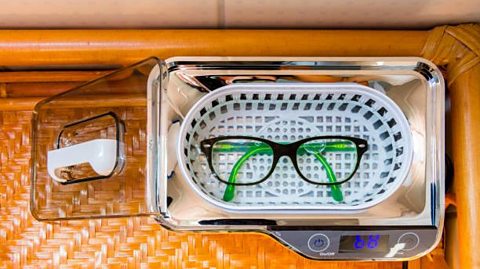
Ultrasound can be used to clean delicate objects like jewellery or a pair of glasses. The machines that make use of this ability are called ultrasonic cleaners.
When the ultrasonic cleaner is switched on, ultrasound waves travel through the water, disturbing it and creating tiny bubbles that vigorously shake the dirt from the object.
Looking inside the body
Ultrasound scans are used to view the inside of our bodies. A small device called an ultrasound probe is used, which gives off high-frequency sound waves.
We can't hear these sound waves, but when they reflect off different parts of the body, they create echoes that are picked up by the probe and turned into an image called an ultrasound scan.
Low power ultrasound is used so that doctors can see images of inside the body without causing damage. Ultrasound waves are used to take pictures of unborn babies, to monitor vital organs such as the heart, or to assist in diagnosis of gall or kidney stones.

Checking for faults inside objects
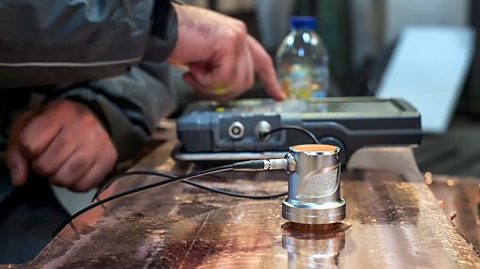
Ultrasound waves are used to check if railway tracks and oil pipes have hidden faults, like a crack inside that is not visible to the naked eye. The waves are aimed at the surface and their reflections are received by a probe. If there is a crack or fault, the ultrasound wave reflects differently from how it does when there isn't a fault, and the probe produces a different noise to indicate that a fault has been found.
Test your knowledge
Play the Atomic Labs game! game
Try out practical experiments in this KS3 science game.

More on Waves
Find out more by working through a topic
- count14 of 15

- count15 of 15
- count1 of 15

- count2 of 15