Key points
A chemical reaction that occurs in the chloroplasts of plants in which the energy in light is stored in glucose. is a chemical process in which green plants make their own food using energy from the sun - this food is made in the form of A sugar produced by plants in photosynthesis and used by all living organisms to release energy during respiration..
Photosynthesis occurs in chloroplasts found within cells. It is the chloroplasts that contain the green pigment chlorophyll which absorbs light.
The plant uses this glucose to grow as well as make other useful substances, such as cellulose found in the cell walls and starch used as energy storage.
The glucose can also be broken down in the plant by A chemical reaction that occurs in the mitochondria of cells in which glucose and oxygen react to produce carbon dioxide and water, releasing energy.
Game - light intensity and photosynthesis
Play an Atomic Labs experiment to explore how light intensity affects levels of photosynthesis.
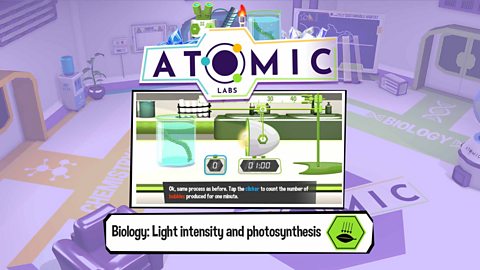
You can also play the full game
(Practical advice on how to work safely in the lab when conducting science experiments.)
Video - Photosynthesis
Photosynthesis is one of the most important reactions on this planet.
Let's have a look at the word "Photo" means light, “Synthesis” means to make - and that's exactly what it does. So, plants harness the energy from the sun to make food.
Photosynthesis happens in the leaves of all green plants. Without photosynthesis there would be no oxygen in our atmosphere and life as we know it would not exist. It happens inside the chloroplasts, which are found in leaf cells and other green parts of the plant.
Chloroplasts contain a substance called chlorophyll, which gives the plant its green colour. Chlorophyll absorbs sunlight and uses its energy to convert carbon dioxide and water into glucose. Oxygen is also produced.
Time for a demo here.
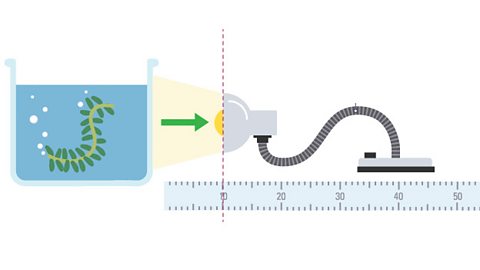
Here we have the aquatic plant named Cabomba. It's very fast at growing and particularly efficient at photosynthesizing.
We're going to have a look at two things.
First, the oxygen produced.
If photosynthesis is happening, the gas collected in the tube over the last 30 minutes should be oxygen. If it is oxygen, it will re-light this glowing splint.
Wicked!
Second thing, light!
The good thing about using underwater plants is that you can actually see the oxygen being produced. The amount of bubbles coming out of the stem of the plant are a good indication of the rate of photosynthesis. But what happens if we reduce the light intensity?
It's practically stopped.
See, without light photosynthesis can't happen. So you can imagine if you were to put this in a pitch black room, there would be no photosynthesis and hence no bubbles being released. So for photosynthesis to happen, we need water, carbon dioxide, chlorophyll and light.
We've already seen that photosynthesis produces oxygen, but the other product is glucose. This glucose is the fuel plants need for energy and to grow. So, essentially, plants make their own food and in turn, animals rely on plants for their food.
Animals get their food from plants by eating plants directly or by eating other animals that have already eaten plants. Plants are the most fundamental part of the food chain.
Photosynthesis is essential to life on this planet for two main reasons. One is it provides us with oxygen, and the second is it harnesses the sun's light energy to produce food.
Wooo-hooo!
Can you answer these questions based on the video?
1. Which four things are needed for the plant to photosynthesise?
2. How do you test for oxygen?
Sunlight, chlorophyll, carbon dioxide and water.
If oxygen is present it will relight a glowing splint.
Photosynthesis is important to living organisms because it is the number one source of oxygen in the atmosphere. Fewer plants would mean less recycling of carbon dioxide and there would be less oxygen production. Without photosynthesis there would be no life as we know it on planet Earth.
How are plants adapted for photosynthesis?
Plants are An organism that has characteristics which improve its chances of surviving. to carry out the process of respiration and photosynthesis. Gases such as oxygen and carbon dioxide can travel through tiny holes underneath the leaf called Tiny pores found most commonly on the bottom of leaves to allow gases to move in and out for photosynthesis and respiration.. Carbon dioxide diffuses into the cells found within the leaf to help carry out the process of photosynthesis, whilst oxygen is released from these cells as a product of photosynthesis.
Plants have adaptations to help them to photosynthesise and ultimately to survive.
Comparing photosynthesis and respiration in plants
Photosynthesis:
Carbon dioxide + water -> glucose + oxygen
Respiration:
Oxygen + glucose -> water + carbon dioxide
The gas carbon dioxide is needed for photosynthesis to take place in plants and is also produced when plants respire. Oxygen is a Products are shown on the right of the arrow in an equation. of photosynthesis - it is needed as a reactant during aerobic respiration within a plant. This means that the The chemical present at the start of a reaction. Reactants appear on the left of a chemical equation, before the arrow →. and products of photosynthesis and aerobic are opposites.

If you memorise one of these equations, then you already know the other, as you can read it backwards.
When do plants respire?
Plants respire all the time, whether it is dark or light. However, they only photosynthesise when they are in the light.
The table shows the difference between photosynthesis and respiration at different times of the day.
| Time | Photosynthesis | Respiration | Gases into leaf | Gases out of leaf |
|---|---|---|---|---|
| Day (light) | ✓ | ✓ | Carbon dioxide | Oxygen, water vapour |
| Night (dark) | ✗ | ✓ | No gas exchange as stomata close at night | No gas exchange as stomata close at night |
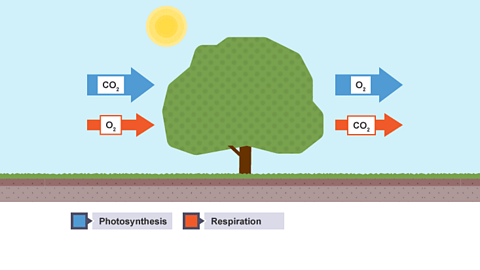
Image caption, Photosynthesis and respiration in plants during the day.
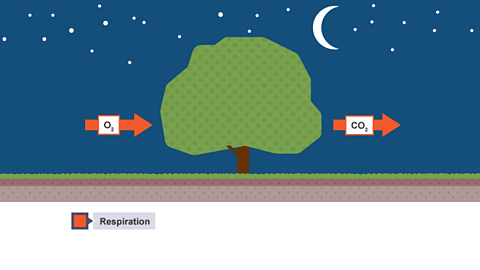
1 of 2
- During the day carbon dioxide diffuses into the leaf through the stomata which is needed for photosynthesis.
- When cells in the leaf photosynthesise during the day, they will produce the oxygen needed for the plant to respire, therefore more oxygen is not required to diffuse into the leaf from the air.
- Water vapour will leave the leaf through the stomata during the day as the stomata remain open. This allows water to move around the plant through the Narrow tubes responsible for the transport of water and minerals in plants.
- The stomata close at night preventing gases from diffusing out of the leaf.
- There are however exceptions to this. For example artificial light that is used at football pitches to help the grass grow during the night.
Light is one factor that affects the How quickly something happens. of photosynthesis. For example, if light intensity is decreased, this will result in a decrease in the rate of photosynthesis. Other factors such as the levels of carbon dioxide, presence of chlorophyll, water and temperature can also affect the rate.
Find out more about the factors which affect the rate of photosynthesis.
Test your knowledge
Quiz
Test questions
Write a paragraph to answer the following question. Tap 'Show answer' to see six points you could have included.
Describe and explain how plants are well-adapted for photosynthesis.
- Plants have broad leaves to trap sunlight
- Leaves are thin to provide a short diffusion path for oxygen and carbon dioxide
- Long roots are good for absorbing more water for photosynthesis
- Stomata allow gases into and out of the leaf
- Guard cells to control the opening and closing of the stomata under different environmental conditions
- Lots of chloroplast to absorb sunlight for photosynthesis
Write an answer to the following question. Tap 'Show answer' to see three points you could have included.
Describe and explain why photosynthesis does not occur in the roots of plants.
- Roots generally grow underground where there is no light
- Root hair cells don’t have chlorophyll
- Chlorophyll is the green pigment required to trap sunlight needed for photosynthesis
Play the Atomic Labs game! game
Try out practical experiments in this KS3 science game.

More on Respiration and gas exchange
Find out more by working through a topic
- count12 of 13
- count13 of 13