Key points
- The gas exchange system is responsible for getting oxygen into the blood and removing carbon dioxide as a person breathes.
- Breathing is also called 'ventilation' and is the movement of gases into and out from the lungs.
- Exercise, smoking and asthma are all factors that can affect the gas exchange system.
Video - How does breathing work?
VOICEOVER: How we breathe.
Breathing - or ventilation - is the process of taking air into and out of the lungs. When we breathe, air, made up mainly of nitrogen and oxygen, enters our body through the mouth and nose. It travels down the trachea – or windpipe – into one of two bronchi and into bronchioles before entering one of millions of alveoli, where gaseous exchange takes place.
When we breathe out, the process is reversed and other gases, now containing less oxygen and more carbon dioxide, leave our lungs. Two important structures for breathing are the intercostal muscles and diaphragm.
As these muscles contract, the volume in our chest cavity increases, the inside pressure decreases and air moves in. As these muscles relax, the volume in our chest cavity decreases, the inside pressure increases and moves air out.
Katie: That was so fascinating. What's next, Dr Tim?
Dr. Tim: All right, next, let's use what we've just heard there to figure out more about how we breathe - or what we should really be saying is how we ventilate. "Ventilation" is the scientific word that we use for "breathing", and as you know, we take in oxygen into our lungs…
INHALES
…and then expel carbon dioxide out of them.
And oxygen is required by every single cell in our bodies for respiration, and we use a number of key parts of the gas exchange system. To do this, they include…
Actually, I'll leave this one to you, Katie. No pressure.
Katie: Bring it on. Well, they're on the autocue, so…
Dr. Tim: Ohh!
Katie: …on the camera, so I know the answers. Your trachea, your windpipe.
Dr. Tim: Yes.
Katie: Bronchi, bronchioles.
Dr. Tim: Yep.
Katie: Alveoli, the little air sacs.
Dr. Tim: Yep.
Katie: Intercostal muscles.
Dr. Tim: Perfect. And there's one more, and it's a really, really important one.
Katie: Ah, yes - the diaphragm. It says it right there!
Dr. Tim: Nice. And our ability to control our breathing is a wonderful thing. We're doing it every moment of every day, whether it's playing the saxophone or singing or even scuba-diving, we're all doing it. Ventilation is an absolute must, so it's really important that we understand the science behind it, and there's one thing in particular that's easily mistaken.
Katie: What's that, then, sir?
Dr. Tim: It's really important that we understand that we do not suck air into our lungs. Ventilation is a passive process, which occurs naturally, without even thinking about it. It's actually our diaphragm and the intercostal muscles that expands our chest volume and it's this difference in pressure that results in the air moving in and out of the lungs.
And I've got a nifty animation here that clearly demonstrates this in action.
So the gas exchange system is made up of your lungs and your airways. The lungs fill with oxygen-rich air from the atmosphere and this oxygen is then transferred into your blood via the alveoli. Carbon dioxide goes the opposite way. The alveoli pass it from your blood back into your lungs before you exhale it. And the intercostal muscles – they're the ones between your ribs – and the diaphragm – muscular sheet under your lungs – contract and relax to help us breathe.
Katie: Wow, it's absolutely amazing that our bodies do this all the time and we don't even have to think about it.
Dr. Tim: It really is amazing and what's also incredible is that our gas exchange system can become more and more efficient when we practise it by leading an active and healthy lifestyle.
Katie: So, with regular exercise, we can take in more oxygen and get rid of more carbon dioxide.
Dr. Tim: Absolutely, and that's because our muscles get stronger and our lung capacity increases over time. All it takes is practice and this is why elite athletes can practise at such high levels.
Can you answer these questions based on the video?
1. What is the scientific name for breathing?
2. How can someone help their gas exchange system be more efficient?
Ventilation
By leading an active and healthy lifestyle including regular exercise.
The gas exchange system
The process of breathing is called ventilation. Breathing in is called inhaling, and breathing out is exhaling.
When you inhale, your diaphragm muscle contracts and moves downwards, and the intercostal muscles contract and move the ribs upwards and outwards. This increases the volume of the lungs, which reduces the pressure inside and so air moves into the lungs to equalise it. Air that is rich in oxygen moves into the gas exchange system and then the body when you breathe in.
When you exhale, our diaphragm muscle relaxes and moves upwards, and the intercostal muscles relax and move downwards and inwards. This reduces the volume of the lungs, which forces air outwards. Air with more carbon dioxide is then removed when you breathe out.
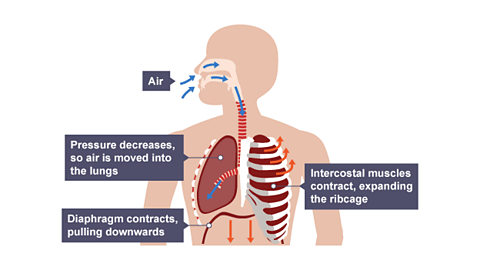
Image caption, Breathing in
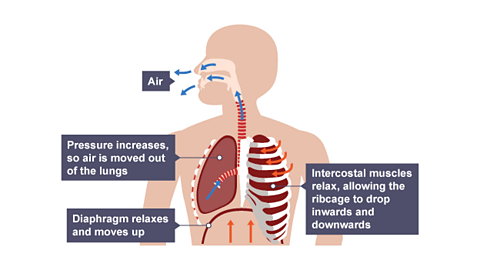
1 of 2
The gas exchange system is made from key parts, each of which has a different function.
| Part of the gas exchange system | Function |
|---|---|
| Trachea | This is also called the windpipe. This tube runs from the mouth, down the throat towards the lungs. It is lined with rings of A tough, flexible material found in the nose and ears, but also between bones in your spine, knees and around your trachea. which keep it open at all times. |
| Bronchus | The trachea splits into a left and right bronchus (plural: bronchi), each leads to a lung. |
| Bronchiole | Each bronchus splits again and again into thousands of smaller tubes called bronchioles which take the air deeper into the lungs. |
| Alveoli | At the ends of bronchioles are tiny air sacs called alveoli. Here oxygen moves into the blood and carbon dioxide moves out. |
| Intercostal muscles | These muscles run between the ribs and form the chest wall. They contract and relax with the diaphragm when a person breathes. |
| Diaphragm | The diaphragm is a dome-shaped, flat sheet of muscle under the lungs. It contracts and relaxes with the intercostal muscles during breathing. |
The alveoli in detail
Alveoli are the tiny air sacs found at the end of bronchioles in your lungs. Gas exchange occurs here. Oxygen moves into the blood and carbon dioxide is removed. This oxygen is needed for respiration to release energy from glucose which has been obtained from food. Carbon dioxide is a waste product in this process and must be removed.
Some water vapour is also lost from the surface of the alveoli into the lungs - we can see this condensing when we breathe out on cold days.
Alveoli have the following key features to maximise gas exchange:
- A huge combined surface area
- Moist, thin walls to maximise The overall movement of particles of gas or liquid from an area of higher to lower concentration.
- Millions of tiny blood vessels called capillaries just behind these walls.
Did you know?
An adult has around 600 million alveoli in their lungs with a combined surface area the size of a tennis court.
Exercise, asthma and smoking
Regular exercise strengthens the intercostal muscles and diaphragm which make breathing more efficient.
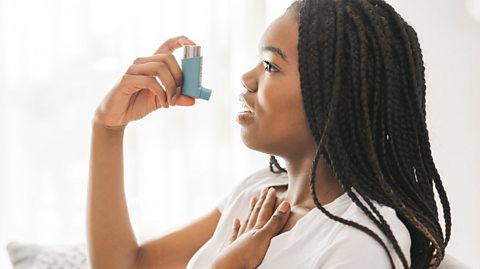
Asthma is a medical condition in which the lining of the airways from the mouth to the lungs become irritated and swell up. This reduces the air that can move in and out from the lungs. It is often treated by inhaling medication from an inhaler.
Smoking damages the tiny hairs that line the gas exchange system; these hairs are called ciliated cells. These move mucus up that has trapped dust and pathogens out of the airways. This can result in smokers developing a cough to remove this mucus. Smoking also irritates the bronchi which can lead to bronchitis. Smoking also breaks down the lining of the alveoli, which means less gas exchange can occur and can lead to chronic obstructive pulmonary disease (COPD). Cigarette smoke also contains carcinogen chemicals like tar, which can cause mouth, throat and lung cancer.
Test your knowledge
Quiz - The process of breathing
Test questions
Write a paragraph to answer the following question. Tap 'Show answer' to see seven points you could have included.
Describe the process of ventilation.
Inhaling in breathing in and exhaling is breathing out.
When inhaling, the diaphragm muscle contacts and moves downwards.
The intercostal muscles contract and move the ribs upwards and outwards.
This increases the volume of the lungs, which reduces the pressure and so air moves into the lungs to equalise it.
When exhaling, the diaphragm muscle relaxes and moves upwards.
The intercostal muscles relax and move downwards and inwards.
This reduces the volume of the lungs, which forces air outwards.
Teaching resources
Need some extra resources to support your biology lessons? In this short film from BBC series Inside The Human Body viewers get a closer look at the process of breathing.
BBC Bitesize for Teachers has thousands of free, curriculum-linked resources to help deliver lessons - all arranged by subject and age group.
Revise for your exams with BBC Bitesize
Get ready for the GCSEs with quizzes, past papers, flashcards, podcasts and more resources!

More on Respiration and gas exchange
Find out more by working through a topic
- count4 of 13
- count5 of 13
- count6 of 13