Characters
There are lots of characters in Shakespeare’s play Romeo and Juliet. Take an in-depth look at the main ones identifying their key attributes and relationships and analysing their part in the play.
As you might expect, characters in 'Romeo and Juliet' fall into two camps - the Montagues and the Capulets. These are the two families who have been at war for many years. Romeo is a Montague and Juliet is a Capulet. There are lots of characters in this play, but the main ones are:
- Romeo
- Juliet
- Friar Lawrence
- The Nurse
Other key characters include:
- Tybalt - Juliet’s cousin
- Mercutio - Romeo’s close friend
- Benvolio - Romeo’s cousin
- Capulet - Juliet’s father
Romeo
Romeo is a young, passionate and impulsive character. When we first meet him he is heartbroken because Rosaline does not return the love he has for her. However, things change as soon as he meets Juliet at the party. He sneaks to her balcony at night and declares his undying love for her. They arrange to get married in secret the very next day, showing how impulsive he really is. When Juliet’s cousin, Tybalt, later challenges Romeo to a duel, Romeo refuses. This shows us how devoted he is to Juliet. We also see his passionate nature at the end of the play when he believes that Juliet is dead and kills himself to be with her.

Image caption, Character attributes

1 of 3
Character attributes
- Impulsive – he falls immediately in love with Juliet and forgets Rosaline.
- Devoted friend – when Mercutio is killed by Tybalt, Romeo is so enraged that he kills him too.
- Passionate – he kills himself in order to be with Juliet.
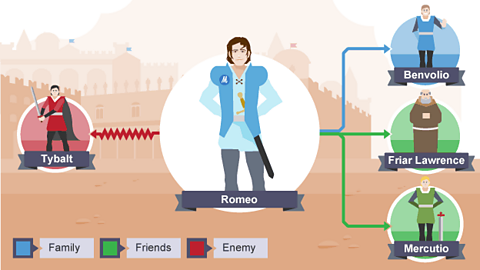
Friends and enemies
Romeo’s friends are:
- Benvolio - his cousin
- Mercutio – his best friend
- Friar Lawrence – marries Romeo and Juliet
He is enemies with:
- Tybalt - a Capulet and Juliet’s cousin
Changes in character
- At the start of the play Romeo is depressed and confused by his love for Rosaline.
- When he sets eyes on Juliet at the Capulet party, Romeo forgets all about Rosaline, claiming he has never experienced true love until this moment.
- Romeo refuses to fight with Tybalt, but when his best friend Mercutio is slain, he fights Tybalt to the death.
Character analysis
Question
How is Romeo presented to the audience at the beginning of the play?
When we first meet Romeo he is presented as a lovesick youth. He finds love confusing and this is shown in the way he talks using A phrase combining two or more contradictory terms - eg. 'deafening silence'. such as 'cold fire'. He says:
ROMEO
Feather of lead, bright smoke, cold fire,sick health
Act 1 Scene 1
Question
How does Romeo express his feelings about Juliet?
When he falls instantly in love with Juliet, Romeo is so overwhelmed by her beauty that she seems to shine brighter than the torches to him. He gushes:
ROMEO
O she doth teach the torches to burn bright!
Act 1 Scene 5
She literally lights up his life.
Question
How does Romeo justify his actions when he kills Tybalt?
After Romeo kills Tybalt he runs away from the scene, remembering the death sentence that the Prince has declared for public fighting. He knows his behaviour has been foolish, but he feels under the control of destiny. Romeo thinks his life is fated. He says:
ROMEO
O, I am fortune’s fool.
Act 3 Scene 1
Question
Is Romeo a passionate character?
Yes. Even when he believes Juliet is dead, Romeo talks of her beauty. He praises the sweetness of her words and the colour of her lips and cheeks. Before he kills himself, Romeo talks at length about his love for her:
ROMEO
Death, that hath sucked the honey of thy breath,Hath had no power yet upon thy beauty.
Act 5 Scene 3
Listening task
In Act 2 Scene 2, Romeo has crept into the Capulet garden and is looking up at Juliet as she appears on her balcony. She cannot hear him speaking about her.
Romeo and Juliet characters - Romeo
ROMEO
But soft, what light through yonder window breaks?
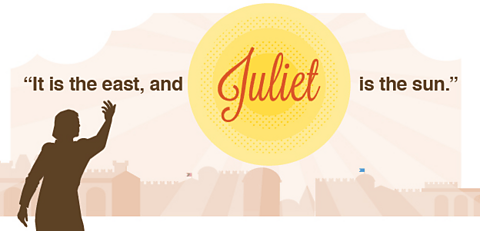
It is the east, and Juliet is the sun.
Arise, fair sun, and kill the envious moon,
Who is already sick and pale with grief
That thou, her maid, art far more fair than she.
Be not her maid, since she is envious;
Her vestal livery is but sick and green,
And none but fools do wear it; cast it off.
It is my lady, O it is my love:
O that she knew she were!
She speaks, yet she says nothing; what of that?
Her eye discourses, I will answer it.
I am too bold, 'tis not to me she speaks:
Two of the fairest stars in all the heaven,
Having some business, do entreat her eyes
To twinkle in their spheres till they return.
What if her eyes were there, they in her head?
The brightness of her cheek would shame those stars,
As daylight doth a lamp; her eyes in heaven
Would through the airy region stream so bright
That birds would sing and think it were not night.
See how she leans her cheek upon her hand!
O that I were a glove upon that hand,
That I might touch that cheek!
Question
How does Romeo describe Juliet’s features?
Bright and beautiful.
Question
What does he compare her to?
The sun and the stars.
Juliet
Juliet is the young daughter of Capulet and Lady Capulet. Early in the play the nobleman, Paris asks her father whether he might be allowed to marry her. Capulet organises a party as an opportunity for the two to meet and get to know each other. However, Juliet’s heart is captured that night, not by Paris, but by Romeo. She is headstrong and determined, going against her parents’ wishes and marrying Romeo in secret. She shows strength of character when Romeo is banished and she commits to a risky plan with Friar Lawrence. She fakes her own death, and when later she finds Romeo dead by her side, she stabs herself.

Image caption, Character attributes

1 of 3
Character attributes
- Obedient – even though she has not thought of love or marriage before now, Juliet agrees to look at Paris at the party.
- Passionate – she falls instantly in love with Romeo.
- Courageous – she disobeys her parents and arranges to marry Romeo in secret. She later kills herself for love.
Friends
Juliet doesn’t have friends her own age. She obviously loves Romeo and she also takes advice from:
- The Nurse
- Friar Lawrence
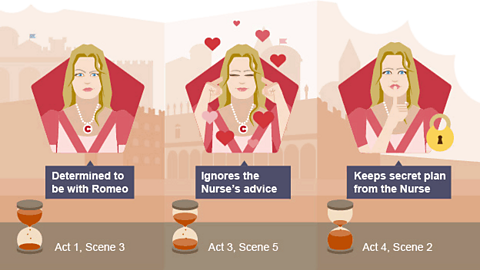
Changes in character
- Initially Juliet is innocent and obedient, but after she meets Romeo we see her more determined side.
- She appears childish at first and is still looked after by her Nurse. However, we later see Juliet stand up to the Nurse when she advises forgetting about Romeo.
- At the start of the play, Juliet trusts the Nurse who even helps arrange the secret marriage. Later though, Juliet acts more independently, keeping her plan to be reunited with Romeo a secret from the Nurse.
Character analysis
Question
How does Juliet show her obedience?
When Lady Capulet mentions the proposed marriage to Paris, Juliet promises to obey her parents’ wishes and to look at Paris at the party with an intent to like him:
JULIET
I’ll look to like, if looking liking move.
Act 5 Scene 3
Question
Is Juliet realistic?
Yes. She asks Romeo not to make promises by the moon because it waxes and wanes (changes):
JULIET
O swear not by the moon, th’inconstant moon.
Act 2 Scene 2
Question
Does Juliet believe her life is fated?
Yes. After Romeo has been banished he and Juliet spend one night together. As he leaves, Juliet looks from the balcony and seems to see a vision of their tragically destined future. She says:
JULIET
Methinks I see thee now, thou art so low,
As one dead in the bottom of a tomb
Act 2 Scene 2
Question
How is Juliet’s death portrayed by Shakespeare?
Juliet is courageous. When she sees Romeo dead by her side, she quickly takes his dagger and kills herself. She says:
JULIET
O happy dagger
Act 5 Scene 3
Her suicide is often seen as a more violent end than Romeo’s death by poisoning.
Listening task
In Act 3 Scene 2 Juliet learns from the Nurse that Romeo has killed Tybalt. In this section she reacts to the news.
Romeo and Juliet characters - Juliet
JULIET
O serpent heart, hid with a flow’ring face!
Did ever dragon keep so fair a cave?
Beautiful tyrant, fiend angelical!
Dove-feathered raven, wolvish-ravening lamb!
Despisèd substance of divinest show!
Just opposite to what thou justly seem'st,
A damnèd saint, an honourable villain!
O nature, what hadst thou to do in hell
When thou didst bower the spirit of a fiend
In mortal paradise of such sweet flesh?
Was ever book containing such vile matter
So fairly bound? O that deceit should dwell
In such a gorgeous palace!
NURSE
There's no trust,
No faith, no honesty in men, all perjured,
All forsworn, all naught, all dissemblers.
Ah, where's my man? Give me some aqua-vitae;
These griefs, these woes, these sorrows make me old.
Shame come to Romeo!
JULIET
Blistered be thy tongue
For such a wish! he was not born to shame:
Upon his brow shame is ashamed to sit;
For 'tis a throne where honour may be crowned
Sole monarch of the universal earth.
O, what a beast was I to chide at him!
NURSE
Will you speak well of him that killed your cousin?
JULIET
Shall I speak ill of him that is my husband?
Question
How does Juliet curse the Nurse’s suggestion that she should forget about Romeo?
JULIET
Blistered be thy tongue
For such a wish
Act 3 Scene 2
Question
How does Juliet feel about the news that her husband has killed her cousin?
She is upset that the one she loves has also caused her pain.
Friar Lawrence
The Friar is a close friend of Romeo’s. He is a good and kind character who supports the young lovers and helps them to marry in secret. After Romeo is banished, he makes a potion that Juliet will take to appear dead. The plan is that she and Romeo will escape together, but the message about the plan never reaches Romeo. Friar Lawrence is an important character as he heavily influences the action of the play.

Image caption, Character attributes
1 of 3
Character attributes
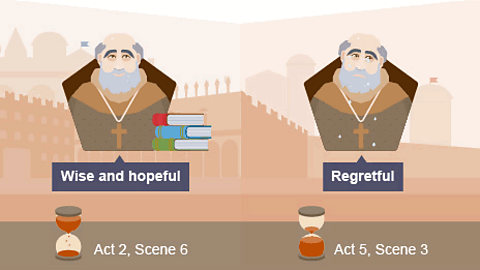
- Trustworthy – both Romeo and Juliet confide in Friar Lawrence. He is a neutral character who hopes that by marrying the young lovers, the two feuding families will come to peace.
- Wise – the Friar challenges Romeo when he switches the focus of his affections from Rosaline to Juliet. He also has faith in the young people.
- Compassionate – he comforts Juliet when Romeo is banished and she is told to marry Paris.
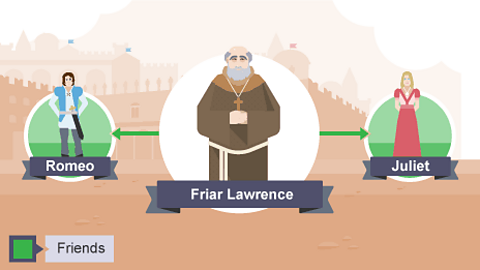
Friends
The Friar’s friends are:
- Romeo - he listens and offers counsel to Romeo
- Juliet – he conducts the marriage between her and Romeo and later helps her come up with a plan to be reunited with her husband
Changes in character
- Friar Lawrence is a steady character throughout the play. He hopes that good will come from the marriage between Romeo and Juliet. The main change we see in him is at the end when he expresses regret about his role in their deaths.- -
Character analysis
Question
Why does Friar Lawrence make reference to nature in his speech about duality?
When the Friar says:
FRIAR LAWRENCE
Within the infant rind of this small flower.Poison hath residence, and medicine power
Act 2 Scene 3
He shows the audience that there is both good and bad in everything, and plants can be both healing and poisonous. This is reflected in the relationships between the Capulets and Montagues. Although the families are enemies, Romeo and Juliet find love.
Question
How does Friar Lawrence show his foresight?
When Romeo and Juliet meet to be married in secret, the Friar worries that the extremes of their passion may end in tears. He says:
FRIAR LAWRENCE
These violent delights have violent ends
Act 2 Scene 6
Question
What does Friar Lawrence show when he says:
FRIAR LAWRENCE
To blaze your marriage, reconcile your friends
Act 3 Scene 3
The Friar shows that he is hopeful. When Romeo is banished, the Friar advises him to be patient and await a time when he will be able to be with Juliet and bring peace.
Listening task
In Act 2 Scene 6, Friar Lawrence marries Romeo and Juliet in secret.
Romeo and Juliet characters - Friar Lawrence
FRIAR LAWRENCE
So smile the heavens upon this holy act,
That after-hours with sorrow chide us not.
ROMEO
Amen, amen! but come what sorrow can,
It cannot countervail the exchange of joy
That one short minute gives me in her sight.
Do thou but close our hands with holy words,
Then love-devouring Death do what he dare,
It is enough I may but call her mine.
FRIAR LAWRENCE
These violent delights have violent ends,
And in their triumph die like fire and powder,
Which as they kiss consume. The sweetest honey
Is loathsome in his own deliciousness,
And in the taste confounds the appetite.
Therefore love moderately, long love doth so;
Too swift arrives as tardy as too slow.
JULIET
Here comes the lady. O, so light a foot.Will ne'er wear out the everlasting flint;A lover may bestride the gossamers
That idles in the wanton summer air,
And yet not fall, so light is vanity.
JULIET
Good even to my ghostly confessor.
FRIAR LAWRENCE
Romeo shall thank thee, daughter, for us both.
Question
Which word does the Friar repeat to describe both the potential "delights" and "ends" of this marriage?
"Violent"
Question
What does Juliet call the Friar?
"My ghostly confessor"
The Nurse
At the start of the play we see the Nurse as Juliet’s carer and confidante and she helps arrange the marriage between Juliet and Romeo. Although she is an adult, she is sometimes seen as less mature than the teenage lovers. Her language is often bawdy and she seems to enjoy crude humour. After Tybalt’s death she tells Juliet that she should forget about Romeo and marry Paris instead. This could be seen as a betrayal by the once trustworthy Nurse, or as evidence that she wants to protect Juliet from pain.

Image caption, Character attributes


1 of 3
Character attributes
- Trustworthy – the Nurse is Juliet’s companion and confidante. She has brought Juliet up from birth and wants the best for her. She keeps the meetings between Juliet and Romeo a secret.
- Playful – when the Nurse brings news from Romeo to Juliet about their marriage arrangements, she teases Juliet by taking time to tell her his answer.
- Caring – the Nurse puts Juliet’s wishes first and takes big risks by arranging secret meetings and a marriage for Romeo and Juliet.
Friends
The Nurse’s friends are:
- Juliet - she is like a mother to her
- The Capulet family – she has a strong allegiance and sense of duty to them
Changes in character
- Early on, the Nurse is playful and goes along with Juliet’s wishes. She shows support for the secret love between her ward and Romeo.
- After Tybalt’s death the Nurse advises Juliet to forget about Romeo and suggests that Paris is the better man. Juliet ceases to confide in her after this.
Character analysis
Question
What does it show about the Nurse’s character when she teases Juliet and prolongs the delivery of her news from Romeo?
The Nurse knows that Juliet is impatient to hear Romeo’s response to the wedding arrangements she has made with Friar Lawrence. Instead of telling Juliet the news immediately, the Nurse makes her wait. She says:
NURSE
Your love says, like an honest gentleman,
and a courteous, and a kind, and a handsome,
and, I warrant, a virtuous, - Where is your mother?
Act 2 Scene 5
She complains she has no breath to talk, that she has a headache, and here pretends to be distracted by Romeo’s virtues, rather than revealing what he has said. This shows us the Nurse’s playful character.
Listening task
We first meet the Nurse in Act 1 Scene 3. Here she talks about how she has nursed Juliet since she was a baby.
Romeo and Juliet characters - The Nurse
LADY CAPULET
She's not fourteen.
NURSE
I'll lay fourteen of my teeth -
And yet to my teeth be it spoken, I have but four -
She is not fourteen. How long is it now
To Lammas-tide?
LADY CAPULET
A fortnight and odd days.
NURSE
Even or odd, of all days in the year,
Come Lammas-eve at night shall she be fourteen.
Susan and she - God rest all Christian souls! -
Were of an age. Well, Susan is with God,
She was too good for me. But, as I said,
On Lammas-eve at night shall she be fourteen,
That shall she, marry, I remember it well.
'Tis since the earthquake now eleven years,
And she was weaned - I never shall forget it -
Of all the days of the year, upon that day;
For I had then laid wormwood to my dug,
Sitting in the sun under the dove-house wall.
My lord and you were then at Mantua -
Nay, I do bear a brain - but, as I said,
When it did taste the wormwood on the nipple.
Of my dug, and felt it bitter, pretty fool,
To see it tetchy and fall out wi’th th’dug!
‘Shake!’ quoth the dove-house; 'twas no need, I trow,
To bid me trudge.
And since that time it is eleven years,
For then she could stand high-lone; nay, by th’rood,
She could have run and waddled all about;
For even the day before, she broke her brow,
And then my husband - God be with his soul,
‘A was a merry man - took up the child.
'Yea', quoth he, 'dost thou fall upon thy face?
Thou wilt fall backward when thou hast more wit,
Wilt thou not, Jule?' And, by my holidam,
The pretty wretch left crying, and said 'Ay'.
To see now how a jest shall come about!
I warrant, and I should live a thousand years,
I never should forget it: 'Wilt thou not, Jule?' quoth he;
And, pretty fool, it stinted and said 'Ay'.
LADY CAPULET
Enough of this, I pray thee, hold thy peace.
Question
Who is Susan?
The Nurse’s own child.
Question
When does the Nurse say Juliet will be 14?
At Lammas-eve
More on Romeo and Juliet
Find out more by working through a topic
- count3 of 5

- count4 of 5

- count5 of 5
- count1 of 5