Watch: Planning a story

Writers plan their stories before they start writing so that they know what is going to happen. Planning is an important part of writing a good story.
Watch this short clip to get some ideas about how to plan a story and what to include.
Narrator: Hey, Frank, let’s write a story, let’s make it a spooky one!
When writing, it helps to have a plan – like this one.
But behind every good plan, there’s research.
Because we’re writing a spooky story, better get reading some spooky books.
Or even better, get some experience in the real world.
Back to that plan we had…this is where we start making notes.
Look around and think about distinctive features for your story.
Think about a setting and some characters.
The best stories have a challenge…
Ghost: OoooOOOoooOO!
Frank: ARGH!
Narrator: …and a solution.
Not to forget an exciting ending too.
We now have the makings of the world’s best spooky story!
Ghost: OooOOOoo!
Watch: What is a story mountain?
Writers call the main events that happen in a story the plot. A story mountain is a useful way to organise your plot.
Watch the following clip to learn about what a story mountain is.
Learn how to give your story a beginning, middle and end.
How to Create a Story Structure
Every story needs a plot – an exciting series of events.
Most stories follow a simple structure that is called the Story Mountain, but obviously all stories don’t have to have a mountain in them!
The foot of the mountain is your opening, where you introduce your hero and start setting the scene.
Ah! A Knight! A perfect character for your story.
Your next stage takes you up the story mountain.
It’s called the build up.
Here you build up the main body of the story.
A plot will always be engaging if you add in a conflict – a fight or a mystery to solve.
It seems that the evil wizard in the castle on the other side of the mountain has kidnapped the heir to the throne.
What a rascal! Our knight must do something about this!
Now you're at the top of the mountain where the story… ahem… peaks, and our characters encounter a major problem, obstacle or dilemma.
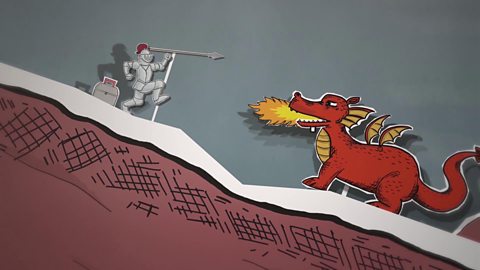
A dragon.
I would consider that a fairly big obstacle.
And the evil wizard has an army as well. Goodness me.
How is the knight ever going to get past them?
Is our knight going to be roasted alive like a metal kebab?
This is the most thrilling part of the story – be sure to keep your readers in suspense…
Next we need a resolution.
How does your character deal with the dilemma?
This is the point at which your character has to solve or resolve a problem to reach their goal.
It’s a good idea to try and make your resolution unusual and original.
Well, I didn’t see that coming!
Serves you right, you weasel!
At the bottom of the mountain is the ending and conclusion of your story with everything resolved.
Just because it’s the end doesn’t mean you can’t be creative.
You could add an unexpected twist!
Your story needs to engage the audience with an exciting plot and keep them engaged from the opening, through the build up, problem and resolution right up to the ending on the final page. And beyond!
Now, I think I’ll have a Wild Boar and Cabbage Special Sandwich.
But, on brown bread or white?
Oh. Black it is.
The story mountain
1. Opening - Start your story with an interesting main character and decide where the story is going to take place.
For example: There is a knight who lives in a peaceful village.
2. Build up - What is going to happen in your story? Add in some problems or a mystery to solve.
For example: An evil wizard kidnaps the king.
3. Problem - Pick what problem your main character is going to have to overcome. Maybe a dragon or an evil wizard is causing problems in the town?
For example: The wizard has a fire breathing dragon locked up guarding his lair.
4. Resolution - How does your character deal with the problem? How will they solve it?
For example: The knight releases the dragon from his chains, giving him his freedom. In thanks the dragon assists the knight. The knight finds the king and the dragon eats the wizard!
5. Ending - What happens to your character? You could add an unexpected twist!
For example: The dragon and knight become allies and friends and return the king back to his throne. The whole kingdom rejoices.
Activity 1
Activity 2
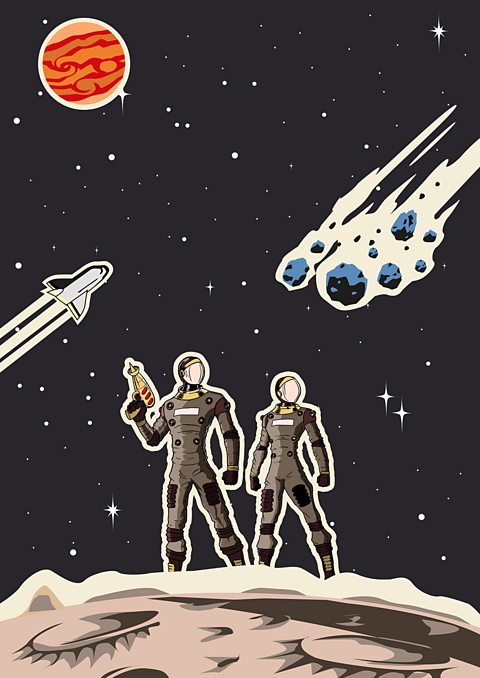
Look at this picture of two astronauts in space.
Imagine you are one of the astronauts in the picture. Write at least five sentences saying what you can see, hear, smell and feel.Try and write interesting sentences that include describing words.
Top tip!
Use your imagination. You could describe things that would be in that setting but that can’t be seen in the picture.
Activity 3
You are going to create a story based on the picture you chose in Activity 2.
First, draw out your story mountain and add labels to show where the opening, build-up, problem, resolution and ending should go. Like this:
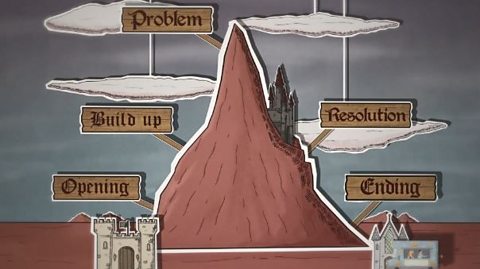
Next to your labels, write notes giving more information. Use the questions below to help you.
Opening: Who is your character? Why are they there? What are they like?
Build up: What happens to your character?
Problem: What problem do they have to overcome? Maybe you introduce a ‘baddie’ here?
Resolution: How does your character fix the problem?
Ending: Is there a twist? Does everything turn out ok?
Top tip!
You can watch the story mountain video again to help remind you about what to include in each section.
This is just the plan, so you do not need to write in full sentences yet.
Activity 4
Now write your story using your story mountain plan.
It does not have to be a very long story, but you need to make sure that you include each part of the story mountain.
Aim to:
- write each section of the story mountain as a new paragraph
- write at least two sentences per paragraph
- use describing words to describe your character and setting
- use full stops and capital letters correctly
Play our fun English game Crystal Explorers! game
Use grammar, punctuation and spelling skills to explore jungles, caves and tombs on your mission.

More on Creative writing
Find out more by working through a topic
- count14 of 25
- count15 of 25
- count16 of 25
- count17 of 25