How does behaviour help animals maintain their body temperature?
Video - Animal behaviour
In this video, learn how conformers and regulators change their behaviour to maintain their body temperature.
Find out how animal behaviour helps them maintain their body temperature.
Come along children.
This lesson is about some of the things animals do to keep what goes on inside their bodies perfectly balanced, and few things are more important to keep balanced than body temperature.
If animals get too hot or too cold, they can die!
This snake is sunbathing, or rather, basking in the sun.
Snakes, like all reptiles, are cold-blooded animals, also called conformers.
This means the temperature inside their bodies depends on their outside surroundings.
This snake is using the heat from the sun and the warmed-up rock it’s lying on to get the warmth and energy it needs to survive.
If it starts getting too hot, it’ll slither off and find some shade to lie in.
Conformers aren’t the only animals who are sun-seekers.
These geese are escaping the winter cold by migrating, which means flying to somewhere warm – sometimes thousands of miles away.
Geese, like all birds, are warm-blooded animals, also called regulators, whose bodies make their own heat, whatever the weather.
But they need plenty of food to do this and food for geese is usually easier to find in warm, rather than cold places, so they migrate.
Warm-blooded bears have a different way to survive winter months when food is scarce.
They make dens that they hibernate in for months on end.
When bears hibernate, everything that goes on inside their bodies slows down, like digestion, circulation and breathing.
This lets them save energy until spring comes around.
We flies, of course, are cold-blooded, so we need to find sources of heat outside our bodies if we want to stay warm.
Ah, fresh bear droppings, roasty toasty!
Learn more about how the weather affects animals and plants here: How does hot weather affect daily life?
What are conformers and regulators?
Video - Conformers and regulators
In this video, learn about the difference between conformers and regulators and how they maintain their body temperature in different ways.
Find out how conformers and regulators maintain their body temperature in different ways.
Right then children, we’ve come to the desert to find out about warm-blooded and cold-blooded animals, which are also known as regulators and conformers.
This sand lizard is a conformer, which means the temperature inside its body depends on its outside surroundings.
Here in the desert, the sand is so hot it has to keep swapping which feet it stands on so it doesn’t overheat!
If it all gets too much, it can burrow under the sand to where it’s cooler.
I think it’s time for us to get out of the hot sun as well.
Come on, get a move on!
Down here in the Antarctic, it’s so cold that it’s mainly only warm-blooded regulators that can live here.
These animals are able to keep their bodies about the same temperature.
But how do they do it?
Insulation is one way.
This seal, for example, has a thick layer of fat called blubber under its skin.
This acts like a blanket for its insides.
Seals also keep warm through something called heat exchange.
Warm blood flowing through their arteries passes alongside cold blood flowing through their veins.
The warm blood gets cooled down so it doesn’t lose too much heat when it reaches less insulated areas like a seal’s flippers or tail.
The cold blood coming back gets warmed up so it doesn’t chill the inside of the seal’s body too much.
Insulation and heat exchange help keep these penguins warm too.
They also huddle together to share body heat, swapping places to take it in turns to face the cold weather, or stay cosy in the middle.
Ah…
I think I’ve got snowed in.
Help me out, would you kids?
Oh…
I knew I should have worn leg warmers.
Quiz
More to learn
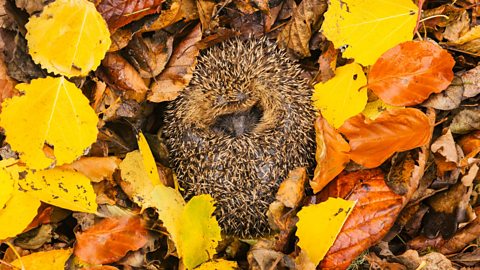
What is hibernation? revision-guide
Some animal hibernate to protect themselves from harsh winter weather conditions.
What is migration? revision-guide
As the seasons change, many animals move from one place to another. This is called migration. Learn more here.

How does hot weather affect daily life? revision-guide
How hot weather affects people, plants and animals

More on Body systems
Find out more by working through a topic
- count12 of 24

- count13 of 24
- count14 of 24
- count15 of 24