Did you know?
- The Times is the UK’s oldest current daily national newspaper, founded as The Daily Universal Register in 1785 before changing its name to The Times in 1788.
- The Daily Mail is currently Britain’s biggest selling daily newspaper.
- The Metro is the most highly circulated daily newspaper.
- The Observer was first published in 1791 and is the world’s oldest Sunday paper.
Introduction to newspaper reports
Have you ever wondered how newspapers came to exist or how newspapers decide what is ‘news’?
Key learning points
- A brief history of newspapers.
- The differences between broadsheet and tabloid newspapers.
- How to write like a journalist, creating memorable headlines and writing informative articles.
Video about newspapers
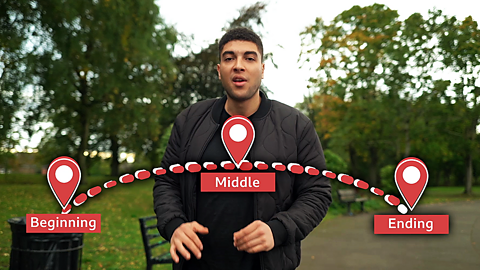
A video explaining the differences between tabloid and broadsheet newspapers and what goes in to making a newspaper report
Newspaper reports are written for different audiences – the same story could be covered in a tabloid, or a broadsheet newspaper.
However, there are likely to be differences in the way the story is reported and presented - starting with the headlines:
Baked Britain
Monday meltdown
Believe it or hot!
Tabloid headlines often use humour. They might also slightly exaggerate (only slightly, though!). They often feature alliteration.
Baked Britain Burns
Tabloids often use shock tactics to make their headlines dramatic and enticing. On the other hand, the headlines in broadsheet newspapers tend to be less dramatic, appealing to an audience interested in reading longer articles:
Hottest day of the year in UK heatwave
Whether they’re writing for tabloids or broadsheets, journalists use facts to add substance and authority. Simple, succinct information can help to clarify specific details.
Hottest day of the year hits 37 C high
After the headline, comes the by-line. A by-line can just say who wrote the article, or it might add a short summary.
Amy Jones reports on how the heatwave is predicted to bring record-breaking temperatures.
Articles often follow an ordered structure, starting with the lead paragraph. The format is similar for either a tabloid or a broadsheet. Stories tend to start with the main news facts: what happened, when, who was involved and why it happened?
Then, in the main body of the article, we might find more details - facts, stats, quotations from relevant people or, perhaps, analysis. The main events of the story are described in chronological order. Quotes are often the heart of an article, and journalists try to build a picture of how this story fits into current trends or the wider world. The summary might point to the future.
So, the same story, a similar structure, but with a different approach to writing - to appeal to different audiences.
Informal, straightforward language in the tabloid, contrasted with more formal, often more complex language in the broadsheet.
And alongside the article, there’s the layout, presentation and images to consider, but that’s another story altogether.
History of newspapers
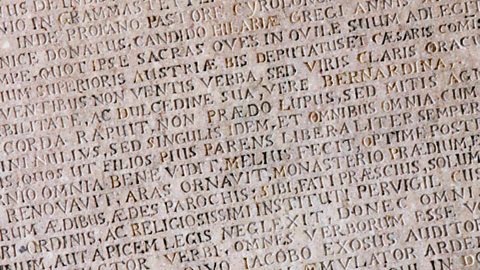
Image caption, The first regular recorded news service was the Acta Diurna (Daily Acts), which was published in ancient Rome from 59 BC. News was carved into stone or metal and displayed in public places. It contained births, marriages, deaths, and important announcements from Emperors to Roman citizens.
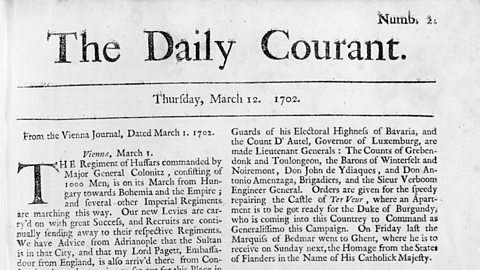

1 of 4
Broadsheets v tabloids
Broadsheets
- Historically A newspaper with large format regarded as serious. were much larger than tabloid newspapers.
- They first appeared in the 18th century to reduce the number of pages a newspaper needed, so as to reduce the amount of tax paid.
- As they focused on political and business news, they had fewer readers.
- They tend to have more in-depth, longer articles.
Tabloids
- Traditionally, A newspaper smaller than a broadsheet, with many images and sensational headlines. newspapers, were significantly smaller than broadsheets.
- Their content was viewed as less ‘serious,’ less in-depth, for entertainment and easier to read.
- Sometimes known as ‘red tops’ in the UK they were instantly recognisable because of their red The newspaper’s title or name, displayed on the front page..
- Also recognisable by their large photographs and less text on the front page.
However, both tabloid and broadsheet newspapers have shared elements of serious news, business, general interest and entertainment. Today, some of the traditional broadsheet newspapers have become smaller in size and some newspapers are now entirely online – so it is not as easy to split them into these two types.
Headlines and by-lines
To attract people to buy and read the news, newspaper articles need to grab readers’ attention. One way every article does this is through the use of headlines.
Headlines are headings that title newspaper articles. inform the reader about the content and purpose of the article. Headlines are usually short and remove unnecessary words, for example, this headline: ‘Baby found alive after earthquake’ has removed all the little words: A baby is found alive after an earthquake.
Headlines can:
- be informative
- be humorous
- use famous quotes
- use puns (word play) or The repetition of the same sounds or consonants in two more words nearby each other.
- make bold statements
- ask a question
- shock the reader
They are often accompanied by subheadlines or subheadings. A subheadline is a smaller title beneath the headline that adds information or makes it clearer what the article is about.
Near the headline or sub-headline, there is a by-line. By-lines give the names of the journalists that are involved in researching, writing and contributing to an article. This gives credibility to an article by showcasing the author, who may be an expert or well-informed about the subject matter in the article.
Puns and linguistic fun in headlines
Grabbing the reader’s attention through headlines needs more than a big bold font. The words selected for headlines are important. The way they are arranged requires linguistic creativity. Since headlines need to be short and punchy, Words or phrases that convey a deeper meaning than the literal one. can be used to create as much impact as possible in the least number of words.
| Linguistic device | Example |
|---|---|
| Puns (word play) | Wages Frozen for Ice-Cream Sellers |
| Alliteration (repetition of sounds and letters) | Pupils Prefer Pizza |
| Hyperbole (exaggeration) | Unluckiest Man in the World |
| Allusion (an indirect reference to something) | Love rat Ricky is no Romeo! |
| Colloquial slang (informal language and nicknames) | Wills and Kate Jet Off |
| Rhyme | Queen’s Green Anger |
| Statistics or numbers | 68% drop in Wildlife Populations |
| Rhetorical question | Is this lake cursed? |
Images and influence
To attract a reader's attention, newspaper articles often use images that support the headline and the content in articles. Photographs in a newspaper are chosen by a picture editor and these choices play a crucial role in determining the look of a newspaper, especially the front page.
Photographs can provide evidence that the news article is authentic and truthful. They are usually accompanied by captions, below the picture, which describe what is happening in the picture.
Images can also include infographics, timelines, graphs – all of which collate and breakdown large and complex information for readers. Other images such as caricatures (distorted and exaggerated cartoons) can also be used to mock and An imitation of something with deliberate exaggeration for a comedic effect. the subjects of the article.
Why images are used
Images provide fast and easily accessible information. The choice of photograph also plays a key role in influencing the reading of a story.
Images can influence readers through their ability to:
- evoke emotion
- ‘see’ what is being written about
- allow the reader to view the evidence for themselves
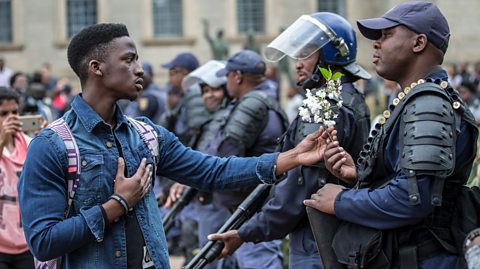
An image of a student peacefully protesting by giving flowers to an anti-riot policeman in Johannesburg, South Africa, accompanied by the headline, ‘Let there be peace!’ could evoke emotion in the viewer by:
A. Making them laugh
B. Making them take the side of armed soldiers
C. Making them feel concerned for the citizen's safety and touched by their bravery
This image will C. Make the reader feel concerned for the citizen's safety and touched by their bravery
The When two very different things are placed together for a contrasting effect. of unarmed peaceful protesters with armed soldiers could trigger shock and support.
Language and structure
News articles are usually written in short sentences with key information given straightaway. The journalist must hook the reader in and ensure they keep reading in the first few sentences. To do this, they must capture the key points of the story using as few words as possible.
The language reflects the readership of the paper, for example, tabloids may use shorter sentences with more informal language - broadsheets may use more formal and complex language.
The language used in newspaper articles also needs to reflect the topic. Lighter, less serious news can be written using humour, unlike more serious news articles on natural disasters or crime.
Click on the interactive graphic below to learn how news articles use an inverted pyramid structure:
Test your knowledge
Play Bitesize secondary games. game
Have fun playing science, maths, history, geography and language games.

More on Non-fiction writing
Find out more by working through a topic
- count6 of 10
- count7 of 10
- count8 of 10

- count9 of 10