When was the Viking age?
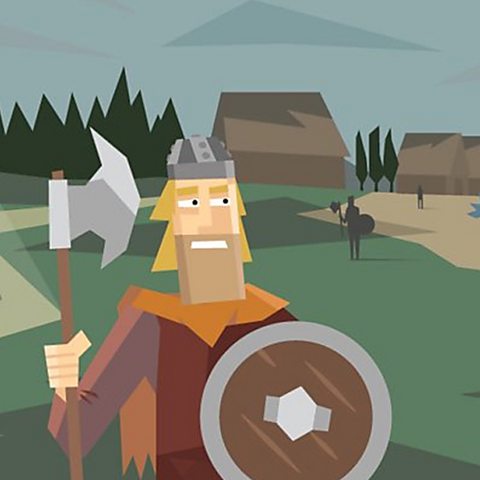
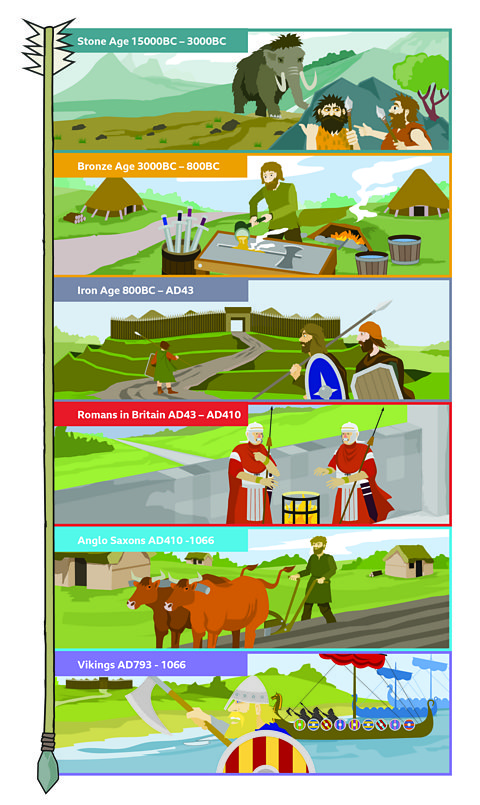
The Viking age was from about AD700 to 1100. Many Vikings left their homes in Scandinavia and travelled by longboat to other countries, like Britain and Ireland.
The people of Britain called the invaders 'Danes', but they came from Norway and Sweden as well as Denmark.
Vikings sailed the seas trading goods. They bought silver, silks, spices, wine, jewellery, glass and pottery to bring back home.
Watch: Who were the Vikings?
Find out more about who the Vikings were and where they came from.
Excuse me. Yes, you… would you like to learn about the Vikings? Great! Well let’s start at the beginning…
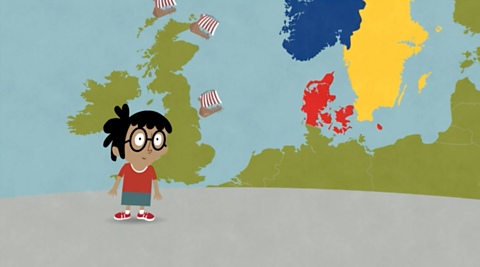
The Vikings lived over 1000 years ago, but they don’t look that old to me, what’s your secret? The Vikings were Norse people who came from an area called Scandinavia. You might know it better as Norway, Sweden and Denmark.
The word Viking means ‘a pirate raid’, which is a fitting name as they were fearsome warriors and often raided monasteries for treasure.
But they weren’t all bad, bloodthirsty and violent - they also settled with their families and farmed the land peacefully for many years.
I’m sorry about this… they never wore horned helmets. Let’s move on.
Did you know they were great explorers too and travelled all over the world? Vikings explored as far away as North America. Can you believe they even travelled through Russia to trade in the Middle East. Amazing!
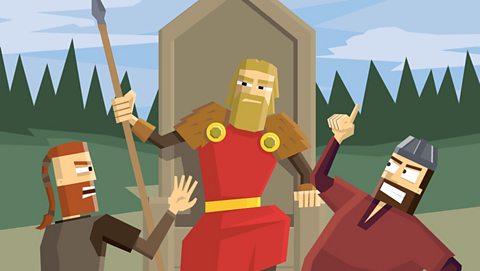
Ah, ‘The Thing’, an early version of today’s parliament. The Norse people met to discuss new laws and solve arguments. They’re arguing over who owns your shoes.
Plus, we still use some of their Old Norse language today. Words like ‘egg’, ‘muck’ and ‘dirt’.
Even some modern town names are based on Viking words! York and places that end in ‘thorpe’, ‘by’ or ‘kirk’. So for example, the Viking word for deer is “djúr” and village is ‘bȳ’ - together making “Derby”.
There we go - the history of the Norse people in a matter of minutes. How enjoyable was that? Fantastic! Isn’t history great? Oh, you look like you need a bath.
What kind of people were the Vikings?
The name 'Viking' comes from a language called 'Old Norse'. It means ‘a pirate raid’. People who went off raiding in ships were said to be 'going Viking'. But not all the Vikings were bloodthirsty warriors.
Some came to fight, but others came peacefully, to settle. They were farmers, and kept animals and grew crops. They were skilful at crafting, and made beautiful metalwork and wooden carvings.
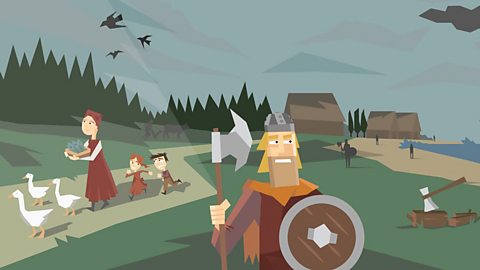
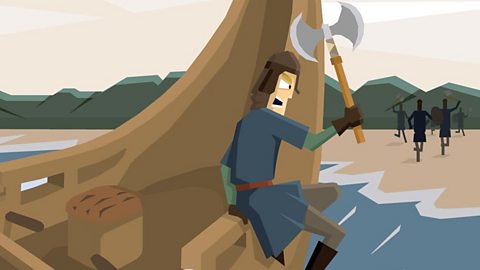
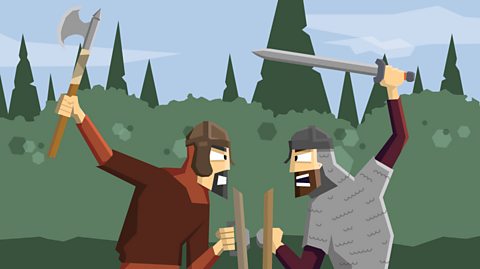
Viking warriors fought using long swords and axes.
The first Viking raid recorded in the Anglo-Saxon Chronicle was around AD787. It was the start of a fierce struggle between the Anglo-Saxons and the Vikings.
The Vikings were pagans, not Christians like most people living in Britain at the time. They did not think twice about raiding a monastery.
Christian monasteries in Britain were easy targets for the Vikings. The monks had no weapons and the buildings were filled with valuable treasures, like gold, jewels and books. There was food, drink, cattle, and clothes too.
Watch: Viking attack at Lindisfarne
In AD793 the Vikings famously attacked a monastery at Lindisfarne in Northumbria, north-east England
Over a 1,000 years ago, on the 8 of June AD793, a small band of Vikings sailed down theeastern coast of England.
Their target was a monastery called Lindisfarne, and they decided to launch a surprise attack.It's likely that the first thing the monks saw was the outline of two or three ships on the horizon, butthat would hardly have been unusual.
Living here, they would have been accustomed to the arrival of ships from all sorts of places.Maybe a few of the monks came down onto the beach to welcome the newcomers, with openarms.
But the monks weren't prepared for visitors like these… because these were Viking warriors.And they had come to kill the monks and steal the monastery's treasure.
Life in England was about to change forever, because the savage attack on Lindisfarne was justthe beginning.
50 years after the attack on the Lindisfarne monastery, a huge force of around 3,000Vikings arrived on our shores, and they wanted to conquer the whole of England.
This was truly a force to be reckoned with. The Anglo-Saxons called it the Great HeathenArmy, and it wasn't just a raiding party intent on slaves and gold.
The Great Heathen Army wanted everything, and to get it, they would have to take on the AngloSaxons.
What was the Viking invasion?
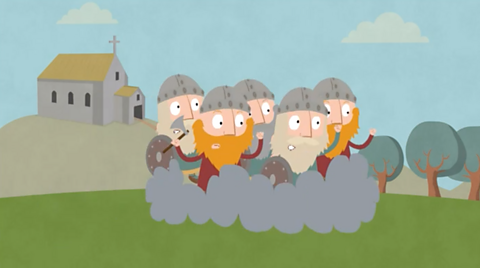
In AD865 an army of Vikings sailed across the North Sea. This time they wanted to conquer land rather than just raid it.
They stayed in Britain for the first time in the winter of AD866.
Over several years the army battled through northern England, taking control of the Anglo-Saxon kingdoms of Northumbria, East Anglia and most of Mercia.
By AD878, almost all the kingdoms had fallen to the Vikings. All except for Wessex, which was ruled by Alfred the Great. King Alfred beat the Viking army in battle but wasn't able to drive the Vikings out of Britain.
What happened between the Vikings and Alfred the Great?
After years of fighting the Vikings and Alfred made a peace agreement. But even after this agreement, fighting went on for many more years. Animaginary dividing line was agreed to run across England, from London in the south towards Chester in the north west.
The Anglo-Saxon lands were to the west and the Viking lands, known as the Danelaw, were roughly to the east.
Where did the Vikings settle?
Vikings travelled from Scandinavia to Britain. They mostly settled in the Danelaw, to the north and east of England.
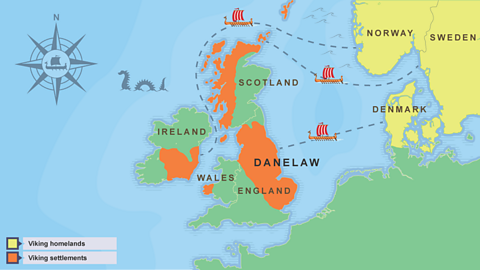
Some Norwegian Vikings or 'Norse' sailed to Scotland. They made settlements in the north, and on the Shetland and Orkney Islands.
Vikings also settled on the Isle of Man and often raided Wales, but few made homes there. In Ireland, the Vikings founded the city of Dublin.
What was the Danelaw like?
The Danelaw covered an area east of their line joining London and Chester. Everything to the east belonged to the Vikings.
There were three main areas where Vikings lived in England:
- Northumbria (which included modern-day Yorkshire)
- East Anglia
- The Five Boroughs (also known as a town: they were Leicester, Nottingham, Derby, Stamford and Lincoln)
Viking families came to settle on these lands. There wasn't much good farmland in the Vikings' own countries, and they were looking for a better life.
The most important city in the Danelaw was the city of York, or ‘Jorvik’ (pronounced 'your-vick'), as the Vikings knew it. Over 10,000 people lived there and it was an important place to trade goods.
Many towns and cities in Britain that were founded by the Vikings can still be spotted today. Places that end in -by, -thorpe or -ay were almost certainly Viking towns.
How do we know about the Vikings?
Almost all of the written evidence about the Viking invasions and settlement in Britain comes from the English version of events, mostly from the Anglo-Saxon Chronicles and later medieval sources, such as histories and poems.
These usually show the Vikings as blood-thirsty invaders and the people and kings of Wessex as the heroic defenders of ‘England’.
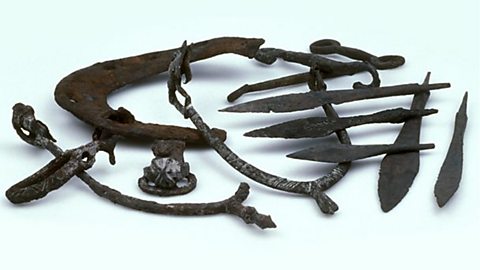
The Vikings themselves did not leave a written record during the Viking Age (AD700-1100) but Vikings did use runes. There is writing from the 13th century that records stories handed down by word-of-mouth for centuries.
Archaeology is a major source of evidence, including the long ships, grave-goods, and coins.
When was the Viking age in British history?
Activity: Quiz – Who were the Vikings?
Teaching resources
Are you a teacher looking for more resources? This collection of short KS2 Vikings videos can help to support your lessons and highlight what life was like as a Viking in Britain.
BBC Bitesize for Teachers has thousands of free, curriculum-linked resources to help deliver lessons - all arranged by subject and age group.
SATs preparation resources. activity
Get ready for the SATs papers with videos, activities, quizzes and games to refresh your knowledge and practise your skills.
More on Vikings
Find out more by working through a topic
- count2 of 10
- count3 of 10
- count4 of 10