Wood and sustainability
Wood is an incredibly useful and sustainable natural material which we get from trees.
In this article you can learn about:
Why we use wood
Why trees are important
Deforestation
How we can use wood sustainably
This resource is suitable for sustainability topics for primary school learners.
Video - Wood and sustainability
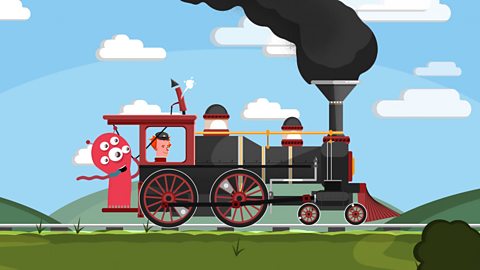
Meet Wood.
She's been helping humans make things for thousands of years.
She might look cute, but she's definitely got a destructive side!
In Great Britain, three quarters of the land was once covered in trees until our ancestors chopped them down to make things, fires and farmland.
Now only one eighth of Britain is forest.
Deforestation is when forests are chopped down, like in Brazil, where over 10,000 square kilometres of the Amazon rainforest is cut down every year.
That's twice the size of Scotland's biggest national park, the Cairngorms.
Thankfully, in Scotland, lots of our forests are sustainable.
So when trees are chopped down, more are planted, which is important, because trees absorb carbon dioxide from the air and help prevent global heating.
Wood naturally decomposes, contributing to the nutrient cycle and helping more life to thrive.
But why do humans still use wood so much?
Well, wood grows naturally, unlike man-made materials like plastic, glass or metal, which all take a lot of energy to make.
Secondly, wood is strong and easy to shape.
We can make houses from it, furniture, floorboards and loads of other stuff.
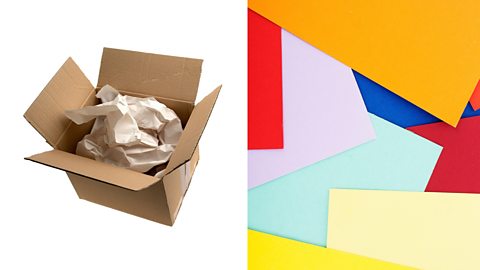
Third, if you chop wood into small pieces, pulp it with water, drain it, press it and dry it, then you get paper and cardboard!
So without wood, we wouldn't have books, breakfast cereal boxes or toilet roll.
Paper and cardboard are also easy to recycle compared to other materials.
So, are wood products sustainable?
That depends on the type of wood.
When you cut down a hardwood tree like an oak, it can take hundreds of years to grow a new one.
But if you chop down a softwood tree like pine, it'll grow back quickly, which is much more sustainable.
Some countries are using wood from sustainable forests to build homes and offices.
The manufacture of steel and concrete produces millions of tons of carbon dioxide.
So using sustainable wood is greener.
Wood isn't perfect. She's not a big fan of rain - it can make her warp and rot.
And she has to be careful around fire. Wood burns.
But if you treat Wood right, she can be strong, sustainable, and used in thousands of different ways.
75% of Britain’s land used to be covered in forest until our ancestors chopped down most of the trees. They did this to clear land and to use the wood for buildings, ships and fuel. Wood is a material which we still use a lot of throughout the world.
You can learn more about forests in Scotland here: Forests
Why do we use wood?
It’s a naturally-grown material that takes no extra energy to make, unlike plastic and metal.
We use wood for buildings, furniture, flooring, paper, cardboard and to make many other things.
Wood is a popular material because it is strong and flexible. It can be shaped or cut in any way and it is renewable. This means that it is a naturally replenishing material – it will grow back.
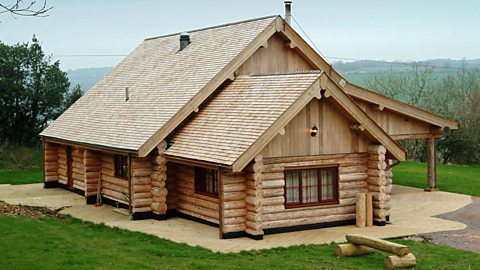
Image caption, Wood is strong enough to create sturdy houses and other buildings. (christopher jones / Alamy Stock Photo)
1 of 2
Why are trees important?
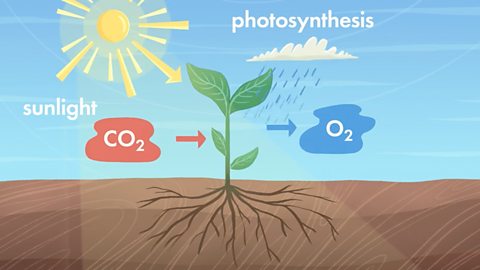
Likes all plants, trees To take something in, gradually. For example plants absorb carbon dioxide.carbon dioxide and release oxygen.
This is useful because:
All animals, including us, do the opposite: we breathe in oxygen and breathe out carbon dioxide. This means trees provide us with the oxygen we need to survive.
By absorbing carbon dioxide it also means trees prevent pollution, improve air quality and slow down the effects of climate change.
Trees also provide food and shelter for living creatures. We need lots of trees as part of our global The living organisms in a particular area (such as plants and animals), together with the non-living components of the environment (such as rocks and soil)..
Learn more about how photosynthesis works: How do plants get energy and food to grow?
What is deforestation?
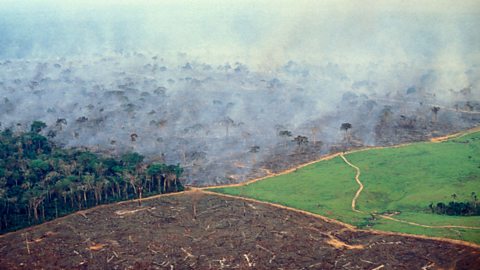
The removal of trees. This is sometimes done to make land for farming, roads or settlement. means the removal of trees. This is sometimes done to clear land for farming, roads or settlements. It is a big problem globally.
For example, in the Amazon Rainforest in South America around 13,235 km² of trees were cut down in 2021. Trees are removed to make space for things like farmland to raise cattle for the meat industry. That’s the same as around 2 million football pitches worth of trees being cut down in a year. It is notUsing something in a way that does not destroy it completely, for example growing food without destroying farmland or cutting down trees without destroying an entire forest..
In Scotland lots of our forests are now more sustainable. That means that when we cut down trees, we plant new ones to replace them so our forests stay alive and we protect our wildlife and environment.
How can we use wood sustainably?
We need to make sure we are making responsible choices about how we use wood.
Governments and companies need to get involved to make a difference.
They need to:
- plant new trees when they cut down old ones
- limit the amount they cut down at any one time
This is especially true of hardwood trees (like oak and ash) which can take up to hundreds of years to grow back. By comparison, softwood trees (like pine) grow back quite quickly so are a more sustainable option.
As wood is a natural material, it can sustain other types of life when it To break down and disappear over time. naturally. This means it breaks down as part of nature and becomes part of Dead wood, leaves and plant material break down and provide nutrients that are then absorbed by new plant and tree roots. by supporting wildlife and other living things.
We should leave most trees in the ground. This will help:
- protect us from climate change
- keep our air quality good
- provide a habitat for other plants and animals
- soak up water from the soil which helps prevent flooding
- give us beautiful landscapes to look at and enjoy
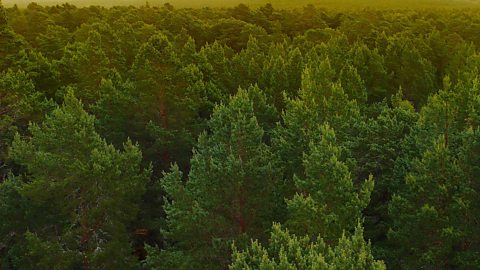
The advantages and disadvantages of wood
Advantages of wood
- It is a strong and flexible material to use in building.
- It has thousands of different uses and is often used in building, to make furniture, toys and types of tools.
- It is naturally replenishing and renewable as it grows naturally in the ground. This means using it damages the environment less than non-renewable energy sources and materials which don’t grow back.
- It biodegrades and breaks down naturally so contributes to the nutrient cycle to support other living things.
Disadvantages of wood
There are many disadvantages to using wood as a material because when alive as trees, wood is very useful to us!
- Deforestation negatively affects natural ecosystems, biodiversity and the climate.
- By absorbing carbon dioxide, trees help to slow down climate change. They also release oxygen and so are a natural part of the ecosystem. Cutting trees down to use as material means we don’t get this fantastic benefit.
- They are a beautiful part of nature when alive – it's a real shame to cut them down and lose stunning views, good air quality and the support of other life such as insects, animals and birds.

Key words about wood
Check your connection, refresh the page and try again. - Doing something that will cause little or no damage to the environment and will be able to continue for a long period of time.
Check your connection, refresh the page and try again. - Materials that are found in nature and have not been made by humans.
Check your connection, refresh the page and try again. - The cutting down of forests or groups of trees to clear the land for another use. Although the trees can be used to build homes and furniture, the land is often cleared to be used as farmland and to raise cattle, to build homes or for mining.
Check your connection, refresh the page and try again. - A geographic area made up of all of the living and nonliving things. It is an area where plants, animals, and other living things, as well as the landscape and weather work together. Ecosystems can be very large or very small.
Check your connection, refresh the page and try again. - A natural gas that is all around us. It is essential for life on Earth. For example, animals (including humans) breathe in oxygen and breathe out carbon dioxide, while plants do the opposite. But carbon dioxide is also created when fossil fuels are burned. This is a problem because there is now too much of it in the atmosphere. As a greenhouse gas, carbon dioxide is the main cause of global heating and therefore climate change.
Check your connection, refresh the page and try again. – A gas that you cannot see, taste or smell. It is all around us and what we breathe. All living things need oxygen for survival.
Check your connection, refresh the page and try again. - This is the long-term change in weather patterns (temperature, wind, rainfall etc.) on Earth, including its side-effects, for example increased drought and flooding.
Test your knowledge
Quiz
Challenge
Write a letter to your local MP, MSP or councillors
Find out what they are doing to support sustainable forests and tree planting in your local area.
If there are opportunities to get involved, you might consider helping. Or you might be able to encourage your MP, MSP or councillor to do more to make sure your local forests are looked after or that new trees are planted to improve your local area.
How do plants get energy and food to grow?
Learn about photosynthesis and respiration, and how plants gain nutrients to grow.
Why are forests important? revision-guide
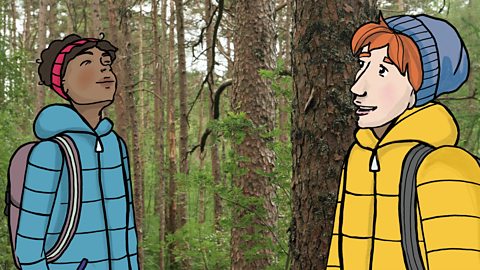
Isla and Connor explore forests in Loch Lomond and the Trossachs National Park.
Secrets of a forestry craftsperson. audio
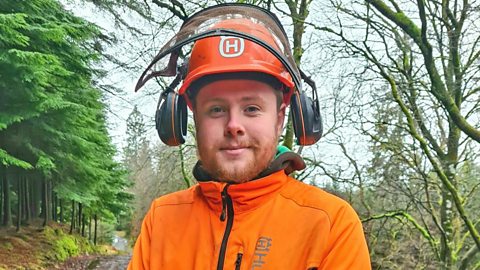
Jay Hannah loves working outdoors and looking after the forest so everyone can enjoy it.
More on Sustainability
Find out more by working through a topic
- count10 of 28
- count11 of 28
- count12 of 28
- count13 of 28