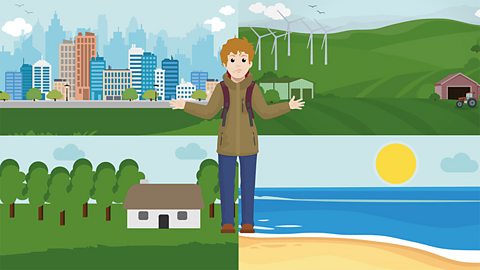
What is a city?
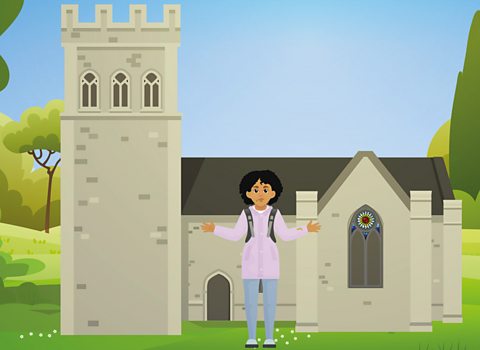
A city is a busy settlement where people live and work.
Cities were originally given their name by a king or queen, however today it could be because of the culture or the history of the area.
Historically, settlements with cathedrals such as Wells and Salisbury became cities.
Watch: Exploring UK cities
Learn more about what can be found in two UK cities, Cardiff and Birmingham.
Seren: Bore da! That’s “good morning” in Welsh. My name is Seren and today I’m in the capital city of Wales - Cardiff!
But what makes a city a city, and why’s it all here in the first place? It’s time to do some exploring.
A city is a big town, but not all big towns are cities. “City” is a title given to a town by a king or queen.
To become a city, a town has to be special in some way. It used to be because the town had a university or cathedral.
But these days it might be because a town has a very large population - that’s the number of people living there - or because it has an interesting history or culture.
Cardiff has it all!
Cardiff is in the south-east of Wales, where the River Taff and the River Severn pour out into the Bristol Channel between Wales and England.
Thousands of years ago, people came here to live so they could use the River Taff as a water supply, and they used both rivers as an easy way to travel.
King William I of England started work on a castle here in 1081 so he could keep an eye on Welsh people, and a town grew around it.
Then about 200 years ago, Cardiff became really well known as a port, shipping coal from the mines in south Wales to harbours all over the world.
A canal was dug and a railway was built. More and more people came here to work and the town grew bigger and richer. In 1905, Cardiff was made a city. In 1955 it became the capital city of Wales - and now about half a million people live here.
But no coal has left the port since the 1960s. The Senedd building - which is where the Welsh Parliament meets - was built right on the docks where the ships used to be loaded.
These days, Cardiff is known as a business centre, with TV and film companies, financial services, retail and many other businesses.
Big business is common in other cities too, such as Birmingham! Which is right in the middle of England in an area called The Midlands. Easy to remember, isn’t it?
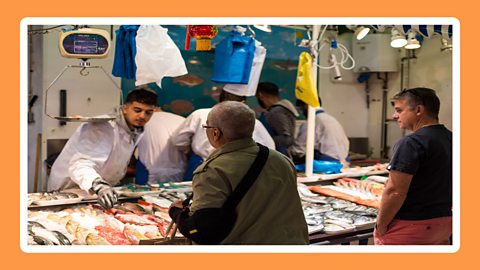
Birmingham is a really big city with a population of over a million people. It started as a successful market town where people would come to shop.
Then in the 1700s, the Industrial Revolution began – and it became known for making and building things in workshops and factories.
What city is nearest to you? Or maybe you live in one. Maybe you could visit a museum, and find out how it all began.
Bye for now - hwyl am nawr!
In the UK, there are 76 cities. There are:
- 55 in England
- 8 in Scotland
- 7 in Wales
- 6 in Northern Ireland.
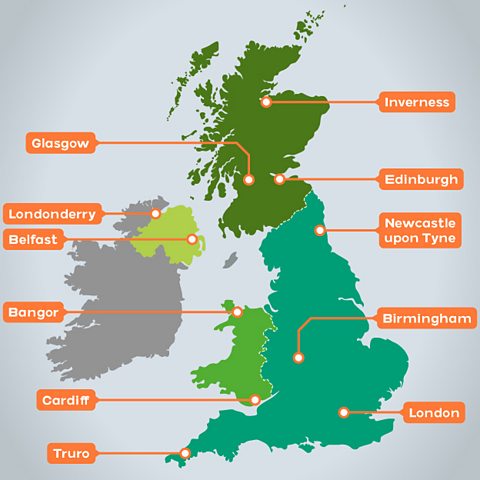
Cities across the UK
Have a look at some of the cities that can be found in the UK.
Features of a city

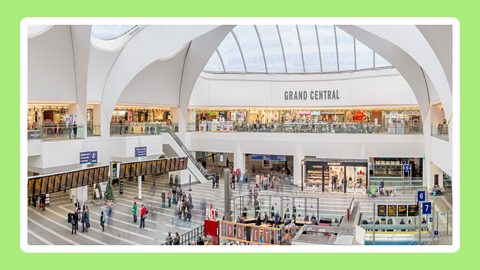
A city is a place that usually has a high concentration of buildings and is home to many people.
Here are some features that can be found in a city:
shopping centres
transport links
businesses and office space
places of worship
theatres and cinemas
Differences between cities
Cardiff, Wales
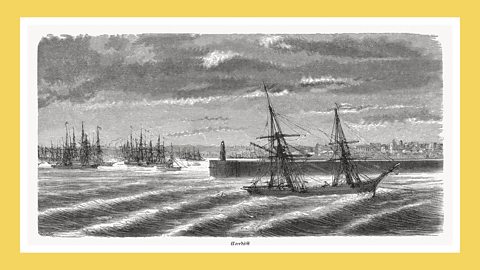
Image caption, History
Cardiff was originally a small town - until the 19th century, when it became a port for trading coal because of its location on the River Taff. A port is a place by the coast where ships can load and unload goods.
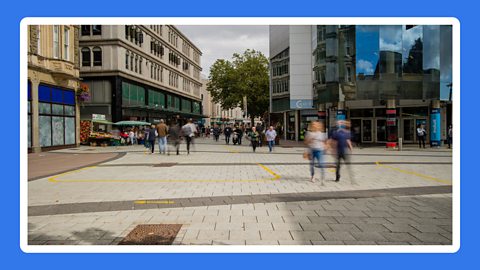
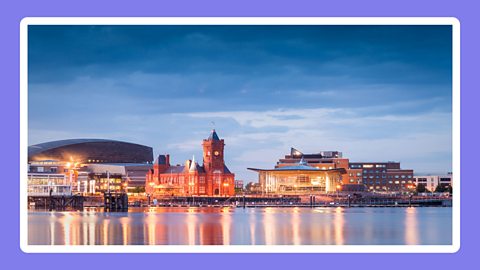
1 of 3
Birmingham, England
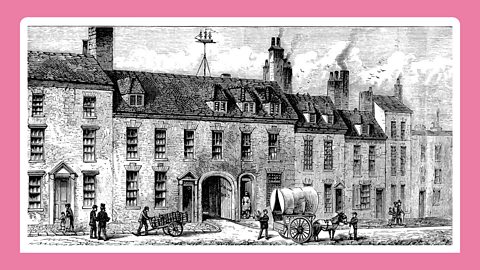
Image caption, History
Birmingham was a market town until the Industrial Revolution, where its central location in the country made it a great place for manufacturing and engineering factories to be built there.
1 of 3
Activities
Tap and find: Does it fit in a city?
Quiz: Exploring the city

Race Across the Continents game - new update! game
Help this team of adventurers race their way to victory. Explore the globe in this exciting game update to discover new audio voiced by Ade Adepitan and fun animations. Challenge yourself with brand-new achievements and become a high-flyer!

More on Geography of the UK
Find out more by working through a topic
- count9 of 32
- count10 of 32
- count11 of 32
- count12 of 32