Angles in Polygons
It may be useful to refer to M1 properties of angles; M1 properties of 2D shapes and M5 Polygons if necessary.
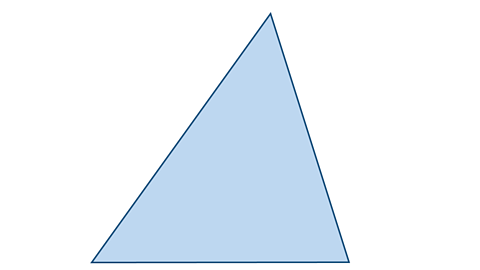
The sum of the angles inside any polygon can be found by spitting the polygon into triangles.
Consider any triangle. The sum of the angles is known to be 180°
A quadrilateral can be split into two triangles. Each triangle has 180°.
The sum of the angles in a quadrilateral is 2 x 180° = 360°
The sum of the angles in a pentagon is 3 × 180° = 540°
The sum of the angles in a hexagon is 4 × 180° = 720°
The number of triangles is always two less than the number of sides.
The formula for finding the sum of the interior angles in any polygon is:
Sum of interior angles = two less than the number of sides × 180°
In algebra this is
Sum of interior angles = 180(n – 2)
where n is the number of sides
In a regular polygon all the angles are equal. Each interior angle is calculated by dividing the sum of the interior angles by the number of sides.
Interior angle in a regular polygon = \(\mathbf{\frac{180(n-2)}{n}}\)
Example
- Calculate the sum of the angles in a regular octagon.
- Calculate the size of each angle.
Solution:
- Sum of interior angles = 180(n – 2)
For an octagon n = 8
Sum of interior angles = 180(8– 2) = 180 x 6 = 1080° - Interior angle in a regular polygon = \(\frac{180(n-2)}{n} \)
\(\frac{1080}{n} = \frac{1080}{8} = 135\textdegree\)
Question
Calculate the size of the interior angle of a regular hexagon.
Answer:
The sum of the interior angles is (6 - 2) x 180 = 720°
Each interior angle is 720 ÷ 6 = 120°
Exterior angles in polygons
If the side of a polygon is extended, the angle formed outside the polygon is the exterior angle.
The sum of the exterior angles of a polygon is 360°.
Calculating the size of each exterior angle of regular polygons
The formula for calculating the size of an exterior angle of a regular polygon is:
\(\text{exterior angle of a regular polygon}~=~{360°}~\div~\text{number of sides}\)
Remember, the interior and exterior angle add up to 180°.
Example
A regular polygon has an exterior angle of 12°.
How many sides does it have?
Solution:
We know that the exterior angle \( = \frac{360\textdegree}{(number~of~sides)}\)
By rearranging this formula we get
\(Number~of~sides = \frac{360\textdegree}{(exterior~angle)}\) When the exterior angle is 12° \(Number~of~sides = \frac{360}{12} = 30\)
The polygon has 30 sides
Question
Calculate the size of the exterior and interior angle in a regular pentagon.
Method one
- The sum of exterior angles is 360°
- The exterior angle is 360 ÷ 5 = 72°
- The interior and exterior angles add up to 180°
- The interior angle is 180 - 72 = 108°
Method two
- The sum of interior angles is (5 - 2) × 180 = 540°
- The interior angle is 540 ÷ 5 = 108°
- The interior and exterior angles add up to 180°
- The exterior angle is 180 - 108 = 72°
Question
Calculate the exterior angles of the irregular pentagon below:
Using the fact that interior plus exterior angles at a point add to 180°.
Working clockwise from the top we have:
- 180 – 78 = 102°
- 180 – 99 = 81°
- 180 – 117 = 63°
- 180 – 90 = 90°
- 180 – 156 = 24°
We can check our answer by ensuring that the exterior angles add up to 360°
102 + 81 + 63 + 90 + 24 = 360°
Remember:
- The sum of the angles in a triangle is 180°. To find the sum of the interior angles of a polygon, multiply the number of triangles in the polygon by 180°.
- The formula for calculating the sum of the interior angles in a polygon is \(({n}~-~{2})~\times~{180^\circ}\) where \(n\) is the number of sides.
- All the interior angles in a regular polygon are equal. The formula for calculating the size of an interior angle in a regular polygon is: the sum of interior angles \(\div\) number of sides.
- The sum of the exterior angles of a polygon is 360°.
- The formula for calculating the size of an exterior angle in a regular polygon is: 360 \(\div\) number of sides.
- If you know the exterior angle you can find the interior angle using the formula: interior angle + exterior angle = 180°
Test yourself
More on M6: Geometry and measures
Find out more by working through a topic