Did you know?
New verbs are being created and added to the dictionary all the time. Sometimes words that already existed in a different use become verbs.
Since the creation of social media, the following words (some of which already existed as nouns) have been added to the English dictionary as verbs:
- photobomb
- twerk
- inbox
- unfriend
- troll
Introduction to verbs
A verb is the word or words in a sentence that show action, or tell you what the subject of the sentence is doing.
There are different kinds of verbs, including dynamic (or action) verbs, stative (or state) verbs and modal verbs.
Verbs also tell you something about when an action is happening.
Video about how verbs can be used
A yoga instructor explains how she uses verbs in her classes
HELEN:My name's Helen, I'm a yoga teacher.
So when you're ready, reaching those hands up…
English was a subject that was kind of here nor there for me, if I'm honest.I didn't love it and I didn't hate it.I quite liked kind of reading and things like that.But I was quite an active person. I was more into PE.
I definitely didn't realise how English would be so important in what I dountil you actually start teaching and you realise your instructions need to be really good.And interesting as well. You don't want to lead a boring yoga class.
So I could just say to people, "Put your foot there and don't move it." That's using verbs.But I try to make it a little bit more of an experience, so I would say:"Press down through your feet,"or "Ground down through your feet,""Anchor through the toes," or something like that—just so that it makes a bit more of an experience.
I never want it to feel like I'm barking instructions at people.I want to keep the environment very positive, nice and relaxed.So I have to choose those verbs wisely.
Bring your soles of the feet together and let your knees drop out.
A verb tense is a really great way to let students know what might be coming up in the sequence.So I'd say something like:"Extend your right leg out and push through your toes,you will feel a stretch underneath the underside of the leg."
So it's that kind of time encoded within the verbsto let students know where they are going in their practiceand what they might be feeling.
We want our yoga practice to be physical but also mental as well.So I use verbs to get people to notice what is going on with their body.So I'd say something like:"Observe what your body is saying here,"or "Feel how your hips are feeling today."
And by doing that, it helps people to go inward a little bit more,take a note on what is going on in their body,and it also just takes the practice away from just being a workoutto something that's more about mental health and mindfulness.
Dynamic verbs
You may have heard a verb described as a 'doing' word. Doing words are dynamic verbs:
- He walks.
- Ben is trampolining.
- The dog wagged its tail.
The words in bold are all examples of dynamic verbs.
Find the verbs
Stative verbs
Stative verbs show a state of being, or emotion, or express a less physical action:
- Students are in the hall.
- The dog likes its food.
- Shona understood the lesson.
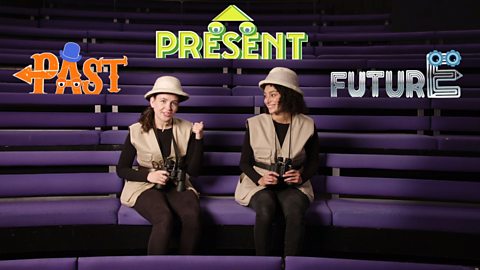
Notice that verbs can be in the pastThe time which has gone before. tense, presentThe period of time occurring now. tense or futureTime yet to come. tense:
I stretched - past
I stretch - present
I will stretch - future
He thought of an idea - past
He thinks of an idea - present
He will think of an idea - future
Fill in the missing verbs
Modal verbs
A modal verb is a type of auxiliary verb (auxiliary just means supporting, or helping) used to show how certain or necessary something is. Examples of modal verbs are: can, could, may, might, must, shall, should, will, and would.
Students may wear uniform suggests a degree of choice.
Students must wear uniform means that they are required to; no choice about it!
As modal verbs are supporting verbs you will always need another verb to go with them.
Is it a certainty or a possibility?
Using verbs in creative writing
Choose your verbs carefully in writing.
Saying that a character’s expression narrows, creases or frowns might reveal more about that character than simply describing a facial movement.
Verbs can be a powerful way to affect the reader’s attitude towards the subject being written about.
Which verb is best?
Test your knowledge
Identify the verbs
Verbs quiz
More on Grammar
Find out more by working through a topic
- count1 of 8
- count2 of 8

- count3 of 8

- count4 of 8

