Key points
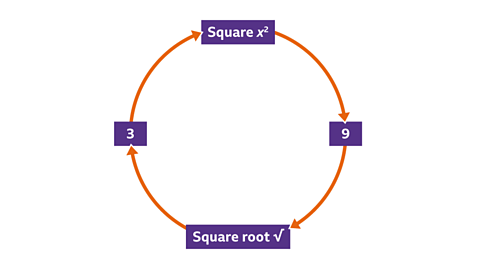
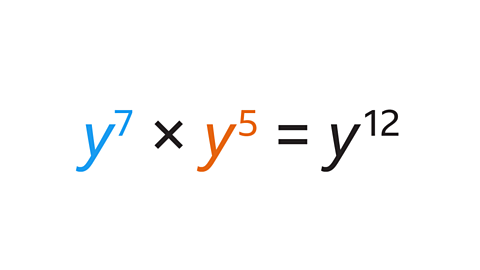
- Using How many times to use the number in a multiplication. For example, 3² is 3 to the power of 2 or 3 squared. is a mathematical shorthand way of writing repeated multiplication using the same number.
- A power is the small floating number that goes to the right of a number or letter. For example, in the expression 3², the ² is the power.
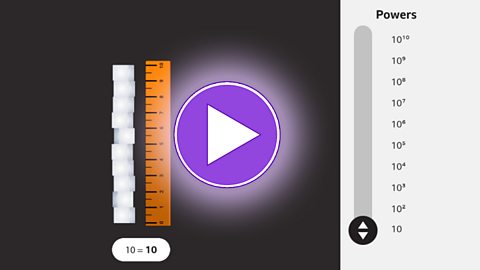
Powers activity
Play this game to see how numbers increase when using powers.
What are powers?
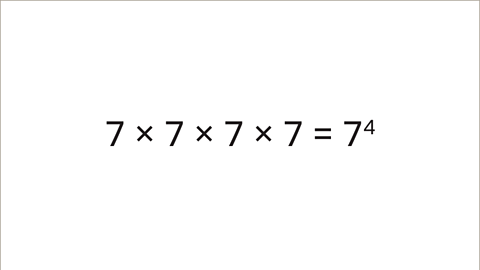
Using How many times to use the number in a multiplication. For example, 3² is 3 to the power of 2 or 3 squared. is a shorthand way of writing repeated multiplication using the same number. For example, rather than writing 4 x 4 x 4 it can be simplified to 4³. This is read as 'four to the power of three'.
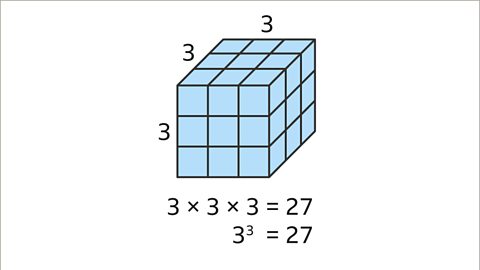
This sort of notation is used when finding the area of a square or the The amount of space a 3D shape takes up. A cubic cm block takes up 1 cubic cm. of a cube. It can also be used to describe other calculations using repeated multiplication.
Examples
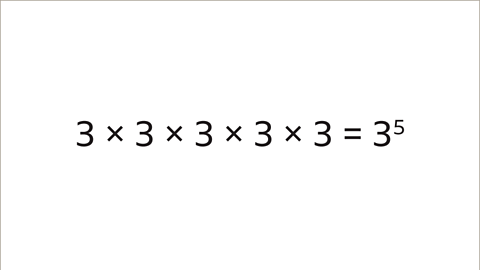
Image caption, Powers can be used as a shorthand way of writing repeated multiplication of the same digits. 3 x 3 x 3 x 3 x 3 can be written as 3⁵. This is read as 'three to the power of five'.

1 of 4
Using index form
A How many times to use the number in a multiplication. For example, 3² is 3 to the power of 2 or 3 squared. can also be known as an Positioned above and to the right of a number. It is an abbreviation of repeated multiplication. Eg, 7³ means 7 x 7 x 7 or an The exponent of a number says how many times to use the number in a multiplication. Also known as index, a number, positioned above and to the right of another (the base), indicating repeated multiplication when the exponent is a positive integer.. An index, is the small floating number that goes next to a number or a letter. The plural of index is indices.
Indices show how many times a number or letter has been multiplied by itself.
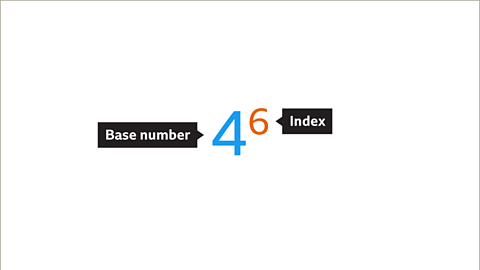
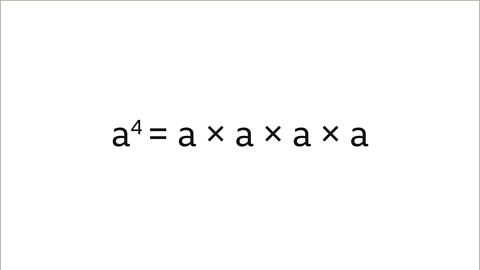
Every expression has maths-specific language to describe each part. For example, 2⁷ is written in index form:
The 2 (larger digit) is called the The number that gets multiplied when using an exponent (index)..
The 7 (smaller digit) is called the The index (or exponent) of a number says how many times to use the number in a multiplication. The plural of index is indices. number. Sometimes this is called the How many times to use the number in a multiplication. For example, 3² is 3 to the power of 2 or 3 squared. or the The exponent of a number says how many times to use the number in a multiplication. Also known as index, a number, positioned above and to the right of another (the base), indicating repeated multiplication when the exponent is a positive integer..
Examples
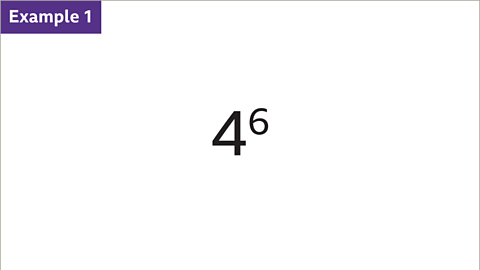
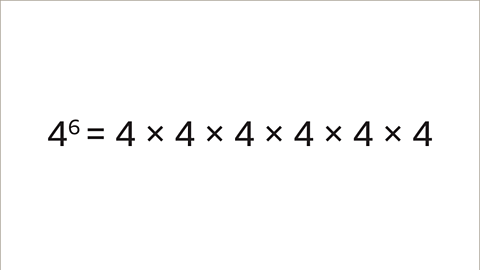
Image caption, 4⁶ is an example of an expression that has been written using index form. This is read as 'four to the power of six'.
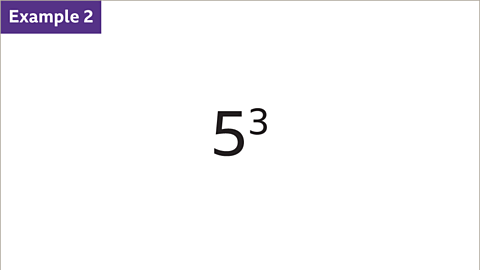
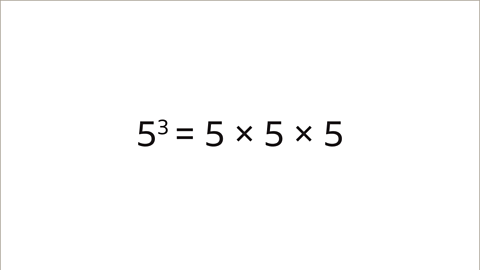
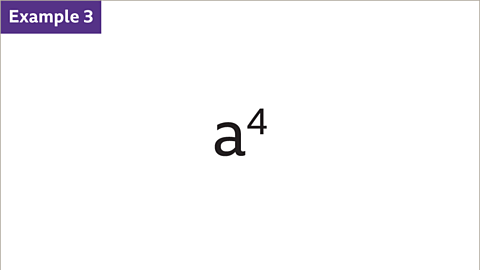
1 of 7
Using a calculator
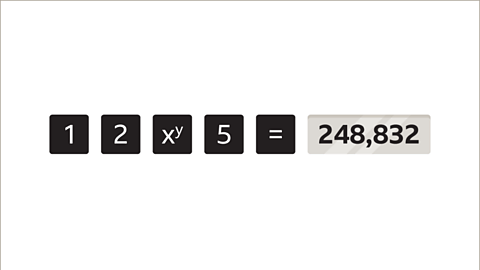
When asked to calculate or work out the value of an expression that is written using power/index notation, some can be completed mentally, whilst other more complicated calculations would involve using a scientific calculator.
All scientific calculators have a ‘power’ button. This is particularly useful when the index number is large.
Examples
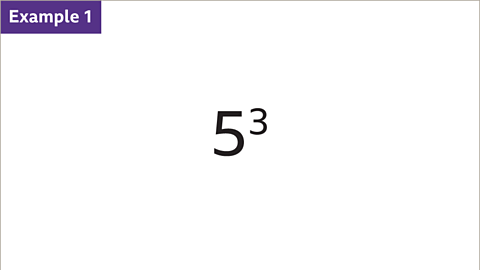
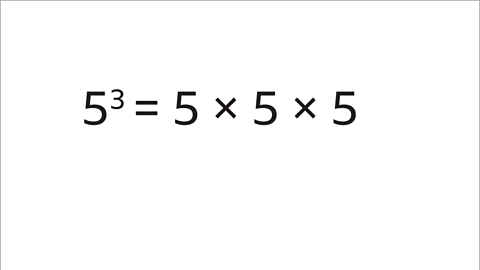
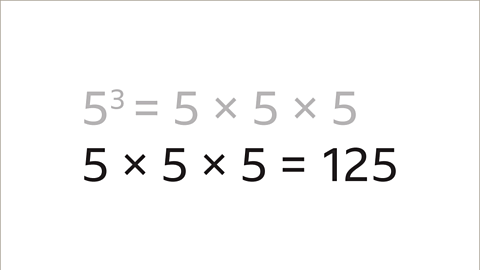
Image caption, Work out the value of 5 cubed.
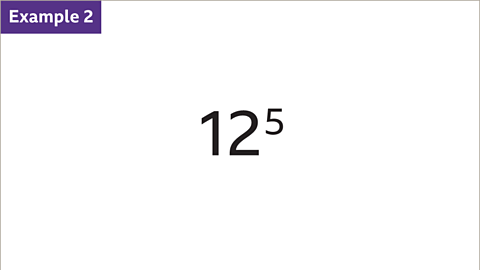
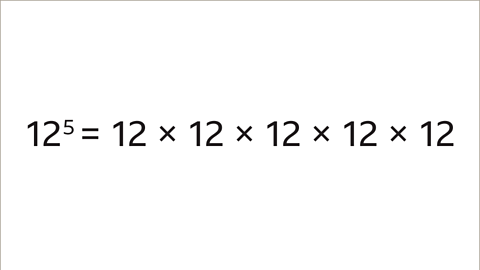
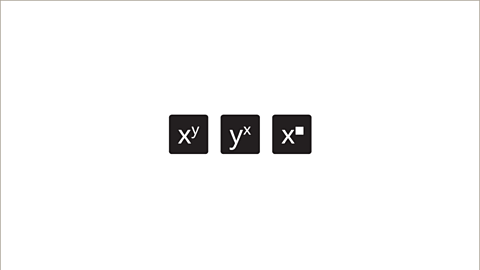
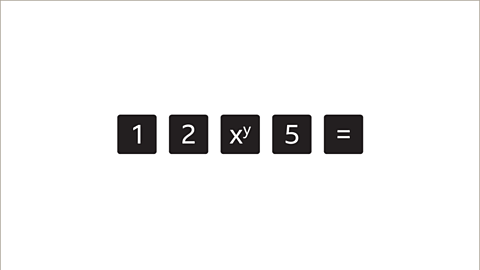
1 of 8
Question
Work out the value of 6 cubed.
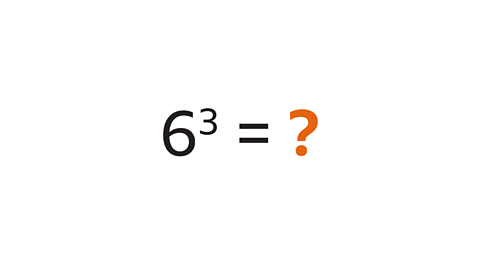
The base is 6
The index (or power/exponent) is 3
6³ = 6 x 6 x 6
6 x 6 x 6 = 216
Practise powers
Practise powers in this quiz.
Quiz
Real-world maths

Using powers is a strategy that is used in everyday life to help solve problems.
A painter or decorator may use powers to calculate and record the area of a square room. For example, a room in a house may measure 4.8 m x 4.2 m, this is an area of 20.16 square metres, this is written as 20.16 m².
Play Sudoku with BBC Bitesize!
Every weekday we release brand new easy, medium and hard Sudoku puzzles. Perfect for testing your skill with numbers and logic.
More on Powers and roots
Find out more by working through a topic
- count2 of 3