What are litres?
A litre is a unit of measurement.
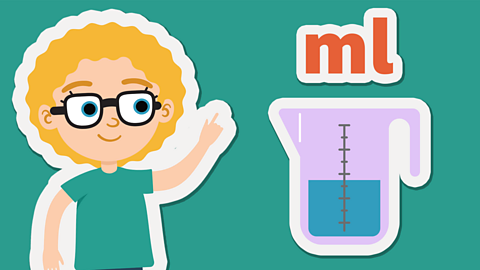
You measure small amounts of liquid in millilitres (ml), while greater volumes are measured in litres.
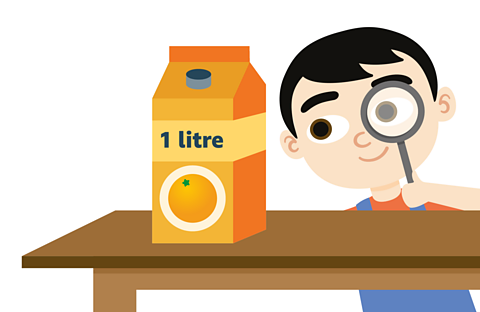
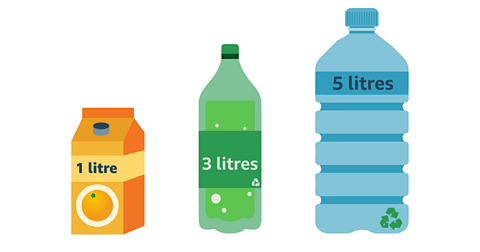
Juice often comes in 1 litre bottles and so do things like bottled water and milk.
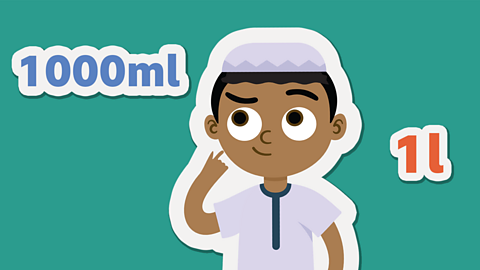
1 litre = 1,000 millilitres
Litre is shortened to 'l', so you can also say:
1l = 1,000ml
Quiz: Measuring in litres
Test out your knowledge of measuring litres with this quiz, then read on to complete the page.
Volume and capacity
Capacity is the maximum amount of space inside a container or how much a container can hold.
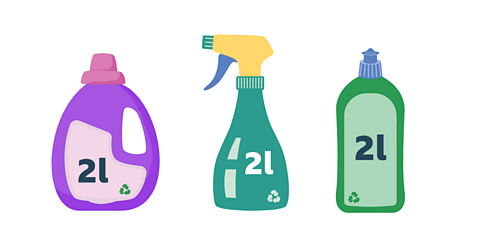
These containers are different shapes, but they all hold up to 2 litres of liquid.
They have a capacity of 2 litres.
Volume means the amount of space that something takes up in a container.
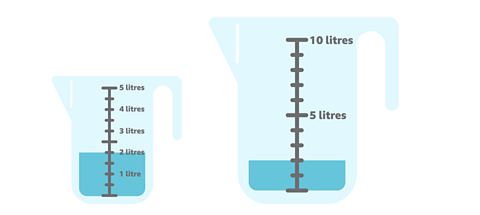
These containers both currently contain the same volume of liquid (2 litres), but they both have a different capacity.
Litre measures
1 litre is the same as 1,000ml.
When you are talking about a volume of liquid that is 1,000ml or above, use litres.
These three liquids are all sold in litres.
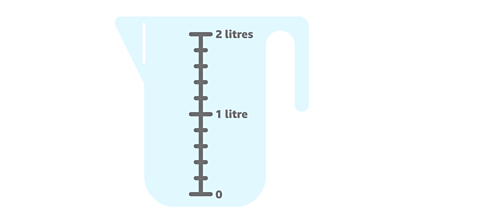
When you are measuring the volume of liquid in litres, you could use a 2 litre jug.
When you are measuring a greater volume of liquid, you could use a bucket or watering can. These have much greater capacities.
Measuring using litres
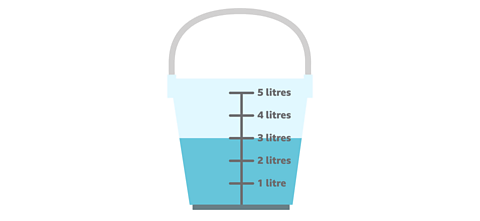
With larger capacity containers, such as buckets, you can measure larger amounts of liquid.
Measuring the volume of water in this bucket is simple. The volume of water is 3 litres.
This next bucket has a capacity of 10 litres.
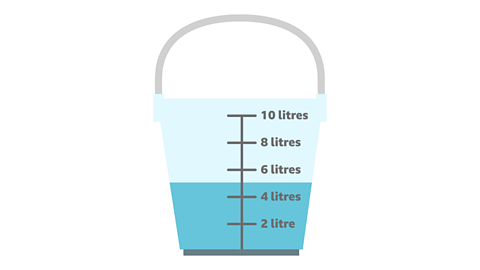
Measuring the volume in this bucket is a bit more difficult. You will need to use your number line skills to help you out here.
The way the measurements are shown on the container is just like a number line.
Which number is halfway between 4 and 6?
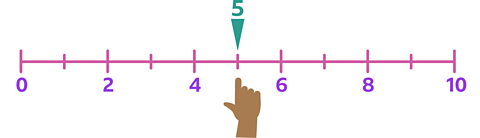
5 is halfway between 4 and 6. So there are 5 litres of liquid in the container.
Finally, this jug has a capacity of 2 litres. It is half full.
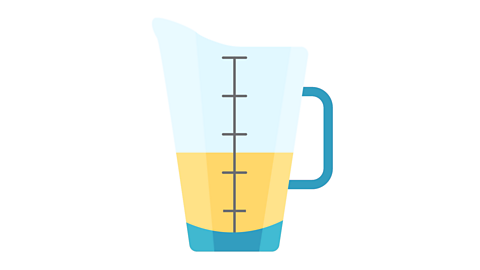
Half of 2 is 1, so the volume of water in this jug is 1 litre.
Example 1
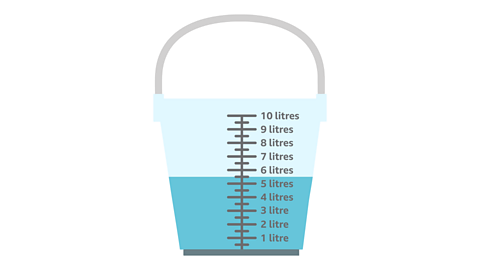
How much water is in this bucket?
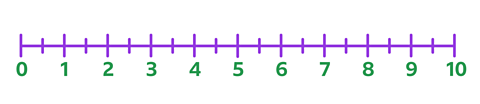
You can use your knowledge of number lines to work this one out.
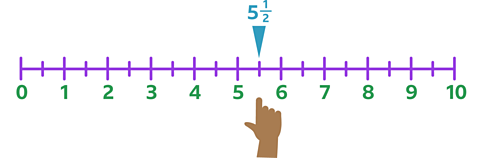
✓ The volume of water in the bucket is 5 \(\frac{1}{2}\) litres.
The small lines in between the numbers are halves.
The volume of water in the bucket is between 5 and 6 litres.
What comes in between 5 and 6? It is 5\(\frac{1}{2}\).
Example 2
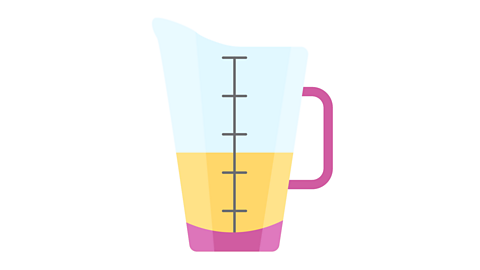
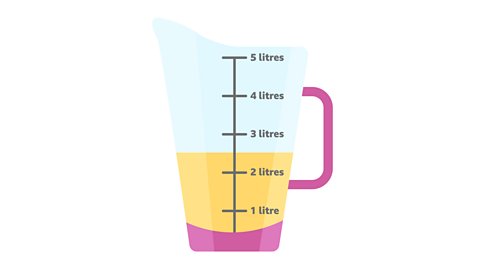
This jug has a capacity of 5 litres. It is half full.
How many litres of water are in the jug?
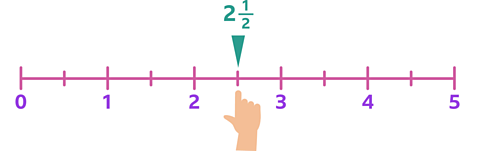
✓ The volume of water in the jug is 2\(\frac{1}{2}\) litres.
To find the volume of water in this jug you need to work out what half of 5 is.
You could use a number line, counting up in halves.
2\(\frac{1}{2}\) is halfway between 0 and 5
Karate Cats Maths game. game
Train with the Karate Cats to become an expert in addition and subtraction, multiplication and division, place value and more!

More on Measuring
Find out more by working through a topic
- count7 of 10
- count8 of 10
- count9 of 10
- count10 of 10