Rounding
There are many situations where it is not necessary to give an exact number.
For example, if there are \(54785\) people living in a town, you could say that the population is approximately \(55000\).
\(54785\) has been rounded to the nearest thousand to give \(55000\).
Rounding to the nearest 1,000
What is \(1484.5\) rounded to the nearest \(1000\)?
It is between \(1000\) and \(2000\), but it is closer to \(1000\), so round down.
\(1484.5\) rounded to the nearest thousand is \(1000\).
Rounding to the nearest 100
What is \(1484.5\) rounded to the nearest \(100\)?
\(1484.5\) is between \(1400\) and \(1500\), but it is closer to \(1500\), so round up.
\(1484.5\) rounded to the nearest hundred is \(1500\).
Rounding to the nearest 10
What is \(1484.5\) rounded to the nearest \(10\)?
\(1484.5\) lies between \(1480\) and \(1490\), but it is closer to \(1480\), so round down.
\(1484.5\) rounded to the nearest ten is \(1480\).
Rounding to the nearest whole number
What is \(1484.5\) rounded to the nearest whole number?
\(1484.5\) is exactly half way between \(1484\) and \(1485\). We use the rule ‘Round up if a number is exactly half way.’
\(1484.5\) rounded to the nearest whole number is \(1485\).
Estimating by rounding
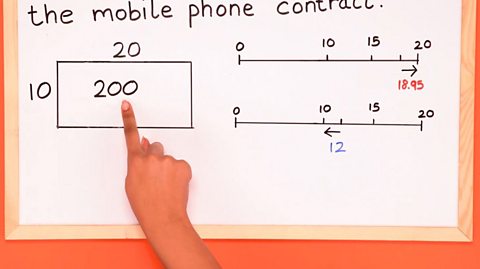
Estimation is used to find rough answers to calculations.
This can be can be useful in a lot of everyday situations:
checking if you have enough money to pay for the items in a shop
estimating how much paint is needed when decorating
working out how much food to order for a party
Gardeners, caterers, builders, joiners, shopkeepers and engineers are just a few of the people who use estimation on a daily basis.
When estimating rounded numbers are used so that it is quicker and easier to get an approximate answer.
Example
Rory is calculating \({11.87}\times{48}\) using a paper and pencil method.
First he estimates the answer.
\({12}\times{50} = {600}\)
When he finishes his calculation and gets an answer of \(5697.6\), he knows that this cannot be right and that the correct answer is \(569.76\).
VIDEO: Estimate before you calculate
Test yourself
Question 1
What is \(1356\) to the nearest hundred?
Answer
The correct answer is \(1400\).
Question 2
What is \(213.8\) to the nearest whole number?
Answer
The correct answer is \(214\).
Question 3
Estimate the total cost of five packets of sweets that cost \(£2.95\) each, and two drinks costing \(£1.45\) each.
Answer
\({5}\times{£3}{~=£15}\) for packets of sweets.
\({2}\times{£1.50}{~=£3}\) for drinks.
Add them together: \({£15~+~£3~=~£18}\)
The correct answer is \(£18\).
Question 4
Estimate what \(£208\) is divided among three people.
Answer
The correct answer is \(£70\) when the amount has been rounded to the nearest £10.
Question 5
Hannah wants to buy two T-shirts for \(£9.99\) each, socks for \(£1.49\) and a belt for \(£8.99\).
She estimates an approximate total cost to see if she has enough money to buy everything.
What should it be?
Answer
\({2}\times{£10}{~=£20}\) for the T-shirts (\(£9.99\) rounded up to \(£10\)).
\({1}\times{£1.50}{~=£1.50}\) for socks (\(£1.49\) rounded up to \(£1.50\)).
\({1}\times{£9}{~=£9}\) for belt (\(£8.99\) rounded up to \(£9\)).
\(£20 + £9 + £1.50 = £30.50\).
The correct answer is \(£30.50\).
More on Rounding and estimating
Find out more by working through a topic
- count2 of 2