What was the Chartist movement?
At the end of the 1830s, only around one in five men had the right to vote in Wales and England. These were mainly wealthy or middle class landowners.
The Chartists were a group of people who felt strongly that this was unfair to the remaining 82 per cent of men. They set about trying to change the political system.
The Chartists’ aim was to gain rights and political influence for the working classes.
Video - The Chartist movement
Hey! Go away, I’m voting! This is for my eyes only!
Being able to vote is a privilege that I take for granted and sometimes I forget that almost 200 years ago, had I been a man or a woman, I would not have been able to do this. Why?
In the 1830s, times were hard and people's living and working conditions were poor. People moved from the countryside to the cities to find a better quality of life. Food was scarce and the working classes didn’t have the right to voice their opinion.
The Chartists were a group of people who wanted to change this. They had a list of six demands.
- A vote for every man over 21
- Secret ballots
- No property qualification
- Payment of MPs
- Constituencies of equal size
- Annual parliamentary elections
Here in Wales, a group of 5,000 Chartists marched into Newport in an attempt to take control of the town. They were led by John Frost, William Jones and Zephania Williams.
Outside the Westgate Hotel, the authorities opened fire killing at least 22 people. Some say you can still see the actual bullet holes from 4 November, 1839.
The Chartist movement in Wales ended abruptly, as their leaders were charged with treason and sentenced to death. Thanks to this man, William Cuffay, a black Chartist from London, the three men were given a less severe sentence.
They were transported to Tasmania, an island off Australia. Eventually, five of the six points on their charter were written into law.Chartism wasn’t an instant success, but it did eventually pave the way for change.
That’s why we can vote once we reach the age of 18. In Wales, 16 and 17-year-olds are also allowed to vote in council and Senedd elections.
People’s Charter of 1838
The name ‘Chartists’ comes from the People’s Charter of 1838. This was a document detailing the six key points that the Chartists believed to be necessary in order to introduce a fair A system which determines how elections and referendums are held and counted. in Britain.
- Give men the right to vote at 21 years.
- Ensure that constituencies were equal in size to help ensure the fair value of votes across areas.
- Provide a salary for Members of Parliament so that workers could stand for an election instead of only landowners and the rich.
- Ensure that there was no property qualification for Members of Parliament so that electors could elect the man of their choice, who could be either rich or poor.
- Hold secret ballots. At the time, voting was a public act and voting books were printed to record people’s votes which prevented some from voting as they wished. Some people lost their homes for voting against their landlords.
- Run annual parliamentary elections. At the time, general elections only needed to be held once every seven years.
The Chartists’ actions
The Chartists were mainly a movement that attempted to achieve their aims by submitting mass A formal written request to an authority requesting that action is taken on a particular matter. to Parliament.
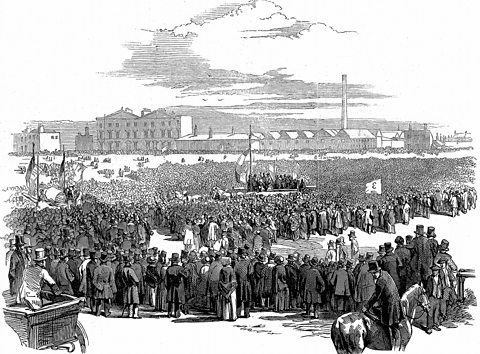
In June 1839, a petition with 1.3 million signatures was submitted to the House of Commons, but the Members of Parliament refused to meet the petitioners. This caused unrest which was quickly stopped by the authorities.
A second petition was submitted in May 1842, signed by over three million people, but once again it was rejected. This led to further unrest and arrests.
Some believed that they would need to arm themselves to achieve the movement’s aims.
Chartism in Wales
Chartism began in Wales in Carmarthen under the influence of Hugh Williams, a solicitor and An extremist or unusual political idea. reformer. Other leading figures were David Rees in Llanelli, Morgan Williams in Merthyr and John Frost in Monmouthshire.
The movement was mostly supported in the industrial areas of Wales.
Although the Industrial Revolution had brought job opportunities to people in areas such as Merthyr, it also led to problems including:
- unhealthy living conditions
- When too many people live in an area causing a lack of space.
- epidemics such as cholera due to a lack of clean water
- dangerous working conditions
Without a vote, workers could not air their A feeling or a complaint from being treated unfairly. about their circumstances or solve the other day-to-day social issues they faced.
Newport Rising
One of the Chartists’ most well-known actions was the Newport Rising. This was the last large-scale armed rising in Wales, with the most use of serious physical force in the history of the Chartist movement.
On 4 November 1839, John Frost, Zephaniah Williams and William Jones led a march of an estimated 3,000 to 5,000 men to Newport in an attempt to release Chartists who had been imprisoned at the town’s Westgate Hotel.
Frost’s followers came from Blackwood, Williams’ followers from Ebbw Vale and Jones’ group from Pontypool. When the men met in Newport and joined together, some say that they had a total of 10,000 supporters.
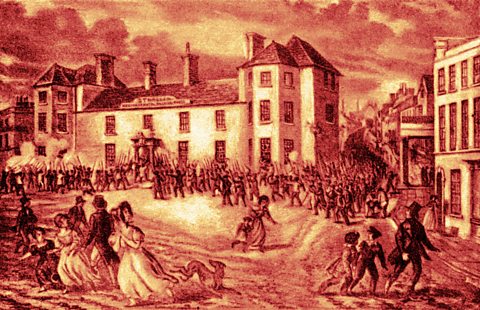
The Chartists marched down Stow Hill in the town centre towards the Westgate Hotel, before calling on the army to release the prisoners.
This led to a fierce and bloody battle with both sides opening fire. The soldiers successfully defended the hotel, despite facing so many people, and after half an hour of fighting, up to 22 Chartists were killed and around 50 wounded.
This led to the arrest of around 200 Chartists.
The leaders, John Frost, Zephaniah Williams and William Jones were found guilty of Betraying one’s own country, eg starting a war against the government.. They were sentenced to be hanged, drawn and quartered.
The three leaders were the last people to be sentenced to this punishment in Britain. However, after others opposed the punishment, they were instead transported from Britain to Australia for life.
After the rising, the Chartist movement continued in and around Newport, but was never again so strong or threatening.
How successful was the Chartist movement?
After 1848, the Chartist movement declined. Some areas continued to strongly support Chartism, but not many people attended their final national meeting in 1858.
However, the movement’s legacy lived on.
By the 1850s, Members of Parliament had accepted that the political system had to change and Changing a system for the better. acts were passed in 1867 and 1884.
Although none of the six points of the People’s Charter were achieved during the movement’s time, by now five of the six aims have been realised (all but the annual parliamentary elections).
Did Chartism include women?
Although a number of leading Chartists believed in giving women the vote, it was never part of the Chartist agenda.
When the People’s Charter was first drafted, it included a clause recommending the extension of the right to vote to women. It was eventually removed as some members believed that this ‘radical’ step would prevent men from getting the vote.
However, a huge number of women were part of the movement, even though they wouldn’t receive the vote if it succeeded.
In Wales, over a thousand Monmouthshire women signed the petition to Parliament in 1839. In total across Britain, one in five signatures on the petition were from women.
In south Wales, Chartism developed as a family movement and a number of Chartist meetings in the summer of 1839 were family affairs with a carnival atmosphere.
Mary Brewer was a well-known Chartist organiser in Newport. Joan Williams, the wife of Zephaniah Williams, also organised meetings for the area’s women at the Royal Oak in Blaina.
Timeline
Since the early part of the 20th century, both women and men can vote in elections in Britain.
Here are some of the most notable milestones in the extending the right to vote.
| 1832 | The Great Reform Act of Britain - More men were given the right to vote. Women formally excluded from voting. |
| 1838 | People’s Charter - The Chartists presented six demands in order to change the political system. |
| 1839 | Newport Rising - Up to 22 Chartists killed when they marched in Newport. |
| 1918 | Representation of the People Act - All men over 21 given the right to vote. Women over 30 years old who owned a house given the right to vote. |
| 1928 | Equal Franchise Act - Women given the same voting rights as men. |
| 1969 | Representation of the People Act - The voting age is reduced from 21 to 18. |
| 2020 and 2021 | 16 and 17-year-olds given the right to vote in Senedd elections and in local elections in Wales. |
Quiz - The Chartist movement
More on Change and movement
Find out more by working through a topic
- count1 of 3
- count2 of 3