Overview of The Circle by Don Paterson
- In The Circle, Don Paterson reflects on his son drawing "outer space" to explore deeper themes about humanity and our place in the universe.
- The recurring image of the circle evolves from a shaky drawing to a of cosmic order and perfection.
- Scientific and spiritual An allusion is when you refer to a person, place, event or idea that other people will know. For example to a famous story or piece of literature. (like "troposphere" and "Krishna") enrich the poem, recalling the poetry of John Donne.
- The poem acknowledges life's fragility, accepting that loss and darkness are part of the universe’s design.
You can read The Circle by Don Paterson on the Scottish Poetry Library website.
Form and structure
Paterson structures the poem as nine A type of stanza - or a complete poem - consisting of four lines that have a rhyming scheme. with a strict A repeated pattern of rhymes, usually written with letters ABAB would mean lines 1 and 3 rhyme; and lines 2 and 4 rhyme also rhyme but differently. and rhythm.
Apart from a few A rhyme in which the stressed syllables of ending consonants match. Also known as a half rhyme or imperfect rhyme. he uses a tight AABB rhyme throughout.
Perhaps the combination of full rhymes and relates to the theme of perfection and imperfection that permeates the poem. The rhythm is for the most part A line of poetry with four beats of one unstressed syllable, followed by one stressed syllable. It sounds like: duh-DUH, duh-DUH, duh-DUH, duh-DUH., similar to that used by Donne in A Valediction: Forbidding Mourning.
This gives the poem a set frame within which Paterson explores philosophical ideas; it could imply that no matter what we think or how much effort we put into influencing the course "our arrows" take, we are still held within the confines of fate’s design.
In the first four stanzas, Paterson describes his son drawing as an outside observer.
In stanza five with the pivotal use of "But", the poem shifts from describing Jamie's personal experience to addressing the boy directly. Paterson moves from talking about his son to addressing a more universal concern in terms of how we all deal with what we are given.
Overall, the poem's structure also has a 'circular' feel to it, as it begins with the boy's poorly drawn circle and ends with the "perfect ring", which gives it a sense of completion.
Stanzas one to two

In the first two stanzas, Paterson describes his son, Jamie, drawing the universe.
My boy is painting outer space
The opening line is a striking beginning, as it suggests that Jamie has taken on a mammoth task, but also that in painting he is creating the universe; perhaps in the eyes of his father he has such power.
The words "My boy" convey a sense of the poet's pride in his son for taking on such a challenge.
The next lines expand on the first by listing all that is included in this "space" and the connection between them.
and all the circuitry they run/ in one great heavenly design.
The use of "circuitry" suggests an electronic circuit made up of the planets that are connected in circular orbits; it also loops us back to the title. The The use of run on sentences with no punctuation at the end of lines or across stanzas. also implies that this circle is completed by a "heavenly design", namely fate, introduced in stanza two. The line spilling into the next stanza could suggest the enormity of the universe and everything in it. It is as if it all cannot be contained. This could also be read as introducing a sense of imperfection that will continue through the poem.
The word "design" is connected to drawing and suggests that, like Jamie's picture, the whole of the universe is mapped out by some force or deity.
his hand shakes, and he screws it up
Just at the last minute, Jamie's drawing goes wrong. It doesn’t turn out as he planned. The word choice here implies he messed it up; the use of slang "screws it up" suits a young boy's frustration, but might also allude to the twisting, circular motion of balling the paper.
Video - Word choice
Revise the role of word choice in The Circle with this short revision video.
What is word choice? How and why would you use it? Bitesize explains with examples from ‘The Circle' by Don Paterson.
Word choice can have a massive impact on your writing.
Words are like ingredients: even a small change in the recipe can affect the finished dish.
"They had a warm laugh"
But what if "they had a hearty laugh"?
Even though these sentences pretty much tell us the same thing, the words have different effects.
‘Warm’ suggests the laugh is friendly. ‘Hearty’ suggests it is wholesome, passionate and sincere.
When you choose a word you need to think about its denotation. That's what it literally means. But you should also think about its connotations - ideas or feelings that the word might suggest or hint at.
"Feeling dizzy, she slid her hand along her head" This just tells us what happened.
But what if: "Feeling dizzy, she slid her hand along her skull” The skull is the bone structure in your head. This is the denotation - what it definitely is. But the connotations of skull are fear, mortality and even death. These connotations suggest that the dizziness she is experiencing is serious.
In the poem 'The Circle’, Don Patterson watches his son painting the planets in the solar system.
“He draws around his upturned cup, his hand shakes, and he screws it up.”
Patterson could have easily written “he messes it up” but “screws it up” is a far more interesting choice.
These words are really informal compared to his word choice in the rest of the poem. This helps him capture the reality and rawness of a young boy’s frustration.
At the same time, “screw” suggests a circular motion, another reference to circular shapes within the poem. It also suggests scrunching up paper and throwing it away. Word choice is a really important part of writing. It’s an invaluable part of writing. It’s crucial!
Stanzas three to four
Paterson describes his son's fragility in more detail in stanza three:
The shake’s as old as he is
"The shake" explains the reason he must "steady" his brush in stanza one and why he messes up the circle. It suggests that like the drawing, Jamie himself is flawed. Perhaps Paterson sees his son as his imperfect creation just as the drawing is Jamie’s.
Paterson puts "(thank god)" in Adding extra information using brackets (), commas , or dashes - -., reminding us of some higher power at work in the background. However, the fact that "god" is written without a capital 'G' implies that there may not be one omnipotent creator of the universe.
one inch from home/we couldn't get the air to him
The "shake" is the only remnant Jamie has of his difficult birth. The phrase "one inch from home" implies he was so close to being completely fine and safe when this happened, just as all is going well until the very last minute. The use of "we" also suggests the collective effort of his family and medical staff willing him to live.
he's all the earth/and sky for breathing-space
The next stanza brings us back to the present with Paterson shifting to the present tense. The use of "he's" is ambiguous and implies that he has a lot of space to breathe in, but also that he is all the world to the speaker.
Paterson uses repetition in "breathing-space" and "breath" to emphasise the sense of having space and time. He takes it further in the following line: "the whole damn troposphere" which extends the space into the layers of the atmosphere. And yet, despite all the space, all the air available, Jamie still struggled to breathe. He still has a "flutter in his signature" – a slight imperfection in his identity. The use of "damn" perhaps conveys the poet's frustration at this.
Stanzas five and six
The fifth stanza of The Circle moves from observing Jamie to addressing him directly.
But Jamie, nothing's what we meant.
It is as if Paterson is trying to comfort his son and reassure him that it is OK to make a mistake by explaining that nothing is perfect.
The "But" changes the direction from the personal story to its more universal implications that "we all resent." He isn’t the only one who is angry about their plan not working out.
There is an uncertainty created by the word "nothing". It implies here that nothing turns out the way we mean it to, but also that this very consequence is 'meant' to be. This is what makes us human.
The speaker continues, "The dream is taxed". There is a double meaning here in the sense that it could be "taxed" as in strained, but also "taxed" as in a financial tax. This suggests a percentage or proportion of our dreams and plans that is taken away from us, that doesn’t work as planned. We don't quite achieve our complete aspiration: we always lose some of it.
the quarter bled off by the dark
This next line extends the idea. A "quarter" links to the idea of a proportion of tax taken from us. It implies that part of our plan is lost to "the dark", possibly the darkness of space. "Bled" implies an injury and how fragile human life is. It could also refer to the paint Jamie is using to draw a planet or moon mixing with the darker paint around it.
between the bowstring and the dark
Paterson uses the Describing something by saying it is something else. While a simile compares things using 'like' or 'as', a metaphor creates a direct comparison of shooting an arrow to describe our actions in life and how we are to some extent shooting in the dark. The "bowstring" suggests the moment a person takes aim, when they make their plan. But once the arrow is released it is out of our control.
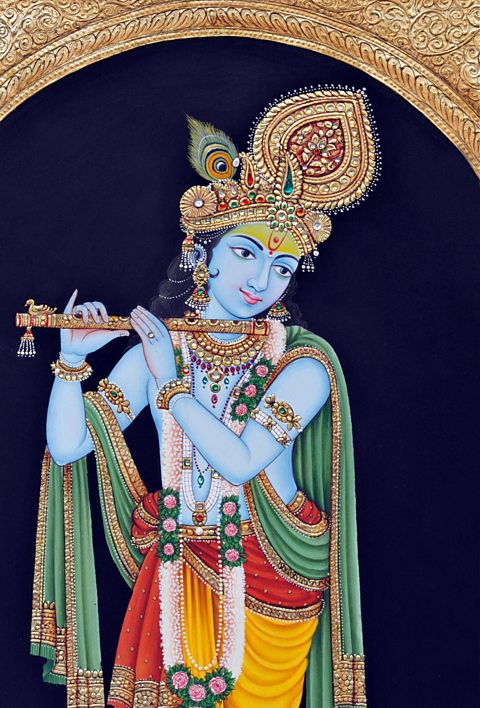
The reference to "Krishna" in stanza seven is significant. Krishna, the Hindu god of love and compassion, was the eighth avatar of the Indian god Vishnu. He was shot by a hunter's arrow and was fatally wounded. This links back to the "bowstring" and bleeding Descriptive writing which appeals to one or more of the five senses. of the previous stanza. The speaker then affirms that "the target also draws our aim", which suggests that the target has its own designs on the shooter. This brings us back to fate "our will and nature's are the same" – we are as we were meant to be.
Stanzas seven to nine
The statement "we are its living word" has religious A word used to describe the ideas or feelings that a word might suggest. For example, a skull conjures up thoughts of fear, mortality and death.. "Living word" usually refers to the 'Word of God' so the implication is that our beings are bound up with the very fate that determines existence. Paterson makes clear we are not entirely powerless. Fate may have written “a book” for us but we are “living”. This suggests we can influence what happens to us.
The "book it wrote and then forgot" could denote any spiritual text, while "its fourteen-billion-year-old song" refers to the age of our universe. "Song" makes us think of a melody or patterning that is passed from generation to generation like poetry itself. We might conclude from this that whether we realise it or not there is some force at work in our actions, in our "right and wrong" and it might even be ourselves.
At this point, Paterson returns to the personal anecdote that begins the poem: his son's drawing. There is a symmetry to the structure as the reference in the penultimate stanza to the "spoiled work and useless kit" takes us back to the second stanza's screwed up picture. The child's fist coming "down like a stone" has a sense of finality about it, as if he simply wants to give it all up. There is a perhaps a biblical link here to the stone that sealed Christ's tomb. In this sense, we might read the final stanza as a sort of resurrection when the stone of despair is rolled away to reveal something miraculous.
look at the little avatar / of your muddy water-jar
Whether it is down to science, or fate or some kind of god, perfection is now to be found in the "muddy water-jar" – in the humblest thing. The rhyme between "avatar" and "water-jar" confirms this. "Avatar" returns us to the image of Krishna. The "muddy" water suggests the mud from which the God of the Old Testament moulded Adam and Eve.
Paterson directs his son and the reader to look to the jar and to find "the perfect ring" which has been there all along. Here is the perfection, which has been created without even trying. Again he refers to "singing" as if this "living" voice is always there, if we just listen to it. The present participle also suggests its perpetuity. Instead of the heavens and space above us, this "ring" now resounds "under everything", which implies it is hidden and that it will accompany us whether we have high aspirations or not. But the final point to make is that, despite its perfection, the ring exists in muddied water and therefore is imperfect. We must accept therefore that perfection is found in imperfection - after all that is what it is to be human.
Themes
Fate and humanity
The concept of drawing and design runs throughout this poem and relates to theme of fate. The boy draws the circle of one planet that is part of "one great heavenly design". Paterson moves from the description of his son to the wider concern that "We all resent/the quarter bled off by the dark". None of us can achieve perfection and there is beauty to be found in imperfection.
Father and son relationships
The pride in his son is clear from the beginning: "My boy is painting outer space." There is a sense of wonder in "My boy" as if he still in awe of the fact his son survived at all. The way he regards his son in the opening stanzas is similar to the way in which he asks him to look at the "perfect ring" in the water-jar – as a sort of miracle. The personal pronoun switches to "you" from the fifth stanza, as if he is consoling his son with this revelation.
Comparing The Circle to other Don Paterson poems
The Circle and The Thread are both about Paterson's relationship with his son, Jamie, and the challenges resulting from his difficult birth. Both poems use imagery to look at the beauty and strength that can be found in fragility. In The Circle, this fragility is conveyed through his son's drawing:
he draws around his upturned cup, / his hand shakes, and he screws it up.
The image of the shaky circle that Jamie draws later returns as a "perfect ring". The circle metaphor transforms from something "spoiled" into something "perfect". Similarly, Paterson uses the metaphor of a thread in The Thread to show how something delicate and breakable can become something strong.
Both poems also explore the theme of fate and humanity. In The Circle, Paterson refers to "trust to Krishna or to fate" and the boy draws a planet that is part of "one great heavenly design". In The Thread, Paterson offers gratitude to the "higher will" that allowed his son to live.
Like The Circle and The Thread, Paterson's poem Waking with Russell and Why Do You Stay Up So Late? also explore the bond between father and son - although these poems are dedicated to his other son, Russell.
The Swing also explores a parent-child relationship and the fragility of life - the titular swing is described as a "frail trapeze." Unlike The Circle, this poem has a much more solemn tone overall. In this poem, Paterson is clearly in awe of his son, despite his flaws, and it ends on a celebratory note with "the perfect ring / singing under everything." In contrast, The Swing explores the grief of losing an unborn child and the swing remains "empty".
Unlike these other poems, 11:00: Baldovan does not explicitly explore a parent-child relationship but does look at childhood and the fragile nature of life.
Revise The Circle by Don Paterson
Revise The Circle and other poems by Don Paterson with interactive quizzes for Higher English.
Quizzes - Don Paterson. quiz
Test your understanding of set texts by Don Paterson with a series of interactive quizzes for Higher English.

More on Don Paterson
Find out more by working through a topic
- count3 of 7
- count4 of 7
- count5 of 7

- count6 of 7

