Speaker one In this practical we will be making a soluble salt called copper sulfate which is used to treat fungal diseases, such as foot rot in cattle.
Speaker two Yep, something I struggle with every single day. A salt is made by the neutralisation of an acid with a base.
Speaker one Our base in this case is copper oxide which will react with sulfuric acid to give us copper sulfate and water.
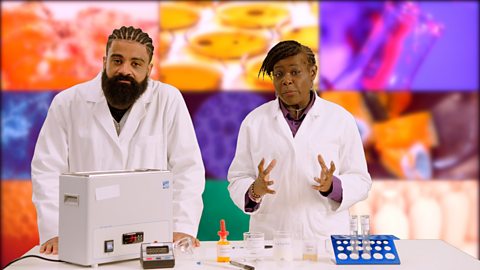
Speaker two This is the equipment that you’ll need. Pause and take a look.
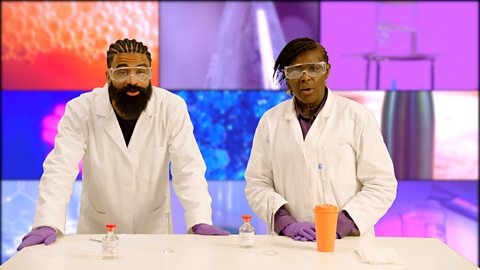
For this experiment, make sure you wear your safety goggles at all times. I’m already wearing them. Because sulfuric acid is corrosive and an irritant. I don’t mess around with that.
Speaker one Measure 40 cubic centimetres of the sulfuric acid.
This is your limiting reactant. All of the acid needs to react during this experiment. That ensures we have pure crystals formed. Next we need to get the flame going to heat up the acid.
Speaker two Now we’ve got to heat it just to bubbling. So that should take about 30 seconds.
Speaker one Okay, perfect.
Speaker two Okay, that’s bubbling.
Speaker one Yeah, Yeah, Yeah.
Speaker two That’s definitely bubbling. Okay. So now we turn that off.
Speaker one So now I’m going to add the copper oxide.
Speaker two Okay. Use your spatula to add the copper oxide to the acid and stir with a glass rod.
Speaker two So, we’re adding copper oxideto neutralise the sulfuric acid. The copper oxide might look like it’s disappeared completely. But it’s actually reacted with the sulfuric acid and made the solution blue.
This is copper sulfate solution.
Once we see unreacted copper oxide in the beaker…we know that all of the acid has been used up.
Yeah, there’s exce-.
Speaker one Wow!
Speaker two That’s excess. We’ve got excess! Success!
Speaker one Next we’re going to make the crystals from the copper sulfate by removing the excess copper oxide. Now, as copper oxide is insoluble it can be filtered from the solution leaving us with a pure copper sulfate solution.
Speaker two Okay, okay.
Speaker one Yeah. And we can see the copper oxide coming out.
Speaker two What we want to do now is evaporate the water to leave us with copper sulfate crystals. So we’re going to pour this solution into an evaporating basin. And then put it over a water bath for about 10 minutes. And after then, when you have half the solution remaining, you should start to see crystals around the edge. Place it somewhere warm and dry for about 24 hours in here or in a little crystallising dish.
Here are some salt crystals that we made earlier. Now, although copper sulfate is a salt, it is not edible. In fact, copper sulfate is classified as harmful if swallowed and can cause serious eye damage. So make sure you are wearing gloves and safety goggles.
Speaker one Now, when writing up your experiment, consider questions like these: What did you do to ensure that the crystals were pure?
Speaker two Could you do this again and get the same results?
Speaker one What could you do to improve or try differently next time?
Speaker two Remember, when you add a base to an acid, a salt and water are formed.
Speaker one A pure sample of crystal can be collected by filtering and then evaporating that salt solution.
Speaker two This is an example of a neutralisation reaction.
Description
A presenter-led science video about how to make a soluble salt called copper sulfate, with Dr Maggie Aderin-Pocock and Dr Alex Lathbridge.