Did you know?
A ballad is a type of poem that was traditionally set to music. The word ‘ballad’ comes from the Latin ‘ballare’ which means to dance – it’s also where the word ‘ballet’ comes from.
Introduction to ballads
Ballads have a long tradition and are still written by poets to this day. Ballads can be based on real-life events (including terrible tragedies), or created purely from the imagination to tell tales of romance, mystery and even magic!
Key learning points
- Find out about the conventions of a ballad.
- Get to grips with A verse that features trochees (If the first syllable is stressed, as for example in ‘ha-ppy’, but not the second, it is called a trochee). and Containing iambs. (When we emphasise the second syllable not the first syllable like ‘to-day’, this is called an iamb). rhythm.
- Try your hand at constructing your own ballad.
Video about ballads
A video about the conventions of ballads, their purpose, rhyme schemes and some examples of ballads
One sunny day, not far away
A writer was in a fix:
They had to write a ballad, so
they hunted for some tips.
To understand the ballad form
and learn to write some lines,
they read through this example
with its ABCB rhymes.
A ballad has a rhythmic bounce
as spoken poems have been
for many years sung to music, but
there's no fixed rhyme scheme.
They’re easy to remember as
they all end-rhyme a lot.
Plus, ballads need a narrative arc,
with characters and plot.
There’s one about The Highwayman
who feels the Moon above
watching his every to and fro,
riding to meet his love.
Another one’s about a guy
who rid a town of rats,
but when that town refused his fee
he stole away their brats.
The Lady of Shallott’s one too:
she lived near Camelot.
A curse came down upon her
when she saw Sir Lancelot.
Or meet The Ancient Mariner,
a sailor man was he.
He shot a lucky seabird and
got stranded out at sea.
Some ballads have dramatic ends:
a noble win or fail.
So, think: ‘what is the message here,
Is this a moral tale?’
One happy day, not far from here
someone walks in the sun:
They’ve learned to write a ballad now
So, goodbye! This one is done.
History of the ballad
The ballad is one of the oldest forms of poetry in the English language. Across Europe, ballads were sung and performed to ordinary people and noble people alike. People remembered them and passed them on by reciting them to others. In the 15th century ballads began to be written down.
Ballads are associated with music and were passed on by travellers through song, in order to share news and stories Communicating by speaking aloud.. The catchy rhythm and rhyme scheme of ballads meant it was easy to remember them, and to pass them on to another village or community.
Ballads were written about many topics. These included sharing real life events and reporting news, the more shocking the better! Sometimes they were political, being rude about leaders and politicians, or campaigning for change. Later ‘literary’ ballads told romantic and supernatural stories with ghosts and visions, often looking back in time to the days of knights and ladies.
Rhyme scheme and narrative form of ballads
The ballad’s (In poetry) The shape of the poem on the page: its length, rhyme, rhythm, lines, stanzas, and punctuation. has varied over the years but, generally, ballads tell a story, have a lively rhythm, often repeat key lines and use a rhyme scheme.
Rhyme scheme
- In a ballad, the rhyme scheme is usually ABCB but there are many variations.
- The rhythm comes from how certain words or parts of words are emphasised or stressed on each line.
Narrative form and refrain
The ballad form revolves around a story or narrative and tells the tale from beginning to end. This means that ballads are often quite long as they take the listeners through the entire journey of the story, from setting and character, through the dilemma and on to the conclusion.
Typically, ballads are written in four line Stanzas separate poems into groups of lines. called quatrains but are variations. The stanzas often include, or are followed by, a refrain. A refrain is a line that appears numerous times – like a chorus of a song. Using a refrain helps to emphasise the main moral, message or dramatic moment of the ballad.

In a famous ballad called The Rime of the Ancient Mariner by Samuel Taylor Coleridge, an old sailor tells the story of a terrifying sea voyage where at one point he almost dies of thirst:
Water, water, every where,
And all the boards did shrink;
Water, water, every where,
Nor any drop to drink.
Which of these typical features of a ballad has the poet used:
A. Rhyme scheme and lively rhythm only
B. A quatrain, a refrain, rhyme scheme and lively rhythm
C. A refrain
Answer: This ballad contains B. A quatrain, a refrain, rhyme scheme and lively rhythm.
Rhythm and metre of ballads
Each line of poetry can be measured by looking at the number of A stressed syllable is said louder or with extra emphasis than the other syllables in the word. syllables and the number of An unstressed syllable is said with less emphasis than the stressed syllables in the word. syllables. A pair of stressed/unstressed syllable is called a ‘foot’. These feet are what gives the poem its rhythm.
In a word like ‘to-day’, we emphasise the second syllable not the first syllable. This is called an iamb. It consists of an unstressed and stressed syllable, in that order – or da-DUM.
If the first syllable is stressed, as for example in ‘ha-ppy’, but not the second, it is called a trochee. A trochee is DUM-da.
How many iambs or trochees should there be in each line of a ballad?
A ballad is traditionally written using three, or four, iambs or trochees in a line.
- Tetrameter – means four iambs or eight syllables in a line. A line containing four iambs or trochees, is called iambic or trochaic tetrameter.
- Trimeter – means three iambs or six syllables in a line. A line containing three iambs or trochees, is called iambic or trochaic trimeter.
Examples of famous ballads
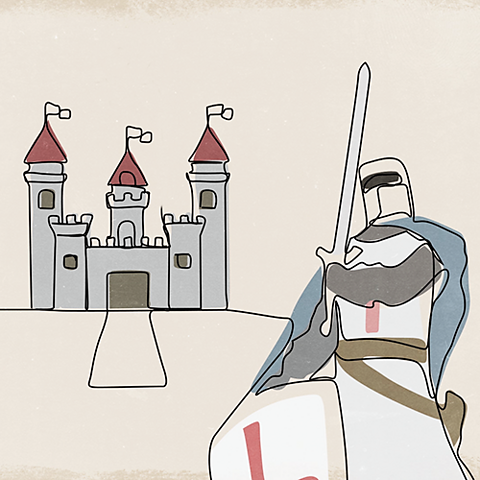
Many famous poets have used the ballad form over the years from Romantic poets like Samuel Taylor Coleridge and John Keats, to Victorian poets like Christina Rossetti and Oscar Wilde.
La Belle Dame sans Merci by John Keats (which translates from French into ‘The beautiful lady without pity’) was written in 1819. It uses the ballad form to suggest the story is taking place in an older time period with courtly knights and ladies. It begins:
O what can ail thee, knight-at-arms,
Alone and palely loitering?
The sedge has withered from the lake,
And no birds sing.
Oscar Wilde’s The Ballad of Reading Gaol, written in 1897, is not about noble lords or ladies. His ballad looks back to the traditions of murder ballads and political ballads which demanded change. It begins:
He did not wear his scarlet coat,
For blood and wine are red,
And blood and wine were on his hands
When they found him with the dead
Ballads are still written to this day. They continue to be written about real-life events and many are performed as songs in the music charts.

These are lines from The Lady of Shalott by Alfred, Lord Tennyson.
Four gray walls, and four gray towers
Overlook a space of flowers,
And the silent isle imbowers
The Lady of Shalott.
……
She knows not what the curse may be;
Therefore she weaveth steadily,
Therefore no other care hath she,
The Lady of Shalott.
Which of the following statements isnottrue?
A: The first three lines rhyme
B: It has a repeated refrain
C: It is all written in tetrameter
D: The only trimeter used is in the last line
Answer: The only incorrect answer is C: It is all written in tetrameter, because the final line of each stanza (the refrain) is trimeter.
Test your knowledge
Play Bitesize secondary games. game
Have fun playing science, maths, history, geography and language games.

More on Reading poetry
Find out more by working through a topic
- count4 of 8

- count5 of 8

- count6 of 8